
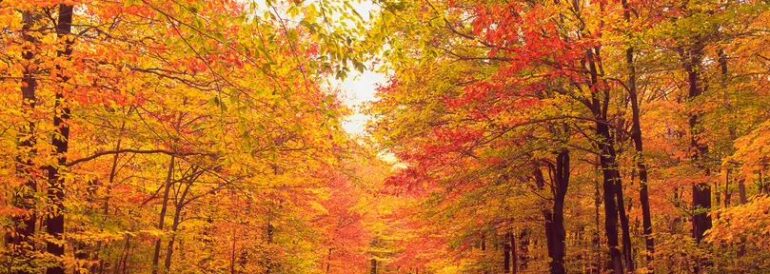
Environmental Factors That Influence Autumn Leaf Colors
Every autumn, millions of leaves take part in one of the all-show performances of nature, changing its colors to a palette of red, orange, yellow, and purple, as well as that of a painter.
It will seem to you that the world is merely cooling down, however, what you are witnessing is nothing but a tree, carrying out a very meticulous annual strategy.
- It is aimed at survival: living tissues are to be frozen without damage, water and energy are to be conserved, and valuable nutrients are to be recycled before winter halts the growth. The visible side effect of such a strategy, or seeing the cogs of a beautiful machine ajar, is the color show.
Fascinating fact
- An average mature tree is estimated to have more than 200,000 leaves and they do not change randomly.
- They react to the same underlying signals and chemistry and hence the canopy moves in a very synchronous manner.
- That coordination is not a miracle: trees are programmed to count seasonal change, to get ready for winter when it is time.
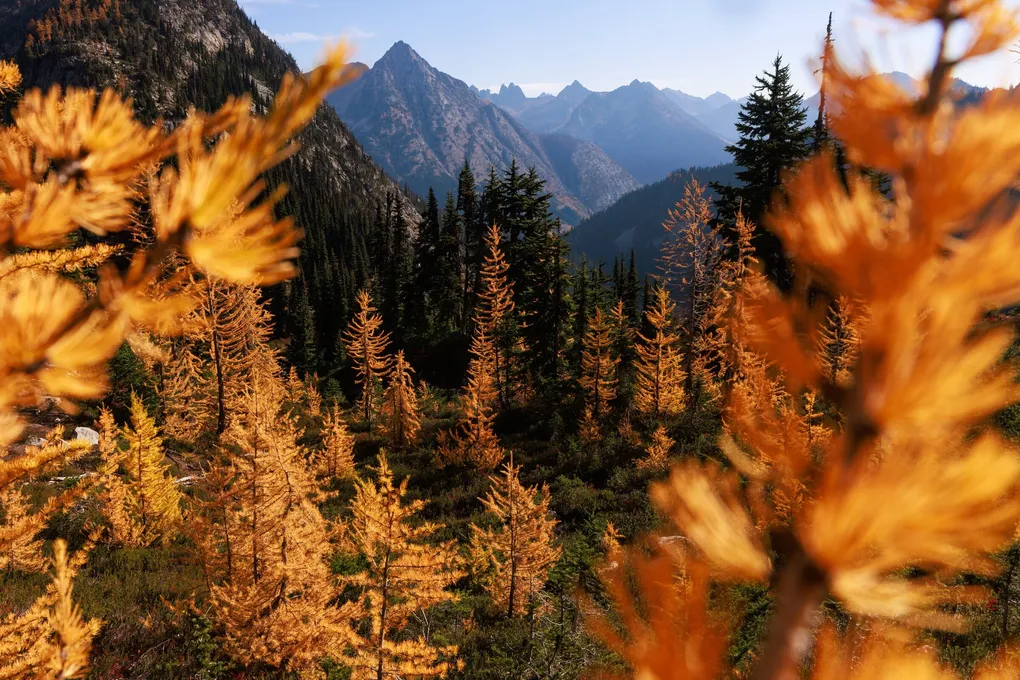
An alpine forest glows with golden autumn larch trees, framed by rugged mountain peaks under clear blue skies.
What This Guide Covers
This manual reveals the entire science of how leaves transform color, which trees transform which hues and why peak colors are likely to happen in various areas.
You will also be educated on the influence of weather on the fall display such as the reasons why some years look splendid and others dull.
Last but not least you will receive some tips to go and see in your own yard not only to experience the fall color more intimately, but also to help notice when things are strange about the coloring of trees and that they are stressed.
Why Trees Drop Their Leaves
The Purpose of Leaf Drop
In the case of deciduous trees, leaf fall is a winter survival mechanism. Broad leaves are water-saturated, thin and prone to freeze damage; thus preserving them over the winter period may cause tissue injury and generate chronic stress.
Water is also conserved by the leaf drop. Transpiration causes the leaves to lose large quantities of moisture and in winter the water which a tree would normally draw out of the soil may be frozen or merely unavailable when required by the leaves.
Energy trade-off is also present. Days can be short and the sun can be low in angle leading to reduced photosynthesis and therefore the cost of a leaf can be more than the energy it generates. Autumn allows trees to go into their dormant state through shedding leaves, which is a seasonal downturn of internal mechanisms that safeguard the internal systems and allows the tree to focus on its maintenance instead of growth until spring arrives.
Why Evergreens Don’t Drop Leaves
The Evergreens retain their leaves, as needles are adapted for the winter season. They have a waxy cover that minimizes the loss of water, their surface area is small which limits the amount of water that is lost through transpiration, and the majority of them contain antifreeze compounds in their cells that enhance the ability to survive at low temperatures.
These adaptations allow them to photosynthesize during winter days that are not too cold and they do not lose a lot of water. This does not always happen to all conifers. Cone trees such as larches and bald cypress do drop their needles and this demonstrates that it is a strategy rather than a rule to be applied to a particular type of tree.
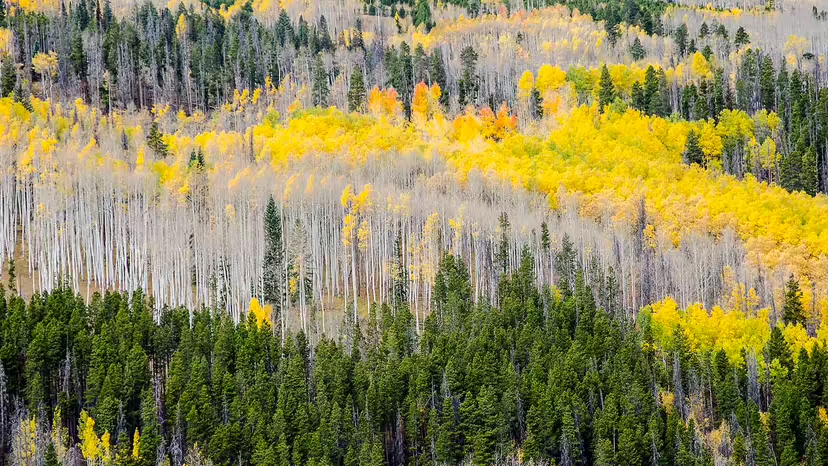
A mixed forest of evergreens and aspens shows striking contrast as bright yellow fall foliage weaves through deep green conifers
What Triggers Fall Color Change
Primary Trigger: Day Length (Photoperiod)
Day length or photoperiod is the primary cause of fall color. Trees also perceive a shortening of the days by having phytochrome receptors in their leaves which are light-sensing systems that enable the plant to gauge seasonal change.
Since the summer solstice on June 21, the number of days becomes shorter and shorter. Once daylight decreases to a level that depends on the species, hormonal processes commence altering the leaf to cease summer generation and enter into nutrient storage.
This is a starting signal that is set by light and not temperature. The day length pattern does not change each year at the same latitude, and therefore, initiation will have a similar calendar period.
Secondary Trigger: Temperature
The effect of temperature on intensity and speed is greater than it has at the start. Low temperatures (below approximately 45°F) hasten the change in pigment and tend to be more colorful. Night can soften the impact as it is a warm night.
The process may be interrupted by a hard freeze under 32°F resulting in the damage of leaves before a complete color is built up, leading to an early termination of the display and leading to a progressive rapid browning and fall of the leaves.
The Abscission Layer Forms
The tree develops the abscission layer which is the body in which the leaves are able to fall safely. At the point of attachment of the petiole to the stem, a special layer of cells is formed at the base of the leaf.
These are the cells that are designed to die and detach, weakening the attachment point until such a time that the leaf falls down either by wind or gravity.
Meanwhile, the formation of the cork cells as a seal over the break minimizes the water loss and prevents infection. This is readily observable by taking a look at a fallen leaf stem, which usually displays a neat split at the point of formation of the abscission layer.
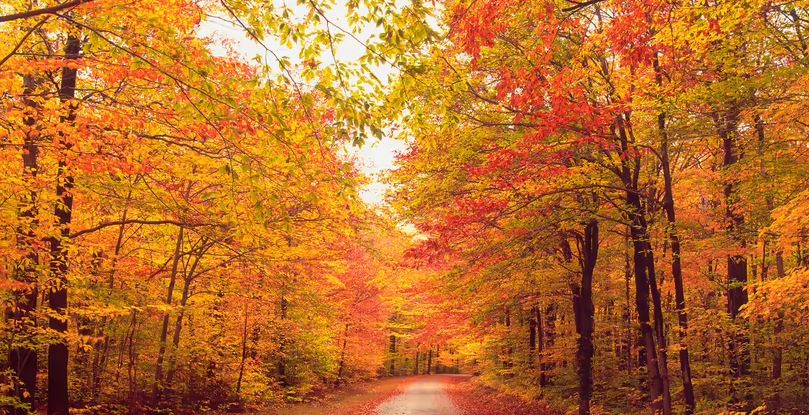
A quiet road runs through a forest glowing with red, orange, and yellow autumn leaves.
The Science of Leaf Pigments
Chlorophyll (Green): The Dominant Pigment
The pigment that attracts sunlight to facilitate photosynthesis is called chlorophyll, and it predominates in the leaf color throughout the growing season.
During the fall, when days grow shorter, chlorophyll synthesis decreases and the available chlorophyll disintegrates and disappears. This disintegration is not a wasted one.
The tree is able to recycle useful nutrients, in particular, nitrogen and magnesium, before the leaf falls, and stores them to be used in spring growth. When chlorophyll dies away, other pigments finally become visible.
Carotenoids (Yellow and Orange): The Hidden Colors
The carotenoids are constantly present in the leaves but are normally covered by the chlorophyll during the summer.
Carotenoids are unlocked when the chlorophyll decays and it results in yellow and orange.
These are identical pigments in carrots, corn and pumpkins, and they assist the leaves in collecting extra wavelengths of light. Trees that tend to be intense yellow or orange are; birch (bright golden yellow), aspen and poplar (golden yellow), ginkgo (brilliant golden yellow), hickory (golden bronze), and tulip tree (golden yellow).
Anthocyanins (Red and Purple): The Fall Specialists
In the fall, anthocyanins are commonly synthesized using sugars collected in the leaves as transport pathways are blocked. They serve the protective purpose in which they resemble a a sunscreen that protects the leaf tissues against light damage as the nutrients are salvaged.
They are particularly sensitive to weather: when it is sunny, the sugar will be produced more, and when it is cool, it will be trapped, and the reds will be brighter.
These are also found in the blueberries, red cabbage and cranberries. Sugar maple, red maple, dogwood, sweetgum, black cherry and sumac are also trees that change to red or purple in the fall, but other types of red maple have a yellow color because of genetic variation and reduced production of anthocyanins.
Tannins (Brown): The Final Stage
Tannins produce other pigments that fade away and form brown, which appears late. They are distasteful to the herbivores and possess antibiotic effects.
Nitrogen and phosphorus are nutrients released back to the soil after the leaves fall. Oaks and beeches are commonly brown and oaks tend to be late in their recovery as the tannins hold nutrients tight, retarding the recovery process and delaying the end-of-season shutdown.
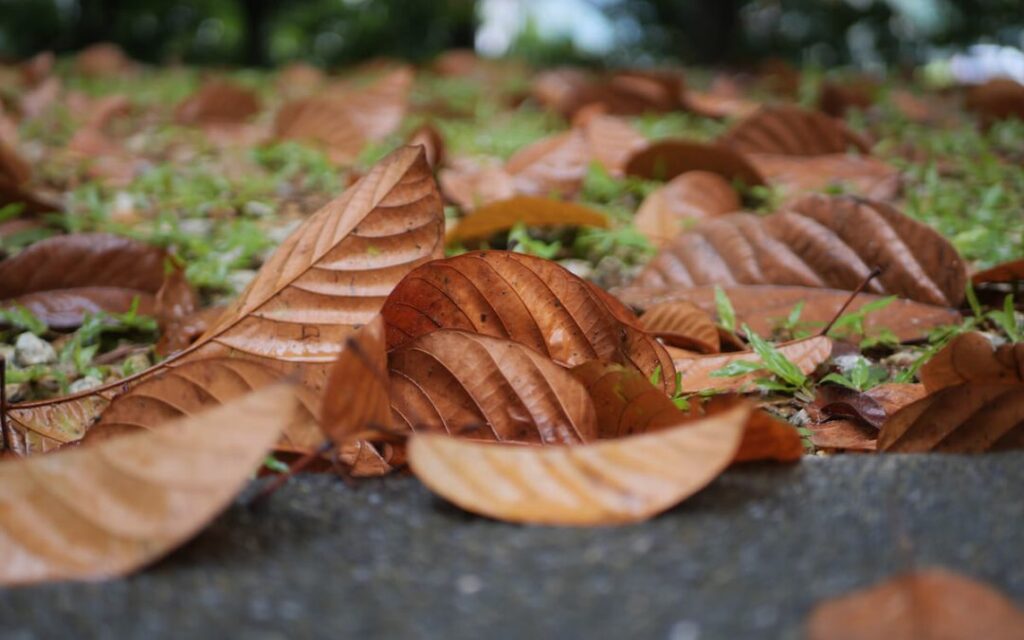
Dry brown leaves scattered across the ground, signaling the quiet arrival of autumn.
When Peak Colors Occur
General Pattern: North to South, High to Low
The highest color in the sky tends to travel like a wave in a north-south direction as temperatures decrease throughout the areas once the photoperiod has begun the cycle.
It is a general rule of thumb that the wave passes south about 100 miles a week, but the weather of the locality may accelerate or retard it.
- Elevation also matters. Approximately 1,000 feet of altitude may replicate approximately 100 miles of latitude thus mountainous regions tend to hit their summit 1 to 2 weeks before adjoining valleys.
Regional Peak Color Timeline
The Upper Midwest, such as Michigan, Wisconsin, and Minnesota, as well as Northern New England or Maine, Vermont, and New Hampshire, normally peaks in late September into early October.
Mid Atlantic such as New York, Pennsylvania and New Jersey tend to peak in mid-October. The Southeast which covers North Carolina, Tennessee, and Georgia usually peaks during the end of October to early November whereas the Deep South, including Alabama, Louisiana, and Mississippi, usually reaches its peak during the end of November to the beginning of December.
- The Pacific Northwest tends to peak in late October or early November. They are wide windows, however, and always tend to the general north-south and high-low.
How Weather Affects Fall Color
Ideal Conditions for Brilliant Color
A certain recipe can give the best fall color. Fall days are sunny and dry, which increases sugar production in leaves, and cold nights that are not below freezing are useful in trapping sugar and converting it to anthocyanins.
A frequently quoted range of daytime temperatures between 50 and 60°F and nighttime between 32 and 45°F is warm enough to promote the accumulation of sugar in the air but not chilly enough to harm the leaf material.
Conditions That Reduce Color
A number of patterns have the capacity to dull or shorten the display. When leaves are prematurely frozen hard, the color is terminated.
An extended warm autumn may postpone color and in most cases the tones become duller since chlorophyll decays gradually and there is also less storage of sugar.
The production of sugars is suppressed in cloudy weather, especially the reds and purples. Heavy rain and strong wind might literally blow away the leaves before color peaks come and leave trees naked at the time they were preparing to shine.
Summer Conditions Matter Too
Fall is the aftermath of summer. The reason is that moderate summer drought at times causes fall colors to be more brilliant as the slightest stress can cause leaf chemistry to be more focused
Bad drought has the reverse effect and early drops of leaves and lessening color since the tree sheds leaves before the pigment process finishes.
Observing Fall Color in Your Yard
Signs to Watch For
Monitoring your trees may show you the usual changes during a particular season as well as issues.
Midsummer early color is often a sign of stress and not a sign of nature. The color of a tree usually moves towards yellow or orange and in some cases red depending on the species and genetics.
The first branches facing the south are often colored due to the increased sun radiation influence on the production of sugars and the temperatures of the leaves.
Tracking Your Trees
Single tracking puts fall as an annual event. Make a note of the date on which you can first see the change in color and take a picture of the same tree on a weekly basis so as to track the progress.
Over time, you will be able to recognize trees based on the colors of their falls and observe how the local microclimate affects the duration and severity.
When Color Indicates Tree Health Issues
Fall color may also spell out health problems. Determinability is premature browning and lack of bright color that may indicate drought, root disease or pests.
The early color change of one of the branches compared to the others can indicate localized pathology, injury, or vascular impaction. Constant or intensive abnormalities should be taken to professionals, especially to an arborist.
Climate Change and Fall Color
Since the duration of the day is constant and the temperature is fluctuating, the conditions of climate change can have an effect on the timing and intensity of fall color. Over the last 30 years, the peak color dates have been approximately one to two weeks later in the Northeast than in earlier years and the warmer the fall the shorter the color intensity may be due to a lack of cool nights to produce anthocyanin.
The heat waves in spring can also have an indirect influence on the fall color as they cause stress earlier on. The potential silver lining is an increase in the fall color season in certain states even though peak brilliance would be less erratic.
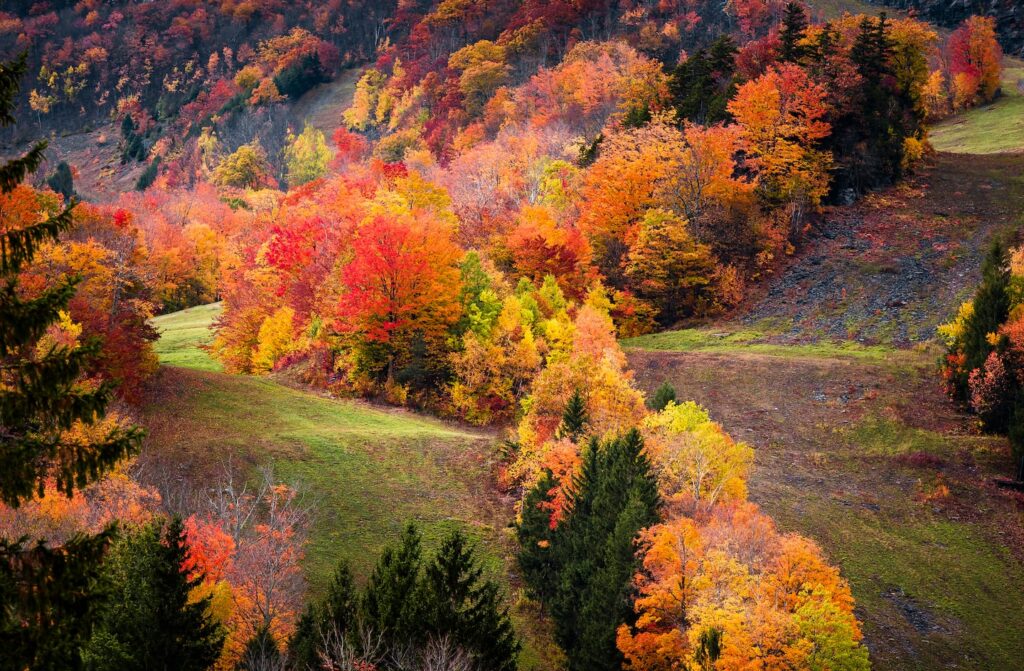
Rolling hills glow with layered bands of red, orange, and gold as autumn sweeps across the landscape.
Conclusion From Allen Tate
The color change of the fall is the appearance of a more profound survival. The shutdown is caused by day length, the intensity and the speed are influenced by temperature, and the colors that will be seen are defined by pigments.
The chlorophyll is lost as the tree rejuvenates nitrogen and magnesium, the carotenoids make the yellows and oranges always there, the anthocyanins make the weather-driven reds and purples to the advantage of leaf protection, and the tannins make the late browns with their defensive value. These leaves are then cleanly detached by the abscission layer and the cork cells protect the tree against infection and water loss. It is more significant to you when you know the science, and it imparts to you useful hints of the seasonal processes in your trees, and of their health in general.