

Step-by-Step Guide to Mulching a Tree Correctly
- You have probably seen it: mulch piled high against tree trunks like little volcanoes. It is well-trimmed and purposeful, almost a sort of protective collar, yet it is one of the most destructive things to do to a tree. Mulching of volcanoes traps the moisture in the bark, covers the flare of the root and gradually makes the tree weaker.
The good news is that it is not hard to do good mulching because you are aware of the correct method.
This manual will take you through all the steps that you should do to mulch trees properly, why it is important, what type of mulch to purchase, how much to purchase, and provide you with an easy-to-follow guide. You will also be taught when to mulch, keeping the mulch rings, fixing the usual troubles, and in exceptional cases such as new trees and slopes.
It only requires a few basic guidelines to have all the advantages of mulch and not kill your trees.
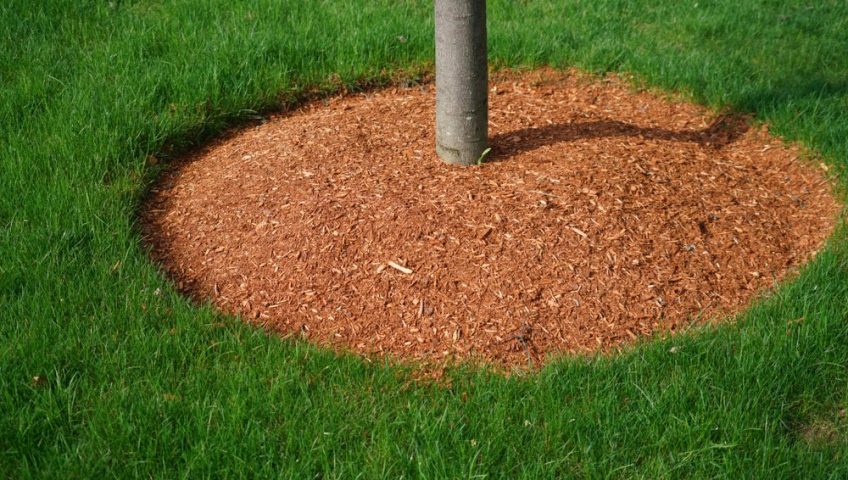
A properly mulched tree base, with a wide, even ring that protects roots while keeping mulch away from the trunk.
Why Proper Mulching Matters
The Benefits of Proper Mulching
Correct mulch ring forms some sort of a shielding cover on the root zone. Organic mulch, 2 to 3 inch layer can cut down water loss to soil by 25 to 50 percent, hence the soil remains moist longer and the need to water the soil reduces. It also controls the temperature ofthe soil, which maintains roots up to approximately 10°F cooler in summer and warmer in winter.
Mulch prevents light penetration and inhibits the development of weeds. Organic mulch is also beneficial because it enhances soil structure as it decomposes and the nutrients are added to the soil. The trunk and surface roots are also insulated by a mulch ring to avoid damage by the mower and string trimmer, and to retain the soil in place during the rain to minimize erosion.
The Dangers of Improper Mulching
The most harmful of these are volcano mulching, in which piles of mulch are stacked against the trunk, and hump mulching in which piles of mulch are stacked atop the hump.
It pins up moisture against the bark and promotes fungal rot, stimulates the growth of feeder roots in mulch rather than soil, decreases air penetrating the bark and creates a barrier limiting water and air penetration to the soil. It is also able to conceal the root flare which may cause a problem with stability.
Thin mulch which is below approximately 2 inches is not very effective. A mulch ring which is small and only encloses the base of the tree will not cover much of the root zone hence most of the benefits are lost.
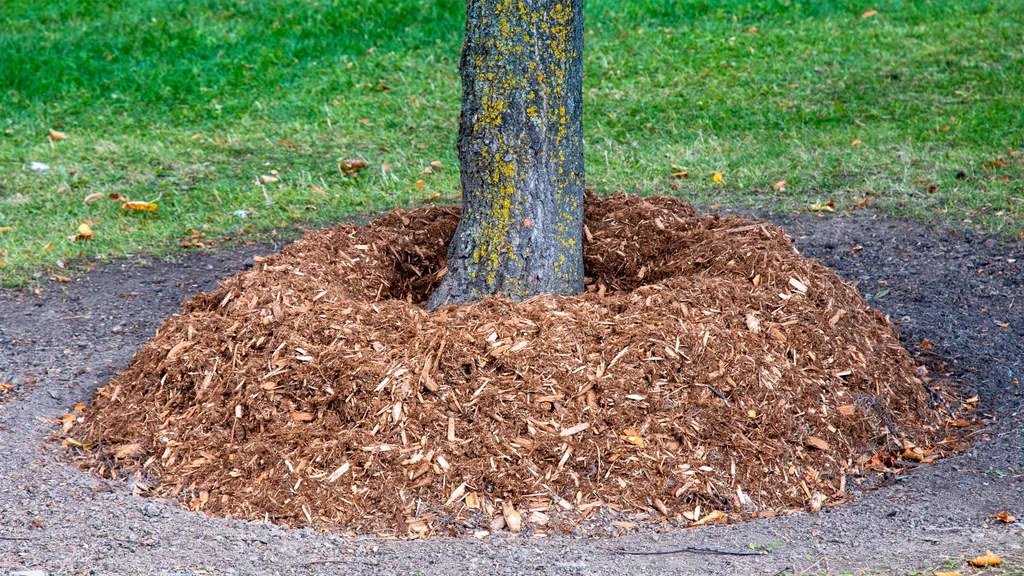
Improper mulching, with mulch piled against the trunk, can trap moisture and lead to rot, pests, and root problems.
Choosing the Right Mulch
Organic Mulches (Recommended for Trees)
1. Shredded Hardwood Bark (Best Overall)
Lasts up to 2 to 3 years, stays in place and is natural and decomposes slowly in addition to providing nutrients, but is generally more expensive than wood chips.
- Most trees: most trees of a landscaping nature are best with this idea.
2. Wood Chips
Wood chips can be sourced freely by tree services or municipalities and are very good for large areas. There is a temporary use of some nitrogen by fresh chips, which are decomposing but this does not affect established trees. Recommended with mature trees, natural landscapes and economic developments.
3. Pine Bark Nuggets
Pine bark nuggets are not only beautiful to look at but also take long to decay. They do not squeeze in making them easy to move the air and water through the mulch layer. But they are free to float and be washed away during heavy rains and they are also more costly. They can be effectively used in comparatively flat spaces and for decoration.
4. Compost
Enriches soil and is fast decomposing, requires regular replenishment and weeds. Mixes best with other mulches or can be used on soil improvement projects.
Inorganic Mulches (Generally Not Recommended for Trees)
Rubber Mulch
Rubber mulch does not enhance the soil, leaches chemicals, and it is more likely to trap heat around the root zone. It cannot be decomposed to organic matter. It would be ok in playgrounds but not in areas with trees.
Rock or Gravel
Rock and gravel are non-nutrient adding materials that are also capable of absorbing and emitting heat and stressing the roots. They are hard to take out once they are planted and they do not improve the soil directly. Rock is also acceptable in xeric landscapes that contain drought-tolerant trees that can tolerate heat and rocks but not most of the trees in the yard.
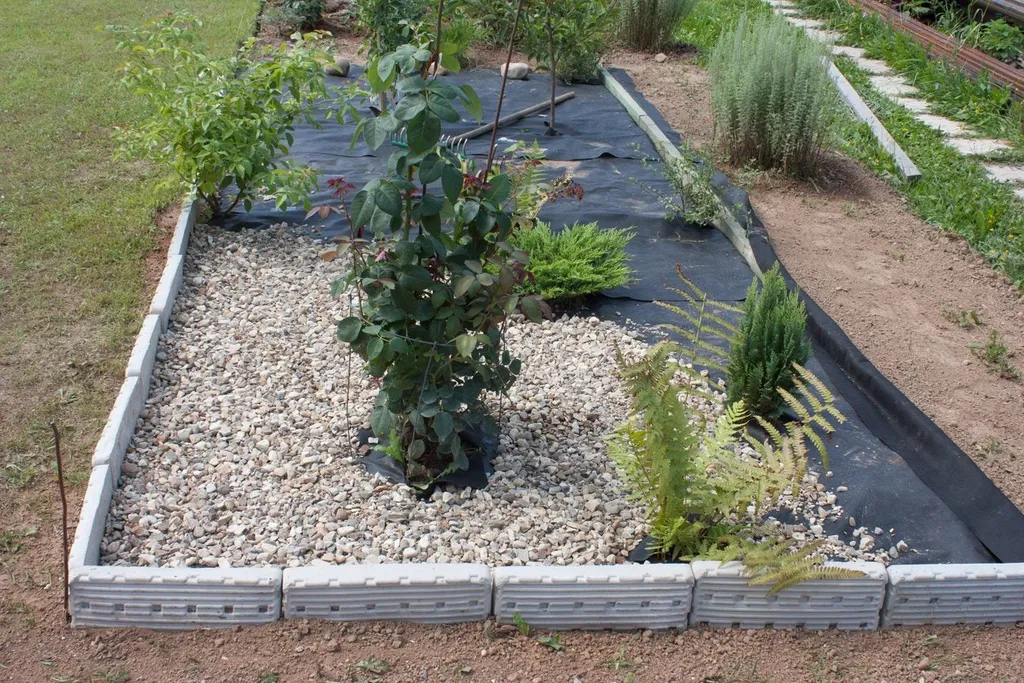
Gravel and landscape fabric used as ground cover, which suppresses weeds but can limit soil health and water absorption for plants.
Mulches to Avoid
Fresh wood chips should not be used because they may be diseased and transmit diseases. Do not use dyed mulches that might have chemicals in them and also avoid pallet wood that has been used before and might have contamination. Grass clippings should not be used as they do not get compact and block air and water and can overheat roots and damage them.
Tools and Materials Needed
Required Tools
A wheelbarrow or cart, a shovel or a pitchfork and a rake will be required to move and to distribute mulch to the ground. A yardstick or a tape is used to measure the radius of the rings and the depth of the mulch. Wear gloves and use a garden hose, water before and after mulching.
Materials
Use organic mulch from the types above, in an amount calculated for your ring size and depth.
Calculating How Much Mulch You Need
The Formula
Use this simple formula to estimate mulch volume:
- Cubic yards needed = (area in square feet × depth in feet) ÷ 27
Step-by-Step Calculation
- Measure the radius of the planned mulch ring from the trunk to the outer edge. Calculate the area as π × radius², or 3.14 × radius × radius, using feet. For a 3-inch mulch depth, multiply the area by 0.25 feet. Then divide by 27 to convert cubic feet to cubic yards.
Quick Reference Examples
A small tree with a 4-foot radius mulch ring uses about 0.5 cubic yards. A medium tree with a 6-foot radius ring uses roughly 1 cubic yard. A large tree with a 10-foot radius ring needs around 3 cubic yards.
Bagged Mulch Coverage
One 2-cubic-foot bag of mulch covers about 8 square feet at a depth of 3 inches. Divide your mulch ring area by 8 to estimate how many bags to buy.
Step-by-Step Mulching Instructions
Step 1: Prepare the Area
Locate the root flare, which is the widening of the trunk at the base. This must be seen above the soil. In case the mulch is more than 3 inches deep, then rake off the extra mulch until the flare and the soil are revealed. Weed off any things within the intended ring.
In a new lawn where rings appear, either pull off the grass or place a piece of flattened cardboard or newspaper over it to smother it; this will be little trouble under the mulch. Pour a lot of water onto the tree to ensure the soil is wet in the root zone and then after that, it is time to mulch.
Step 2: Determine Mulch Ring Size
The perfect ring is made up to the drip line of the tree, the outer point of the branches, as the place has numerous absorbing roots.
When that is not practical, strive to get 3 to 4 feet in diameter rings with small trees, and 6 to 8 feet with big trees. Large rings would be the optimal choice, as roots may extend 2-3 times past the canopy.
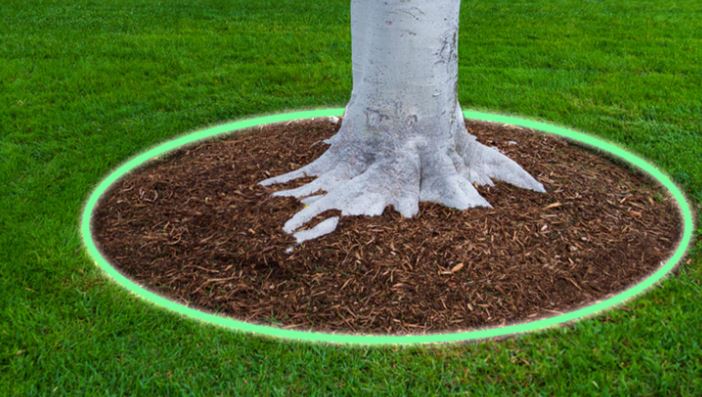
Proper mulching ring around a tree, keeping mulch away from the trunk to protect roots and prevent rot.
Step 3: Apply Mulch Properly
Begin with the outer ring and radiating mulch. Maintain the depth of the layer to be 2-3 inches deep using a yardstick.
- The most important guideline is that you should not ever have mulch touching the bark around the trunk because it is a critical area that should always be left bare (6 inches).
When shaping the mulch, it is crucial to remember that the shape must be a flat donut and not a cone with the root flare being visible above the line of the mulch. Rake the surface smooth.
Step 4: Water the Mulch
Lightly water the mulch to help it settle and reduce blowing. Do not overwater to the point of creating soggy conditions.
Visual Checkpoint: What Proper Mulching Looks Like
When it is finished, the mulch should take the shape of a donut with an apparent 6-inch bare ring around the trunk and the root flare visible. The depth is regular, 2 to 3 inches and the ring goes up to the drip line, or at least 3 to 4 feet above the trunk.
Best Time to Mulch
Spring Mulching (March to May)
Spring mulching is best for refreshing mulch and preparing trees for the growing season. Apply after the last frost when soil has begun to warm.
Fall Mulching (September to November)
Fall mulching protects roots before winter. Apply before the first hard freeze while the soil is still workable.
Avoid These Times
Do not mulch over frozen ground, since that traps cold around roots. Also avoid very early spring when the soil is still cold, because mulch can slow warming.
Mulch Maintenance
Monthly Tasks
Lightly fluff up the mulch on a monthly basis during a growing season with the help of a rake in order to break up compaction and increase the movement of air and water.
Make certain that there is no mulch that has drifted or washed up around the trunk and rearrange the mulch to get back to the 6-inch bare area. Eradicate any weeds that crop up in the ring of mulch.
Annual Refresh
Check depth once a year, either in the spring or fall. In case the mulch has decomposed to less than approximately 2 inches, add approximately 1 inch of fresh mulch without adding more than about 3 inches altogether. In case the layer is already thick and matted, then clear some old mulch, then put up more.
Signs Mulch Needs Refreshing
The loss of color and tightness or flattening of the texture, depth less than 2 inches, or recurrent weeds indicate that the mulch needs to be fluffed and some new mulch added.
Common Problems and Solutions
Problem: Already Have Volcano Mulch
If you already have a mulch volcano, pull mulch away from the trunk until there is a 6-inch bare zone and the root flare is exposed. Spread extra mulch outward to widen the ring or remove it.
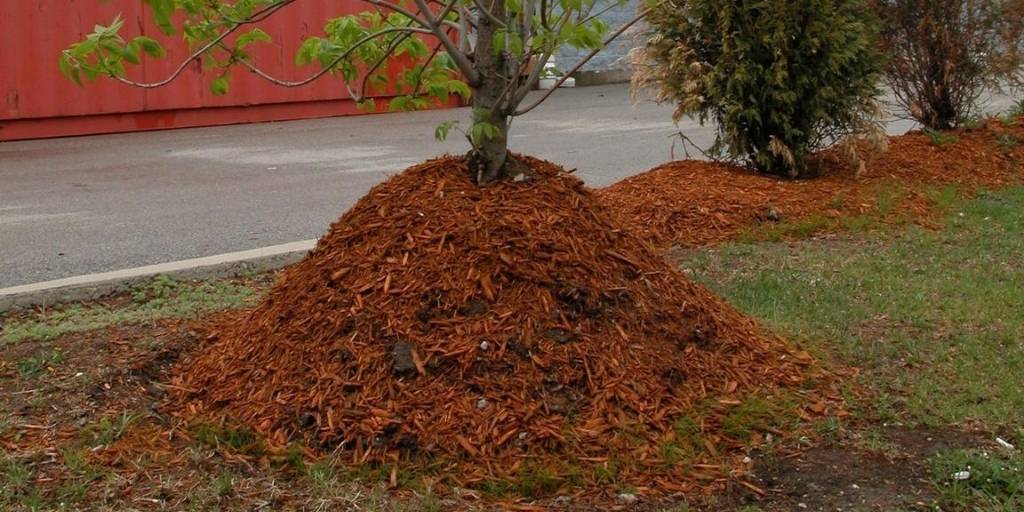
Mulch volcano around a tree, an improper practice that traps moisture against the trunk and can cause rot and disease.
Problem: Mulch Growing Mushrooms
Mushrooms typically imply the presence of mulch that is in the process of breaking down and mushrooms do not tend to cause harm to trees. Bar to disturb them and fluff them up to allow more air.
Problem: Mulch Washing Away
Mulch can be washed down slopes. Larger bark nuggets that fit onto one another should be used and thought of terraces or landscape edging to assist in keeping the mulch on the ground.
Problem: Mulch Smells Sour or Rotten
The smell is a sour or rotten smell, which is a sign of anaerobic decomposition. Place mulch in a less thick layer and rake it to allow air penetration. When the smell is already there, take it away and use fresh and well-aged mulch.
Special Situations
Newly Planted Trees
Mulch newly planted trees immediately to conserve moisture. Keep mulch 3 to 4 inches away from the trunk and maintain normal depth. The first two years are critical, and consistent mulch helps roots establish.
Trees with Exposed Roots
For trees with exposed surface roots, mulch can cover and protect them from traffic and drying if you keep mulch off the trunk and root flare.
Multiple Trees Close Together
Where trees are close, you can connect individual mulch rings into one larger bed. This creates a continuous protected root zone and simplifies mowing. Inside the shared bed, maintain a separate 6 inch bare circle around each trunk.
Trees on Slopes
In case trees are on slopes, bigger bark nuggets are used which will not be washed away or slide easily. This is to be combined with landscape edging or small terracing in order to retain the mulch and shield the soil.
Conclusion
It is not difficult to do proper mulching with just a few rules. Apply organic mulch, maintain the depth of the layer at 2 to 3 inches, and never cover the trunk with the root flare on it. Stretch the mulch ring as far as possible, preferably to the drip line, and do not form any mulch volcano.
Mulch should be replaced with fresh one each year and this should be in depth with the issues like stacked-up mulch or foul smell being rectified immediately. These easy practices allow mulch to do what it is supposed to do which is to protect roots, stabilize soil and aid in the long-term health of trees. An arborist who has the status of an ISA certified arborist can assist you in the combination of good practices, such as proper mulching, with other good practices of taking care of trees.