You go out and see mushrooms at the bottom of your tree. What comes to your mind: It is my tree that is dying.
Should I be worried? To have mushrooms on trees is frightening, with reason. But they do not necessarily imply that your tree is not going to be spared.
Mushrooms indicate that there is something occurring within your tree; however, the degree will be determined by the type, location, and other indications that you may notice.
Mushrooms never indicate anything other than that some form of decay or decomposition is taking place. Fungi are in most instances, decomposing wood tissue, compromising the structural integrity of the tree.
The outward appearance of these fungi, mushrooms, is the fruit of much greater networks of mycelium developing within the wood.
When you see mushrooms the fungal network is several months or maybe even years old. This guide will assist you in determining the most problematic mushrooms, the degree of risk to your tree, and the time when you need to call an expert.
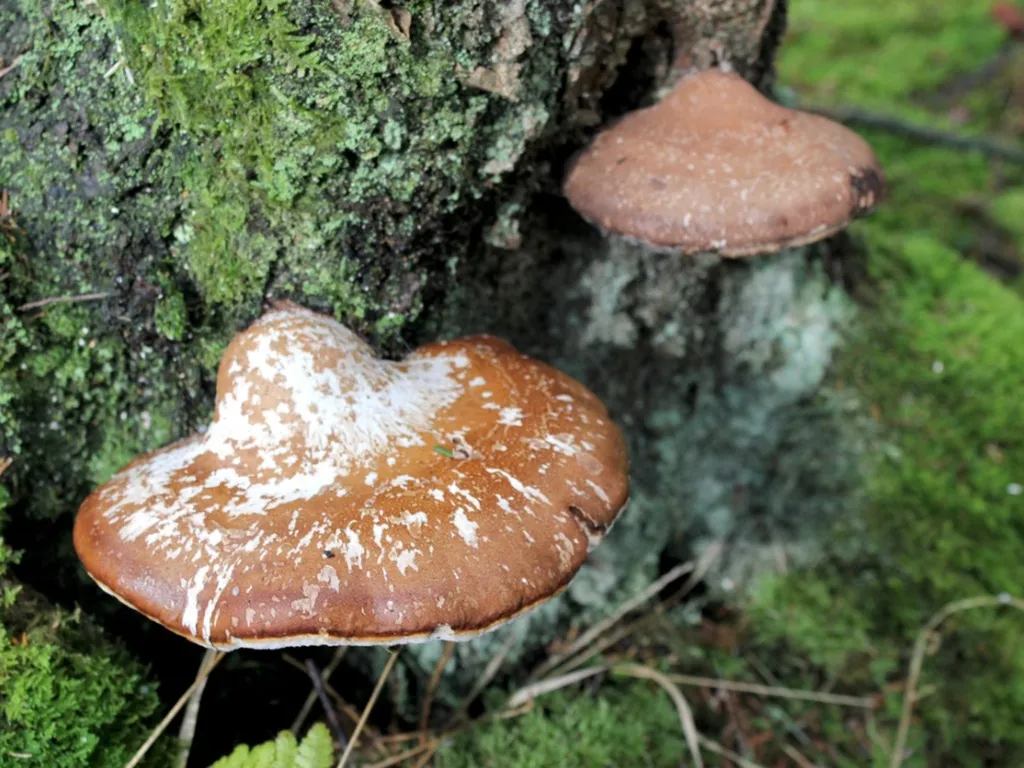
Fungi growing on a tree, a common sign of wood decay and tree health issues.
What Mushrooms Growing On Trees Actually Mean
The Biology Behind Tree Mushrooms
The reproductive structures of fungi are called mushrooms, which are a component of a larger network of mycelium that develops inside the trunk of the tree.
These fungi require a certain environment, such as moisture and appropriate temperature, to develop and manufacture mushrooms. The look of it is an indication that the fungus has been living in the tree for months or even years and has led to the deterioration of the internal part of the tree.
When mushrooms appear it means that there is active wood decay occurring. This rotting may cause the tree to have low structural stability and be susceptible to fracture or fall. An important factor is the presence of moisture as fungi are known to grow in damp areas, hence why you will find mushrooms in areas that are more humid like as cracks or wounds in the bark.
The fungus spores usually penetrate through the trees through wounds or cracks and they grow and mature with time. Mushrooms will appear in case the fungus is in a mature state indicating that the decay is ever advancing. When mushrooms grow, it is an indicator that the decomposition has established its roots.
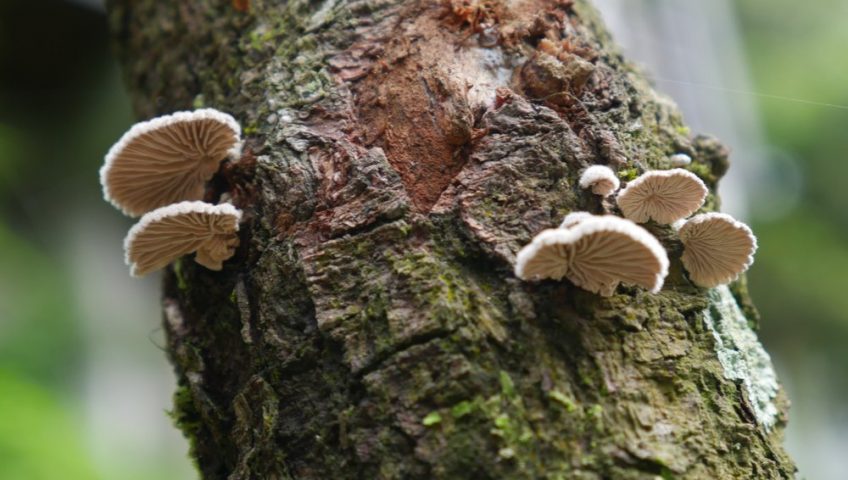
Fungi growing on a tree, often signaling internal decay and weakened health.
Two Critical Categories of Tree Fungi
Saprophytic Fungi
These are fungi that are involved in the process of the natural decomposition cycle but feed on the dead wood. They are not normally detrimental to a living tree; however, this can be an indicator of deadwood in the tree that can affect the overall well-being of the tree.
Parasitic Fungi
These are fungi that attack and feed on living tree tissue and thus actively damage the healthy tree tissue. They are extremely dangerous to the life of a tree, as they tend to spread actively and bring about vast deterioration.
Location Matters – Severity Levels
Base/Roots (Most Serious)
Fungi on the bottom or roots of the tree may be a cause of root rot or butt rot. This undermines the structural base of the tree and may lead to the total collapse of the tree.
Trunk/Main Stem (Serious)
The use of fungi on the trunk causes the decay of the heartwood and the weakening of the internal structure of the tree, which leads to its fracture.

Fungal growth on a tree, indicating potential decay and weakening of the wood.
Branches (Less Critical)
Branches often have fungus, which is a sign of dead or dying wood. The tree is not always diseased and it might just require the removal of the affected branch.
Common Types Of Mushrooms That Grow On Trees
There are several varieties of mushrooms that are common on trees, but you want to be able to find out what sort of mushroom you have growing on your tree.
This question is crucial in the process of identifying the magnitude of the problem and proceeding with it.
The following are the most typical types of mushrooms you may come across on your trees in the most worrying to the least worrisome:
Honey fungus (Armillaria mellea)- Extremely dangerous
Honey fungus presents itself in the form of mushroom colonies of honey color or even yellow-brown on the lower part or root of the trees. This fungus is highly parasitic and is able to kill trees in 3-5 years.
It spreads in the soil, infecting the trees surrounding it, and it is a great worry to any homeowner. This is important in case you find honey fungus, you should go to a specialist as soon as possible. There might be a need to remove trees to curb additional destruction and prevent the spread to other trees.
Artist’s Conk/bracket Fungus (ganoderma Applanatum) – Very Serious
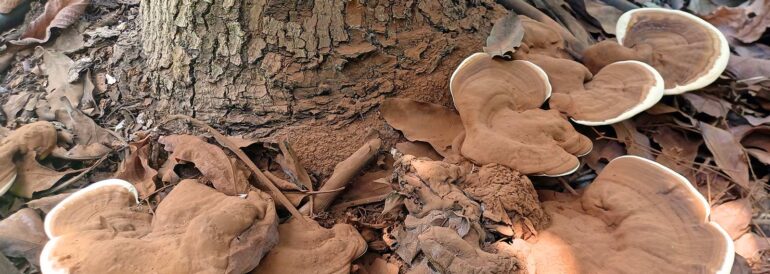
The Conk, a fungus that develops on the mature trees, is large and shelf-like, and it is commonly associated with a lot of heart rot. It looks like it has been damaged internally and its stability is seriously undermined.
This fungus may take years to spread, decaying continuously. It is necessary to conduct a professional tree risk assessment to understand whether or not the tree is dangerous and requires removal. The vicinity of buildings and busy streets should also be taken into consideration when making such a decision.
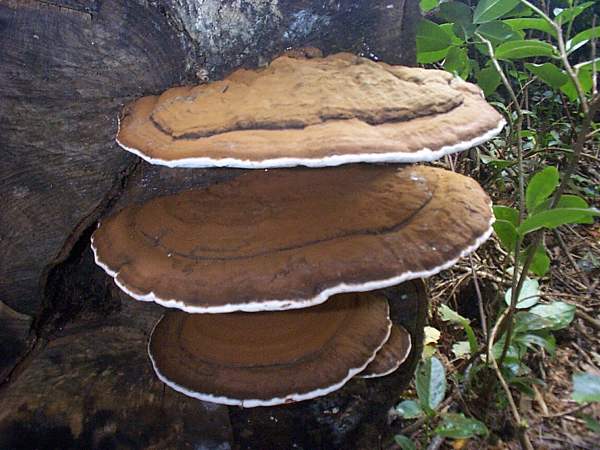
Stacked fungal growth on a tree, indicating possible wood decay and weakening.
Chicken of the Woods (Laetiporus sulphureus) – Serious
It is an orange fungus that grows on hardwood and is unmistakable and bright orange, Chicken of the Woods. It brings about brown rot that decomposes cellulose in the wood, making it brittle and prone to cracking.
This greatly reduces the tree integrity. This fungus is commonly found in oak, cherry and willow trees and in certain instances it may cause the removal of the tree in case the rot is too much and beyond repair. The stability of the tree should be assessed to determine whether it should be removed or not.
Turkey Tail (Trametes versicolor) – MODERATE CONCERN
The Turkey Tail is a small fungus that is colored and grows in concentric rings of brown, tan, gray, and occasionally, blue or green. Turkey Tail is a white rot fungus in most cases commonly in deadwood, stumps, or dead branches.
Although it is not as aggressive as other species, its presence could denote the dead or rotting parts of the tree. When it is growing on a branch, the deadwood can be removed and further decay might be avoided. But when it is on the trunk, then it should be evaluated by a professional.
Oyster Mushrooms (Pleurotus ostreatus) – LOWER CONCERN
Oyster mushrooms are saprotrophic i.e. they are parasites on dead wood. They usually grow in groups on the trees and usually show the presence of deadwood in the tree.
These fungi are not as frightening as parasitic ones, but still, they should be observed in case they start to spread to the living area of the tree.
When you see oyster mushrooms, you need to observe whether they are growing on dead or living tissue and take suitable action to control the proliferation.
Slime Molds – NOT TRUE FUNGI, HARMLESS
Slime molds do not constitute fungi but are confused with them. These are blob-like growths that are available in different colors, such as yellow, orange, or white and feed on decaying organic matter.
Slime molds do not cause any damage to the trees and are not dangerous to the health of the trees. You may come across them at the foot of trees or upon bark, but do not take any action when you come across them.
Critical Identification Mark
In case you are uncertain about what type of fungus is growing on your tree, just get a photograph from several angles (top, bottom, side view, and where it is growing on the tree) and seek the advice of a certified arborist.
There are numerous types of fungi that appear to be alike, yet they are very dissimilar in terms of implications to trees. Do not consume wild mushrooms that grow on the trees; most of them are toxic. To be able to identify properly, it needs expertise and an arborist can assist you in knowing what to do.
Is Your Tree Dying? Warning Signs Beyond Mushrooms
Mushrooms can hardly grow alone, so when signs of a tree that has mushrooms visible, in addition to other warning signs, then the case is more severe.
Visible Structural Issues
It may be leaning, cracks, cavities, or a lack of bark, which is an indicator of internal instability. The fact that fungi grow at the base is also alarming, as it may be an indication of root rot which weakens the foundation and stability of the tree, making it much easier to fall.
Foliage Problems
Poor canopy cover, dead leaves or early fall of leaves may indicate internal rot due to fungi. When the leaves of your tree are smaller than normal or you are not getting any new growth it is possible that your tree is not doing well.
Root Zone Issues
Bare roots, loose soil or root rot fungi in the root area are some indications of root rot. This situation makes the tree a weak foundation and the tree may not be able to maintain its structure and it may collapse.
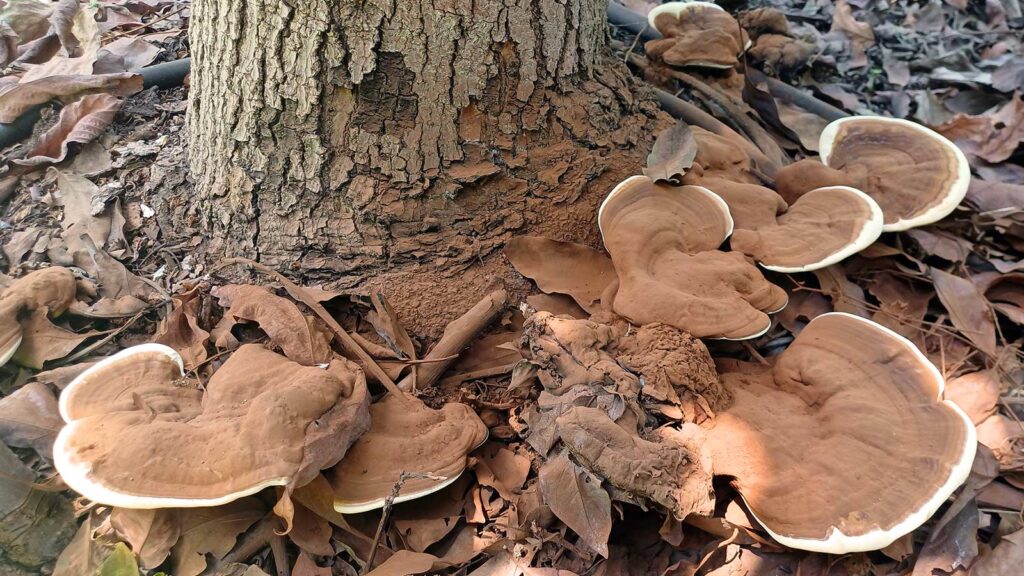
Fungal growth at the base of a tree, indicating potential root rot and decay.
Trunk Assessment
The trunk is soft or spongy, with piles of sawdust at its base, or the trunk is woodpecker-infested are all indications that the tree lacks integrity on the inside. Such symptoms signify rotting, and the tree can be loose.
What To Do When You Find Mushrooms Growing On Your Tree
Immediate Actions
Begin by recording the circumstances. Take a picture of the mushrooms and where they are on the tree and any other apparent symptoms i.e. cracks, dead branches or bent. Determine the safety of the tree, in particular, whether it is close to your residence or a place of high traffic. There is no need to remove the mushrooms because it will not fix the root cause of the problem but will stop the spread of the spores to other trees.
Short-Term Actions
A certified arborist needs to be consulted to determine the nature of the fungus and the severity of decay. The arborist will be checking the internal damage with such a tool as a resistograph or sonic tomography and decide whether the tree is safe. According to the findings, they will give recommendations on whether treatment can be done or removal is required.
Treatment Reality
It is impossible to get rid of fungi once they are present within the tree. Treatments aim at the prevention of decay and the reduction of risks. In extreme instances, it might be necessary to eliminate the affected wood or even the whole tree, particularly when the tree presents a hazard to property or even people.
Can You Prevent Mushrooms From Growing On Trees?
Although there is no way of keeping fungi spores out of trees, you can minimize the chances of this happening by taking care of the trees.
Entry points to fungi could be minimized by preventing tree wounds, controlling moisture levels and pruning trees correctly. Also, the elimination of dead trees and stumps will harm the fungal reservoirs leading to the spread of fungi to the healthy trees.
Fungal infections have a tendency to take over situations and can be prevented by ensuring that the health of trees is checked on a regular basis and preventive actions are taken.
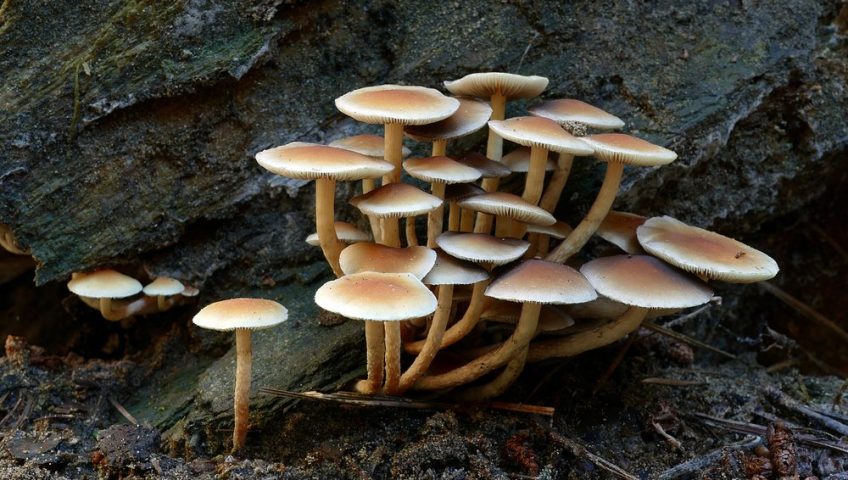
A cluster of mushrooms growing on decaying wood, signaling fungal activity.
Faq – Mushrooms Growing On Trees
Are mushrooms growing at the base of my tree a bad sign?
Yes, mushrooms at the base typically indicate root rot, which can compromise the tree’s stability. A professional assessment is crucial.
Can I remove the mushrooms to save my tree?
Removing mushrooms won’t save the tree. The fungi are the fruiting bodies of a much larger fungal network inside the wood.
Do all mushrooms on trees mean the tree is dying?
Not always, but they indicate some level of decay. The severity depends on the type of mushroom and the location on the tree.
How long after seeing mushrooms will my tree die?
The timeline depends on the fungus type and extent of decay. Some fungi can kill trees within a few years, while others may take longer.
Can tree fungus spread to other trees in my yard?
Yes, some fungi, like honey fungus, spread through soil, infecting nearby trees. Removing infected trees can help prevent further spread.