

Homeowners want the same thing: a yard that feels mature now, not in 30 years. It is possible to achieve a landscape presence, privacy, and shade on a human timescale with fast-growing trees.
There are numerous examples of species that can mature within 10 to 15 years with the right species and management, rather than 30 to 40 (Sullivan 10). That is to say that you get to experience the comfort and curb appeal when you are staying there.
Fast-growing trees are effective in that they offer quicker outcomes but the pace is achieved at a cost. Rapid growth can be associated with weaker wood, shorter life span, pruning and monitoring which is more than the slow, dense-wood trees.
There are fast growers, which have shallow roots or aggressive roots and may interfere with the sidewalks and patios. Some others fall over more twigs, seeds, or leaves.
- None of this is a deal breaker; it only represents that the best option fits in your space, climate and the extent of maintenance you are prepared to give.
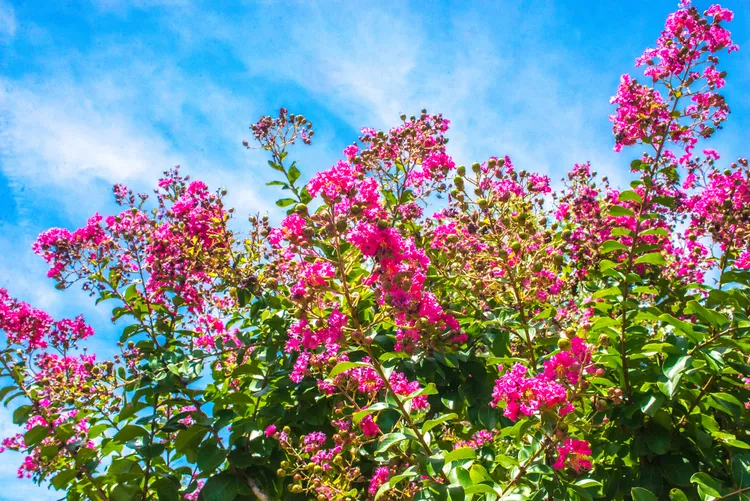
A crepe myrtle in full bloom, showcasing vibrant pink flower clusters that thrive in warm summer conditions.
What This Guide Covers
You will get 10 fast-growing trees sorted by purpose, how to select the correct tree for your situation and climate, the truth of concerns of the fast-growing, how to plant and surround your tree, and the expectation of long-term maintenance.
You will also know what it should not be such as planting too near pavement, ignoring root flare, or settling on ultra-fast trees where there are high storm risks in the local area.
Important: Check Your USDA Hardiness Zone
The Hardiness Zones of the USDA are determined using the average annual minimum winter temperatures. The best zone will be the most rapid way to eliminate the trees that cannot be relied upon to survive your winters.
Check the USDA Plant Hardiness Zone Map here: planthardiness.ars
Understanding Quick-Growing Trees
What “Quick-Growing” Means
- The rate of growth is commonly determined in terms of height per annum in favourable conditions. The trees that grow slowly have a growth rate of less than 12 inches annually (oak, hickory, most conifers).
- In temperate growers the amount of growth added is about 12 to 24 inches per year (many maples and lindens). There is an increase of approximately 24 to 36 inches annually (red maple, tulip tree, river birch).
- Quite fast growers may grow between 36 and 48 inches (or more) a year (willow, poplar, leyland cypress). Whether it is climate or soil, water or pruning, the real-world numbers are affected, yet such ranges are a pragmatic means of comparing options and setting expectations before you plant.
Pros & Cons
Advantages
The fast trees provide fast results which include shade, privacy and landscape impression in 5 to 10 years. They assist in filling empty spaces on new construction fields and can also produce cost-effective screening which at times is cheaper as compared to fencing large fields and also have an instant buying advantage with respect to the property value since you can experience the gain throughout the property ownership.
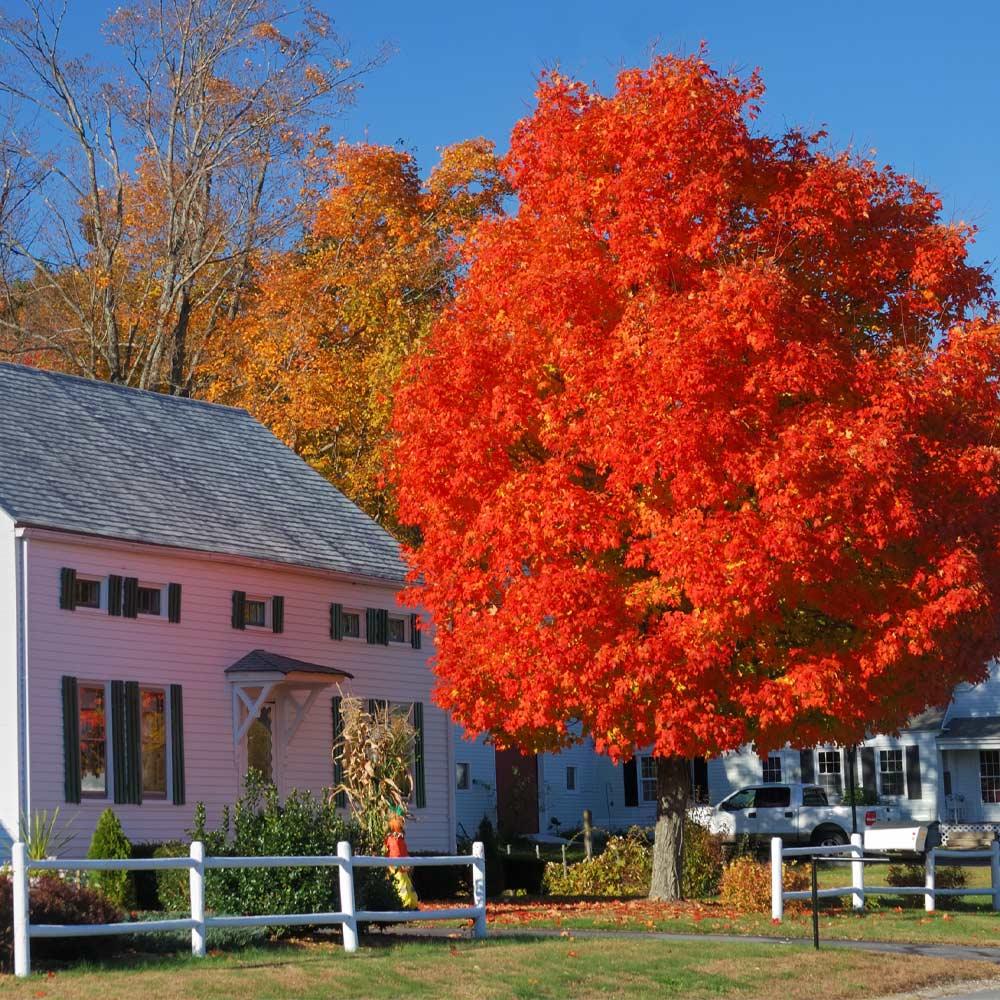
A mature maple tree displays brilliant red fall foliage, adding vibrant autumn color to a quiet residential landscape.
Disadvantages
Quick growth is associated with a relatively short life span, usually not 100 to 200 but 20 to 40 years old of quick-growing oaks and of some varieties of maples.
The wood is also often weaker, and this makes it easier to have storm damage, and break branches and split them.
Trees have shallow and aggressive roots that make trees less stable and cause them to be likely to heave sidewalks or driveways. It is more expensive to maintain with pruning required more frequently, between every 2-3 years as opposed to every 5-7 years. More prone to pests and infections as well as messier, dropping twigs, seeds, or leaves more frequently, many fast growers are more susceptible.
When Quick-Growing Makes Sense
The fast growers are suitable when the property is to be owned in the short term (say 5-15 years), when you require instant shade or privacy, when the property is being constructed on bare ground with a tabula rasa and when you are ready to accept that maintenance and life span tradeoffs.
Quick-Growing Trees by Purpose
CATEGORY A: BEST FOR SHADE (Deciduous Trees)
1. Red Maple (Acer rubrum)
Rate of growth 24 to 36 inches per year; full grown 40 to 60 feet (12 to 18 meters) in height and 30 to 40 feet (9 to 12 meters) in width; zones 3-9; full sun to partial shade; can grow in a wide variety of soils, but best in moist ones.
The color of fall is brilliant red-orange and seasonal. Best in medium to large-sized yards where these are required to shade in the summer. Hurdles are seeds, drops of small branches, and surface roots that have the ability to raise pavement.
- Spacing: vegetation 20 to 25 feet away between vegetation and buildings or the pavement.
2. Tulip Tree (Liriodendron tulipifera)
Growth of 24-36 inches/yr; maturity 60-90ft x 30-50ft; Z4-9; full sun; damp, well-drained, slightly acidic soil. Seasonal interest consists of spring tulip-shaped flowers and the fall color of yellow gold.
- Climate: Best for large properties where there is room to plant a giant shade tree. Difficulties: requires lots of room; aphids may bring about honeydew drippage. Distance: 3040 feet between structures.
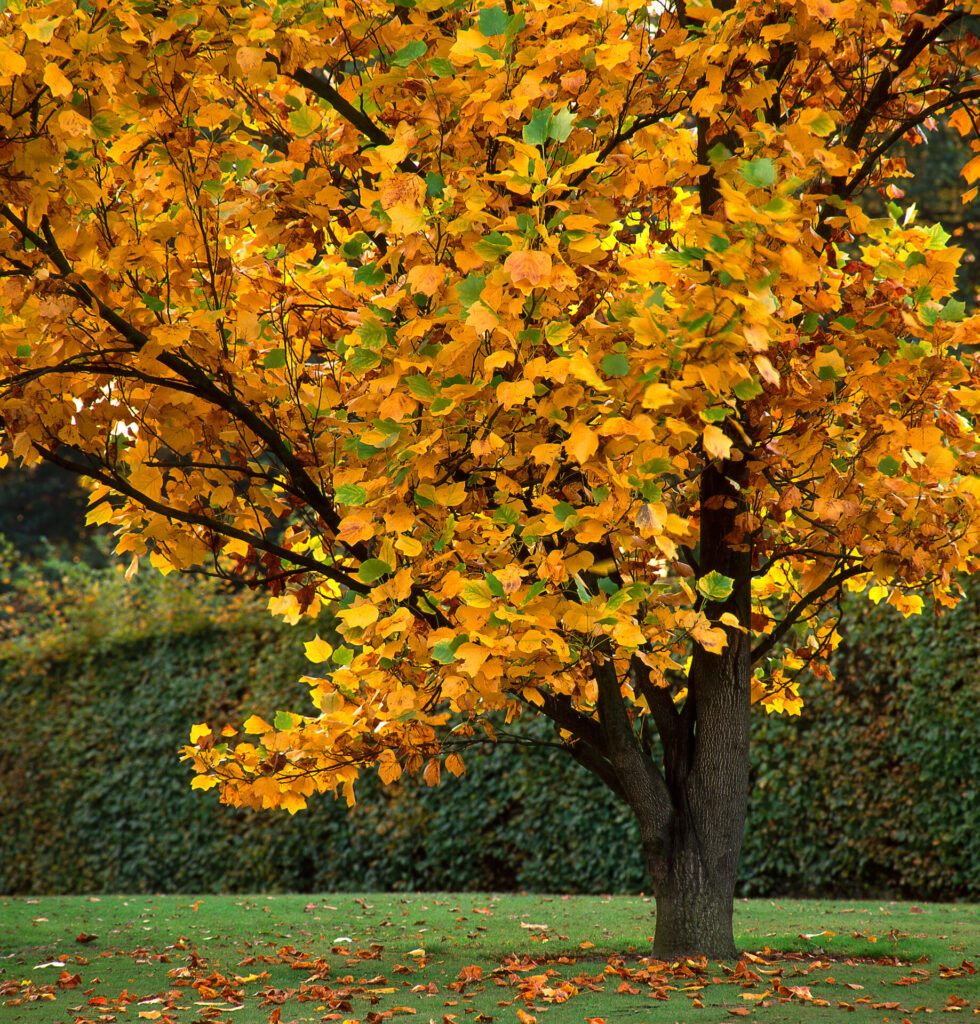
A tulip tree displays rich golden-yellow fall foliage, marking the peak of autumn color before leaf drop.
3. Silver Maple (Acer saccharinum)
Growth rate 36 to 48 inches/year; mature height 50 to 80 feet with a width of 35 to 50 feet; Zones 3 to 9; full sun; can take wet climates. Best when there is an urgent need for shade in wet places and on big properties.
- Problems: extremely poor wood that is readily storm-damaged, vicious root masses on the surface, very short life expectancy (usually 25 to 30 years), and very messy.
- Note: Arborists call it a junk tree but it is only used where you are willing to make trade-offs of great magnitude.
CATEGORY B: BEST FOR PRIVACY SCREENS (Evergreens)
4. Leyland Cypress (x Cuprocyparis leylandii)
Growth 36 to 48 inches/yr; mature 60-70ft high and 15-20ft wide; Zones 6-10; full sun. Most suitable with fast privacy screens and barricades.
- Problems: they are susceptible to cypress canker disease, have a relatively short life (20 to 25 years), and can be unnaturally artificial or monotonous.
- Distance: 8 to 10 ft. between a screen, 15 or more between individual specimens.
5. Thuja Green Giant (Thuja standishii x plicata)
Growth rate 36 to 48 inches/per/year; mature 50 to 60 feet/tall/12 to 20 feet/wide; Zones 5 to 9; full sun to light shade.
- Privacy screens; they are said to be deer-resistant.
- Benefit: as a rule, more resistant to diseases than the Leyland cypress. Distance: 5 to 6 feet to a tight screen, 8 to 10 feet to a loose hedge.
CATEGORY C: BEST FOR SMALL YARDS (Compact Options)
6. River Birch (Betula nigra)
Growth rate 24 to 36 inches per year; matures 40 to 70 feet tall by 25 to 40 feet wide; Zones 4 to 9. Ornamental value is distinctive peeling cinnamon-brown bark with year-round interest; often grown multi-trunk.
- Best for wet areas and as an ornamental specimen.
- Challenges: susceptible to bronze birch borer if stressed. Spacing: 20 to 25 feet from structures.
7. Crape Myrtle (Lagerstroemia indica)
Growth rate 24 to 36 inches/year; mature 15 to 25 feet high by 10 to 15 feet wide (depends upon cultivar); Zones 6 to 9 (most energetic in warmer zones). The summer flowers (pink, red, white, purple), fall color, and good bark are also a part of seasonal interest and most suitable to be used in small yards, patios, and multi-season ornamentation.
- Note: shrubby in colder areas.
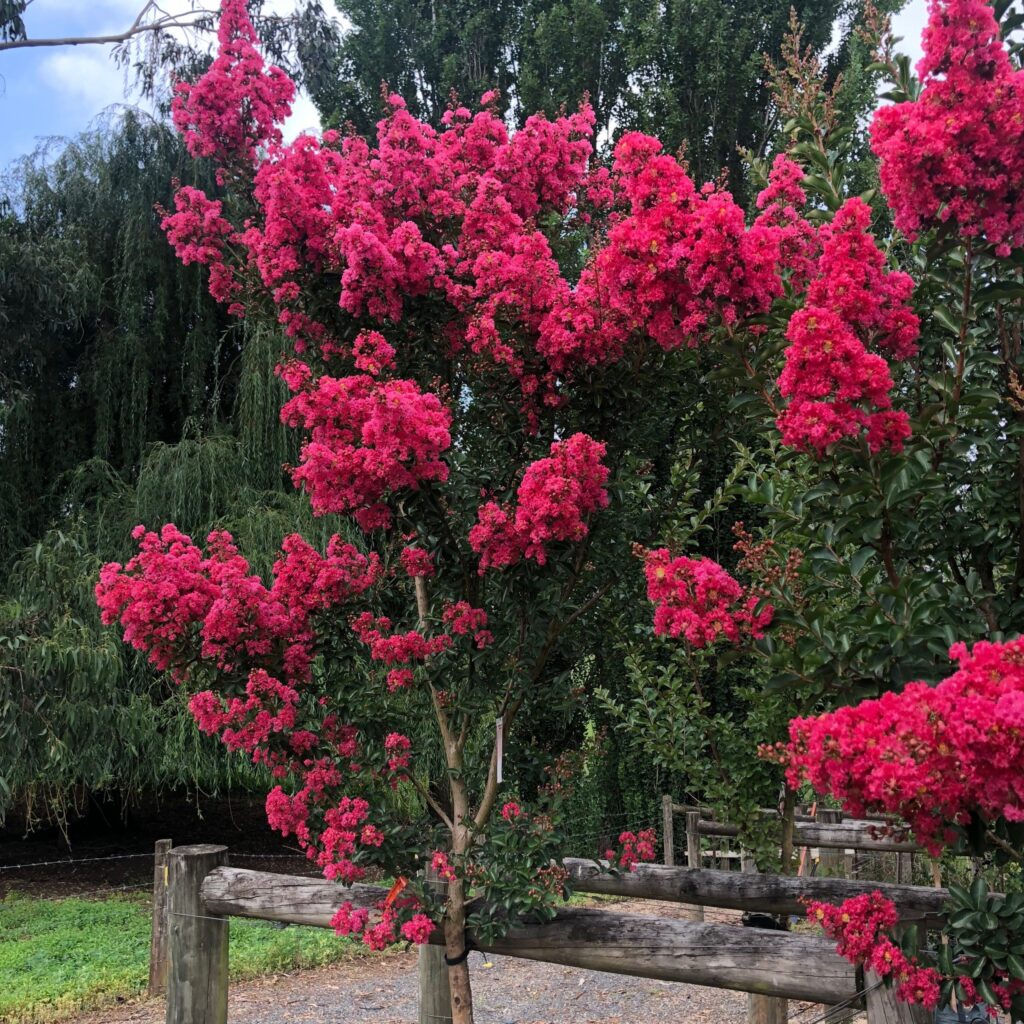
A crepe myrtle covered in dense pink blossoms, creating a striking summer display against lush green surroundings.
CATEGORY D: BEST FOR FLOWERING (Ornamental Trees)
8. Flowering Dogwood (Cornus florida)
Growth rate 12 to 24 inches/year; matures 15 to 30 feet tall, 15 to 25 feet wide; Zones 5 to 9; does not like hot afternoon sun. Seasonal interest comprises spring flowers (white or pink), red fall color and red bird berries. Best understorey planting, 4 seasons of interest and the value to wildlife.
CATEGORY E: FASTEST OPTIONS (Use With Caution)
9. Weeping Willow (Salix babylonica)
Height 36 to 72 inches yearly; full size 30 to 50 ft. high and 30 to 50 ft. wide; Zones 6 to 8. Virtuous close to water features, ponds and wet areas.
- Troubles: highly rotten wood, repeated dropping of branches and leaves, extreme tapering roots which may lead to plumbing difficulties, low life span (30 years or so), extremely untidy.
- Caution: plant only on the condition of great maintenance and cleanup.
10. Hybrid Poplar (Populus deltoides x nigra)
Growth rate 48 to 72 inches a year (usually 5 to 6 feet); mature 40 to 50 feet in height, 20 to 30 feet in width; Zones 3 to 9. Ideal for temporary windbreaks, biomass utilization and in rural areas.
- Problems: frail wood, hostile roots, pest issues, extremely short life (in most cases, 15 to 20 years).
- Note: It is disposed of as a short-term and temporary tree.
How to Choose the Right Tree
Begin with a point of purpose for your site. Shade can be red maple, tulip tree or silver maple. In the case of privacy screening, Leyland cypress or Thuja Green Giant can be used.
Dogwood or crape myrtle would be good as an ornamental. River birch, crape myrtle and dogwood can be used in smaller yards instead of incredibly large canopy trees.
Next, check your USDA Hardiness Zone at https://planthardiness.ars.usda.gov. The zone determines which trees can survive your winters, so treat it as your first filter.
Then evaluate the yard conditions. Survey the space and ensure that the distance is clear from the house, property boundaries, pavements and utilities. Check sunlight: full sun = 6 hours and more, partial shade = less, shade = little direct sun. Soil assessment: clay, sandy or well-drained or wet. Lastly, consider the way the tree will fit with your current landscape which is not only at the present time but also at its full size.
Finally, determine whether to be evergreen or not. Deciduous trees in summer provide shade and are sun in winter and fall color and tend to be less expensive. Evergreens deliver screening throughout the year and they also have winter interest and tend to be more expensive.
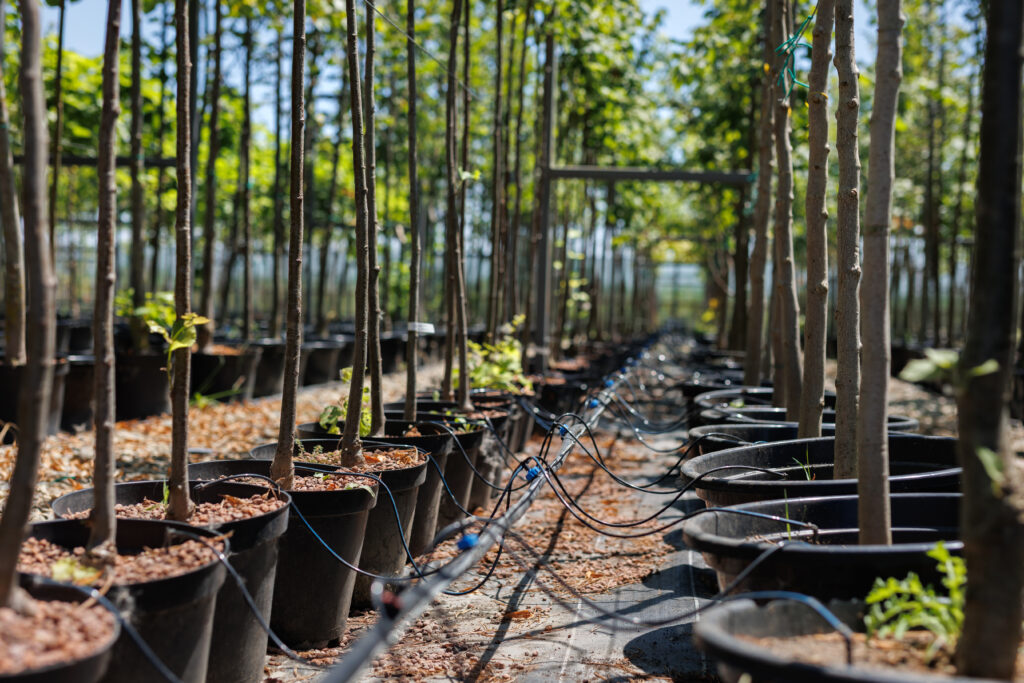
Rows of young nursery trees growing in containers, carefully irrigated and trained for healthy transplanting and future landscape planting.
Planting Quick-Growing Trees
Best Planting Season by Climate
Zones 3 to 5: plant early spring (March to April) before bud break. Zones 6 to 7: fall (September to October) or early spring. Zones 8 to 10: fall and winter (October to February).
Step-by-Step Planting Instructions
- The hole to be dug should be 2-3 times bigger than the root ball and of the same depth, not deeper.
- Rough up the sides of the hole to avoid the encircling of roots.
- Take out the vessel and loosen the roots around.
- Root flare must be placed at or a little above soil level.
- Native soil Backfill, do not make any amendments unless necessary indicated by a soil test.
- Wet the soil completely to get rid of the air bubbles.
- Add a 2-3 inch ring of mulch but leave the mulch 6 inches off the trunk. Stake, however, where necessary, as the natural movement makes the trunk strong.
First Three Years: Establishment Care
- First year is vital: water intensively 1-2 times/week in warm or dry weather, more frequently in hot soil, want 1-2 inches/session with slow wetting; monitor stress signs such as wilting or leaf fall.
- 2nd year plays a crucial role: one should maintain watering but decrease the frequency a bit due to the growth of roots; the removal of stakes is possible.
- Year 3 is set: the tree is supposed to be rather independent with some additional water mostly in the drought period.
Long-term Maintenance
The trees that grow faster mostly require pruning every 2 to 3 years. Its optimum time of application is late winter or early spring when it is in dormancy.
It is better to pay attention to structural pruning to avoid weak unions of branches, since weak wood is easily broken and to avoid the risk of future storms, it is better to prune it off in advance.
Check pests and diseases of trees on a seasonal basis. The problems should be solved early as the trees that grow rapidly may even deteriorate rapidly when they are subjected to pressure.
Hire an ISA Certified Arborist to do a site analysis or tree selection consultation before planting, to have them do routine visits after 3-5 years on fast growers and also in risk assessment as trees approach buildings.
When Slow-Growing Might Be Better
Fast-growing trees are to be used to achieve fast results, though slow-growing trees may be a better option in case you are considering long-term ownership of property of 30 years or more and you are interested in a strong and long-lasting tree of 100 years or more. There is also a better match with slow growers, in case you wish to reduce the maintenance costs of the long term and maximize the storm resistance. They are the best when you desire a heritage or legacy tree that the generations to come will enjoy the benefits of as opposed to a solution that has a shorter lifespan and thus requires a replacement at a faster rate.
Good low-growth choices are oak species, including white oak and red oak, which have life spans of 100 to 200+ years, sugar maple, with spans of 100+ and more, and spectacular fall color, and American beech with life spans of 200+, and smooth gray bark.
The best results are gained when many homeowners combine the strategies whereby a fast grower is used in near-term requirements and a slow grower is used in long-term landscape structure.
Conclusion From KD
Sometimes, the results of using quick-growing trees can be impressive in just 10 to 15 years instead of 30 to 40 because trees that grow very slowly provide all the benefits (shade, privacy, mature landscapes) far faster.
Speed has disadvantages such as reduced life, reduced strength of wood, superficial rooting, increased messiness and more frequent pruning. Which of them is the best option depends on your purpose, USDA zone, the available space, and whether you will keep the tree long enough.
When they are properly planted, they are watered for the first three years of establishment and their structure is pruned proactively; all high-impact trees can be a smart investment that grows fast. The most secure way to go in planting near structures or long-term screening and shade is most of the time professional consultation.