
Seattle property owners usually have to replenish trees once they have been cut. The urban canopy is preserved by the requirements of replacement plantings in urban areas.
Quick Links: Tree Selection Resources
Explore these official resources to select the perfect native tree for your Seattle property. Click any link below to access comprehensive guides and tools.
-
King County Native Plant List
Comprehensive database of native plants with photos, growing requirements, and ecological information. Our primary resource for clients.
-
Trees of Washington State (WFPA)
Beautiful photography and detailed species descriptions. A favorite resource for understanding native trees and their natural habitats.
-
WA Native Plant Society Directory
Ecological information and trusted nursery sources for native plants. Essential resource for finding quality native specimens.
-
SDOT Tree Selector Tool
Interactive tool for Seattle right-of-way planting with approved species lists and site assessment guidance. Required for SDOT projects.
-
King County Tree Planting Guide
Quick overview of tree selection and planting best practices from King County’s sustainability program.
This manual will offer the necessary facts on regulations, schedules, and alternatives. Blooma Tree is on your side to make the process of replanting seem easy-going, with compliance, and help Seattle towards a green future. We have all the information right here with you.
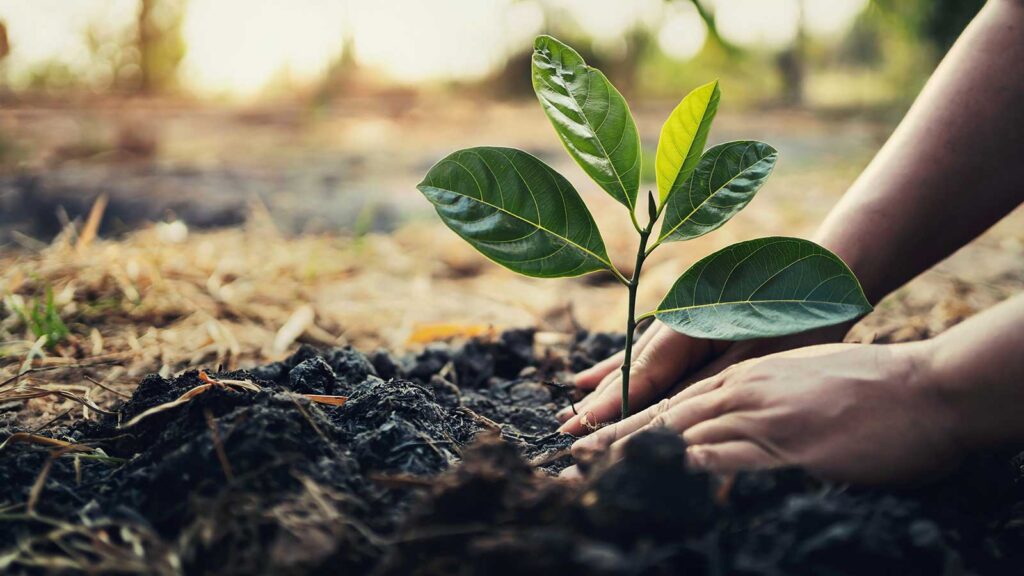
Planting a young sapling in rich soil to support its growth and development.
When Do You Need to Replant After Tree Removal?
The process of tree replacement in Seattle is presented by the codification of the city, according to which trees falling under certain size and location criteria have to be replaced.
Usually, a 2:1 or 3:1 replacement ratio is needed, which is the number of new trees needed to replace a mature tree taken out, usually 2-3 trees. But there is no need to replant in situations where a tree is diseased or where it is dangerous.
Different neighborhoods of Seattle have different requirements and some of them have extra ordinance requirements especially when it comes to extraordinary trees whose value is unusual. The property owners have a role to comply with such as by providing the required documents for tree removal permits.
The Seattle Department of Transportation (SDOT) also has its own methods of removing and replacing trees in the right-of-way, which encompasses both street trees or other trees in a piazza.
The rules that determine when timelines will be replanted include the type of tree, the area and the regulations in the neighbourhood. These needs are important and need to be addressed in time so as to avoid punishment. Blooma Tree is on board to walk you through the procedure and with the codes required in the city, by the law, and with your landscaping program.
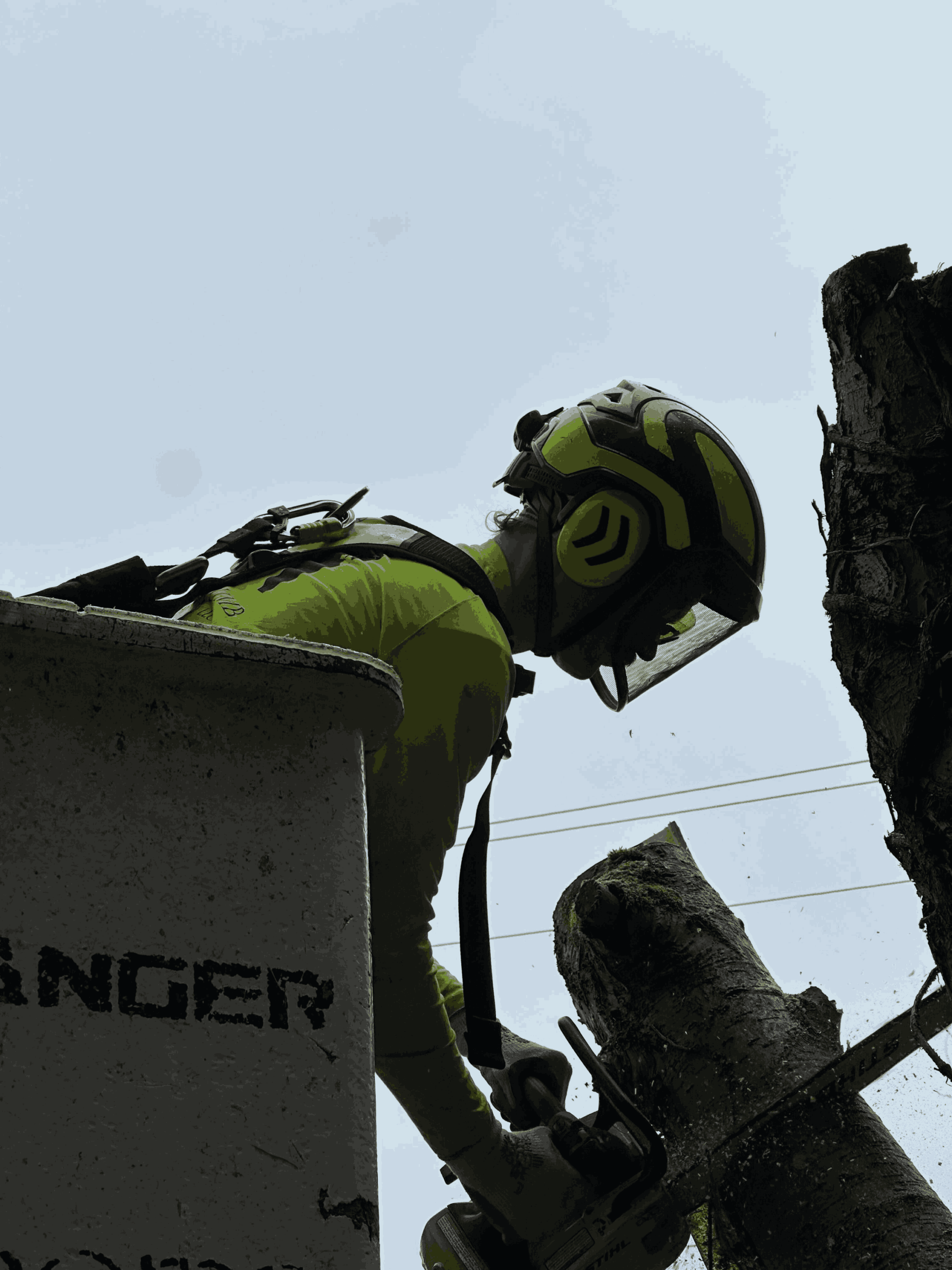
Blooma Tree Professional Arborist performing tree removal with safety gear and equipment.
Choosing the Right Native Tree for Your Property
Selecting Native Trees for Seattle’s Climate
The decision of selecting the correct tree to be used in your Seattle house is an ecologically friendly choice. The climate of Seattle favors native trees, which have a number of benefits. They are acclimatized to the climate of the Pacific Northwest, such that they are strong and need minimal maintenance when established.
Native species also provide a level of support to the local wildlife, birds and pollinators to improve the ecosystem. They also use less water and are more resistant to diseases and hence a sustainable option.
Why Choose Native Species?
The native trees do well in the climate of Seattle and do not require heavy irrigation to survive during rainy winters and dry summers. They sustain important habitats to the local wildlife such as birds and pollinators. When introduced, they need less water and pesticides than non-native species. The native trees are also more resilient to the diseases of the region and thus they facilitate the long-term well-being of your landscape.
Key Factors to Consider When Selecting Your Tree
It is important to consider such factors as the sun exposure, the height of the trees after growing and the rate of growth when selecting a native tree.
There are trees that love full sun and others that are shady. It is important to consider the height of the tree when it grows up so as not to conflict with the utilities or the foundation of your home.
The rates of growth of the trees are different, and there are those that grow fast and those that grow slowly, which impacts the long-term maintenance. There are also the aesthetic tastes, such as evergreen or seasonal interest and deciduous.
The location factors, including the soil type, drainage and space, are vital. Certain trees need well-drained soil, whereas others survive in a wet environment. Think of the wildlife worth of the tree, planting those species that will appeal to the birds and the pollinators.
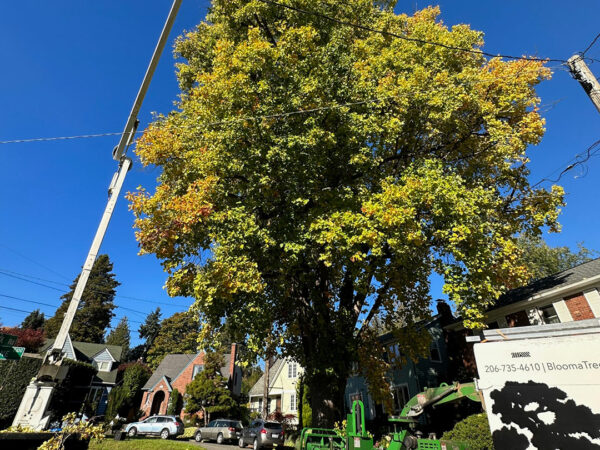
Blooma Tree team using equipment for tree care in a residential area.
- Expert Advice: Before choosing a tree, consider overhead utilities, underground services and distance to buildings. Blooma Tree can be used to assess your location and give suggestions on the most suitable species. Call (206) 714-9835 for a consultation.
Large Native Trees (Over 75′ Mature Height)
On larger estates, enormous native trees are used to produce a dramatic effect that brings beauty throughout the year and provides environmental values.
Bigleaf Maple (Acer macrophyllum) – 100′
Bigleaf Maples are large, with gold and yellow fallen leaves and like the trees they find in the sun or shade, they flourish in the fall and are beneficial to wildlife besides enhancing the quality of soil.
Douglas Fir (Pseudotsuga menziesii) – 250′
Growing quickly, the trees are used as a year-round privacy and for the vertical interest and they seed well in full sun to part shade.
Western Red Cedar (Thuja plicata) – 200′
These trees are culturally relevant and have a rot-resistant aroma of wood and grow in a vertical manner and thrive in well-drained and moist areas.
Red Alder (Alnus rubra) – 120′
Red Alders are a fast-growing plant that fixes nitrogen in the soil, which grows in sunny spots and also gives immediate outcomes.
Medium Native Trees (30-75′ Mature Height)
Medium-sized trees will be a compromise of privacy and shade without casting too much shade on smaller areas.
Garry Oak (Quercus garryana) – 75′
Slow-developing, old-fashioned oak that hosts the natives, can grow in the sun to clear the shade and can adjust to different soils.
Pacific Madrone (Arbutus menziesii) – 60-90′
An extremely beautiful evergreen with scaly red bark and white blossoms, grows in the sun to part shade and in well-drained soil.
Pacific Dogwood (Cornus nuttallii) – 60′
This tree is a beautiful spring bloomer and has a fall color and it can be used in part shade and has cultural value to your landscape.
Cascara (Rhamnus purshiana) – 30′
This is a small, medicinal understory tree that provides habitats to the birds, which grows well in the sun to shade.
Small Native Trees (Under 30′ Mature Height)
Small native trees are ideal in small lots; they are beautiful and have the advantages of the bigger trees, and take up less space.
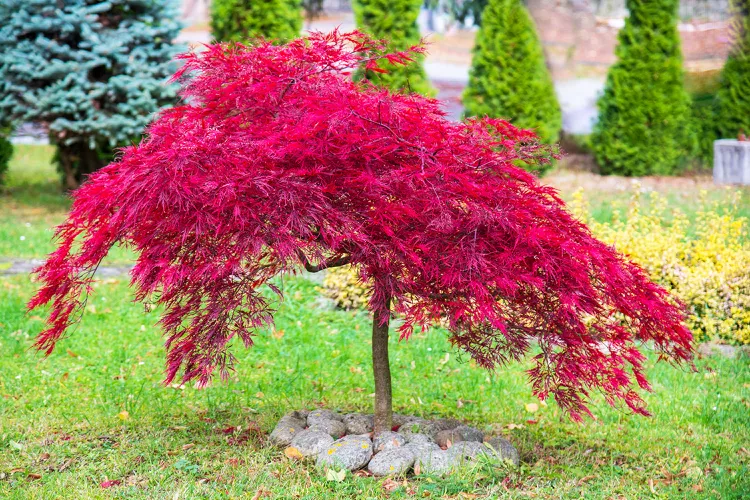
Japanese Maple tree showcasing vibrant red foliage in a garden.
Vine Maple (Acer circinatum) – 25′
Vine Maples are brilliantly colored in the fall and are multi-stemmed and can be used in smaller city lots in part shade.
Pacific Crabapple (Malus fusca) – 40′
This tree is sun-loving, as it sprouts winter-feeding fruit and wildlife benefits, and it is aesthetically attractive and ecologically valuable in providing shade in the upper part of shaded areas.
Bitter Cherry (Prunus emarginata) – 30′
It is a smaller tree, which flowers early in spring and serves to provide shelter to wildlife in the sun to part shade, as well as draw pollinators.
- Design Note: To make these species easier to find, it may be a good idea to make a simple sortable table or visual grid of these species containing icons of sunlight preferences and other important characteristics such as growth rate and wildlife value.
Official Resources & Tree Selector Tools
Expert Resources for Seattle Tree Selection
To make a good choice of replacing the tree in your Seattle property, we have created a list of credible government resources. Such tools provide in-depth data regarding indigenous species, their needs, and characteristics to make an informed decision.
The King County Native Plant List is an extensive plant database containing the native plant data with growing needs, photographs and ecological data. It enables you to sort species by the amount of sun and moisture required and the value of wildlife.
Trees of Washington State by the Washington Forest Protection Association provides captivating photography and detailed species descriptions and it is not hard to learn the nature of native trees and their habitat.
The Washington Native Plant Society Directory gives ecological background as well as a list of reputable nurseries of native plants.
In the case of Seattle and its right-of-way planting, the SDOT Tree Selector Tool should be used. This interactive application provides an accepted species list and site evaluation advice.
Native Tree Planting Quick Reference
At-a-Glance: Native Trees by Growing Conditions
Here are some tips and tricks to make the right choice of the native tree depending on the conditions of your site:
To be in full sun, Douglas Fir, Garry oak, Quaking Aspen, Shore Pine, or Western Larch would be a good choice. These trees are grown in open areas and offer permanent beauty.
To be used as a shade, use Western Hemlock, Western Red Cedar, Vine Maple, Pacific Yew or Grand Fir. These trees are very adaptive to the shady areas and have good ecological values.
On any small urban lot, use small trees such as Vine Maple, Pacific Crabapple, Bitter Cherry, Pacific Yew or Douglas Maple. These species provide the advantage of bigger trees in a smaller structure.
Rapidly growing trees such as Red Alder, Black Cottonwood, Paper Birch and Douglas Fir will soon give the area shade and attractiveness.
To have greenery throughout the year, evergreens should be Douglas Fir, Western Red Cedar, Western Hemlock, Grand Fir, Shore Pine, or Pacific Madrone.
Finally, to preserve the value of wildlife, choose trees such as Garry oak, Pacific Crabapple, Bitter Cherry, Pacific Dogwood, and Red Alder that are preferred by the birds and pollinators.
Downloadable Reference Guide
You may download our Native Tree Reference Guide to help you select a tree. This sheet contains a list of 30 suggested species to plant in the Seattle area that provides data on mature height and sun exposure needs, among other details. This source will enable you to make the most appropriate decision regarding your property.
The guide has trees that have been purchased in King County, Snohomish Conservation District, WSU Extension, and the Washington Native Plant Society.
Professional Planting & Consultation Services
Let Blooma Tree Help You Choose & Plant
Blooma tree has ISA Certified Arborists who offer professional site evaluation to advise on native species that are healthy on your site. To provide successful planting services, we provide professional planting services, ensuring the correct planting of the tree and assist in getting through the requirements of the city permits. We guarantee the long life of your tree through our continuous care programs with regular checking and maintenance of your tree to keep it healthy.
Contact Information:
Phone: (206) 714-9835
Email: [email protected]
[Schedule a consultation]
For more information, visit our tree planting services, consultation/assessment services, and ongoing tree care services pages.

Supporting Seattle’s Urban Forest
Native trees are needed in the ecosystem of Seattle as they provide a home to wildlife, as well as improving the quality of air and beautifying the city. Blooma Tree focuses on offering science-based and holistic tree maintenance in order to maintain the well-being of the urban forest in Seattle. We will maintain this resource accordingly and enable you to make wise decisions. Contact us in case of any questions. We’re here to help!