
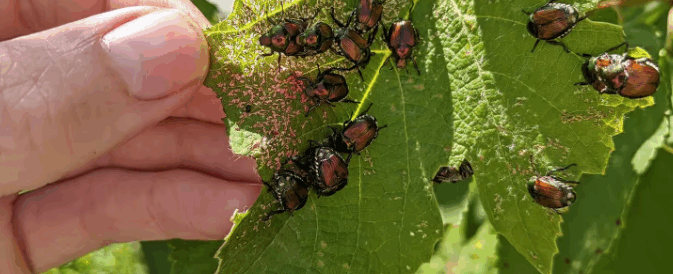
Japanese beetles (Popillia japonica) are considered to be among the most destructive garden pests in North America, with immense destruction of ornamental plants, fruit trees, turf grasses, and crops. Behind them, they can abandon withered flowers, skeletonized leaves, and parched lawns.
Questions that are frequently posed to both the homeowners and the farmers include what the Japanese beetles find attractive and why some properties have been more infested by them than others. The point is that beetles are drawn by a complex of biological, chemical, and environmental conditions, and it is important to know how the attraction occurs to prevent infestations and design an effective pest control program.
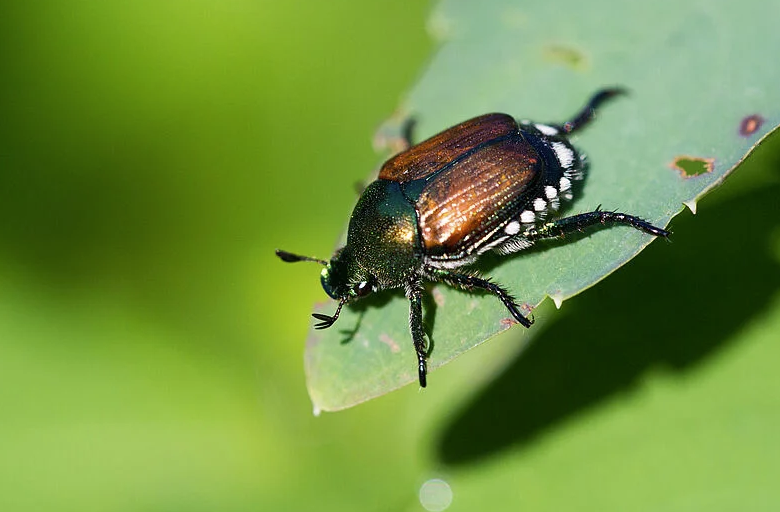
Figure 1. Japanese beetle (Popillia japonica) feeding on a leaf, showing its metallic green head, coppery wing covers, and characteristic white tufts along the abdomen. (Image Credits: koppert.com)
What attracts Japanese Beetles?
Japanese beetles are also highly sensitive to sensory data, they utilize pheromones, chemical cues, and visual cues to locate food and mates. Pheromone attraction is the most significant process. When a group of beetles starts feeding on a host plant, they also release aggregation pheromones that will attract other beetles in the area within hours. One feeding group can accommodate ten to fifty newcomers within a limited time, and as the population increases, the severity of pheromone release increases exponentially, producing a daisy-chaining effect. This is why infestations tend to burst after some time.

Figure 2. Japanese beetle (Popillia japonica) feeding on flower clusters, drawn by the plant’s floral volatile and its natural preference for bright, sunlit blooms. (Image Credits: abctermite-pest.com)
Plant-released chemical signals also significantly contribute to the attraction of Japanese beetles. Stressed leaves secrete volatile compounds as a kind of distress signal, and beetles have co-evolved to read these as indicating food.
After a couple of beetles have started to feed, the chemical signals of the beetles and the damaged plants interact to form an effective attraction zone. These mechanisms are supported by the visual cues. Bright sunlight and light surfaces are very appealing to the beetles and facilitate their ability to trace the plants.
They have very sensitive organs that pick up pheromones and volatile cues that can be detected over a distance of two miles and that is why they are very effective in identifying good places to feed.
- Maximum attraction is usually noted in sunny mornings where the temperature is above 80°F, as the beetles are most active then and the dispersion of the pheromones is also the strongest.
Environmental Factors That Attract Japanese Beetles
In addition to pheromones and plant chemistry, environmental conditions define the level of activity and destructiveness of the beetles.
- It has been found that Japanese beetles become three times more active on sunny days with temperatures between 75 and 85°F than on cool or overcast days. They prefer temperatures of 75 to 95°F with slow activity at temperatures of 70°F or below and slow feeding at temperatures of 100°F or higher.
Especially important is sunlight, because beetles seldom flock in shady places. Beetles are also more active on calm weather days, as aggregation pheromones diffuse more effectively when there is only still air. Conversely, when the weather is windy, chemical plumes are scattered, and beetles can no longer easily find appropriate feeding areas.
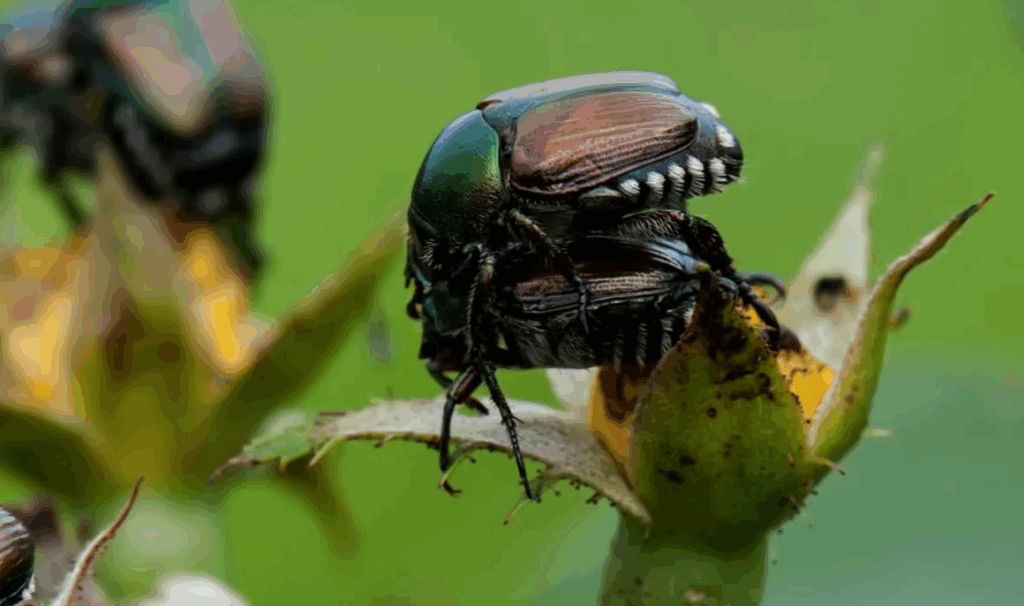
Figure 3. Groups of Japanese beetles feed on rose buds, with activity heightened under warm, sunny conditions that favor pheromone dispersal and mass aggregation. (Image Credits: saferbrand.com)
Humidity, too, plays a role in beetle behavior, with the highest rates of activity being supported by moderate levels of humidity (between 40-70 per cent). Feeding habits are also influenced by the time of day.
Beetles hatch in the morning sun, are most active in the late morning and early afternoon, and disappear somewhat in extreme afternoon heat. At the seasonal level, the most hazardous period is between late June and August, when adults emerge, mate, and feed aggressively, then lay eggs in lawns and turf.
What Plants Attract Japanese Beetles Most?
Although Japanese beetles feed on more than 300 plant species, they are much more attracted to certain plants than to others. Infestations of roses, grape and linden trees are at least 70 per cent higher than those of other common landscape plants.
- Linden trees of various kinds (particularly American and littleleaf) are regularly among the most sought-after hosts, frequently being heavily skeletonized.
- Another good target is Japanese maples due to their fragile foliage. All types of rose bushes, especially hybrid teas and climbers, are the target of a large number of beetles and tend to suffer severe feeding damage in midsummer.
- Fruits (such as apples, cherries, peaches, and plums) and fruit trees are also common victims, and birch trees (including river birch and paper birch) are particularly susceptible to high feeding pressure in most areas.
- Grape vines are both ornamental and fruit-bearing, which makes them a target for very large populations of beetles and hence one of the crops most at risk.
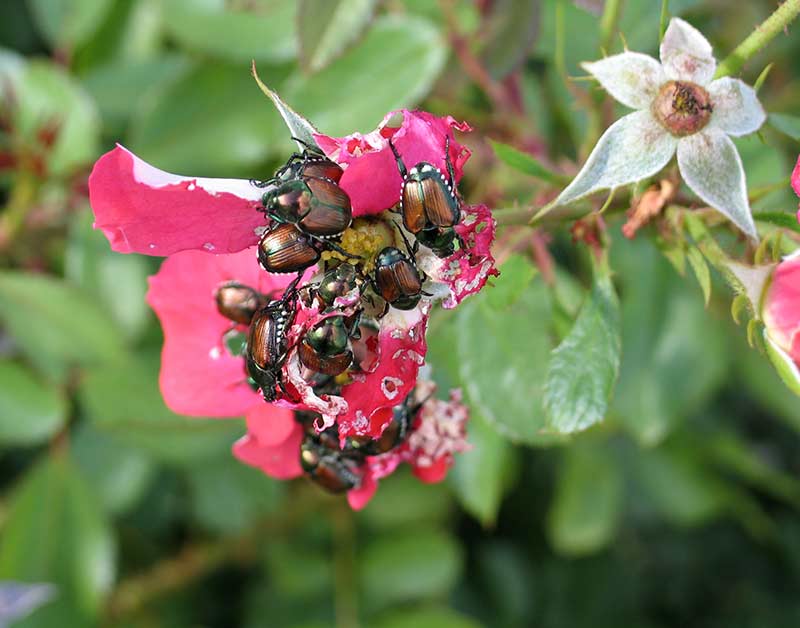
Figure 4. A cluster of Japanese beetles feeding on rose petals, with roses being among the most attractive and heavily infested host plants in gardens and landscapes. (Image Credits: gardentech.com)
- Flowers and ornamental plants provide additional sources of attraction. Hollyhock is a major summer host, while hardy hibiscus varieties suffer extensive skeletonisation damage to both flowers and foliage.
- Four o’clock flowers are unusual in that they attract beetles during the evening, while smartweed species serve as frequent wild host plants. Evening primrose is also targeted, with beetles consuming both the petals and leaves.
- Sassafras trees that are native to the area tend to be heavily infested with pests. Collectively, this combination of plants creates a diverse and perilous palette of hosts that will transform any garden into a beetle haven.
What Plants Do Japanese Beetles Eat?
Japanese beetles are not only evidently selective in their choice of host plants, but also exhibit a characteristic feeding behavior. They are often known to skeletonize leaves, feeding on the soft tissue between veins and leaving the leaf with a lacework-like structure.
Light feeding can at first seem like cosmetic damage. Still, as an increasing number of beetles are attracted by the pheromones, it becomes apparent that the damage can quickly escalate into a stage of severe defoliation. In severe situations, the foliage of whole plants can be removed in as little as two to three weeks.
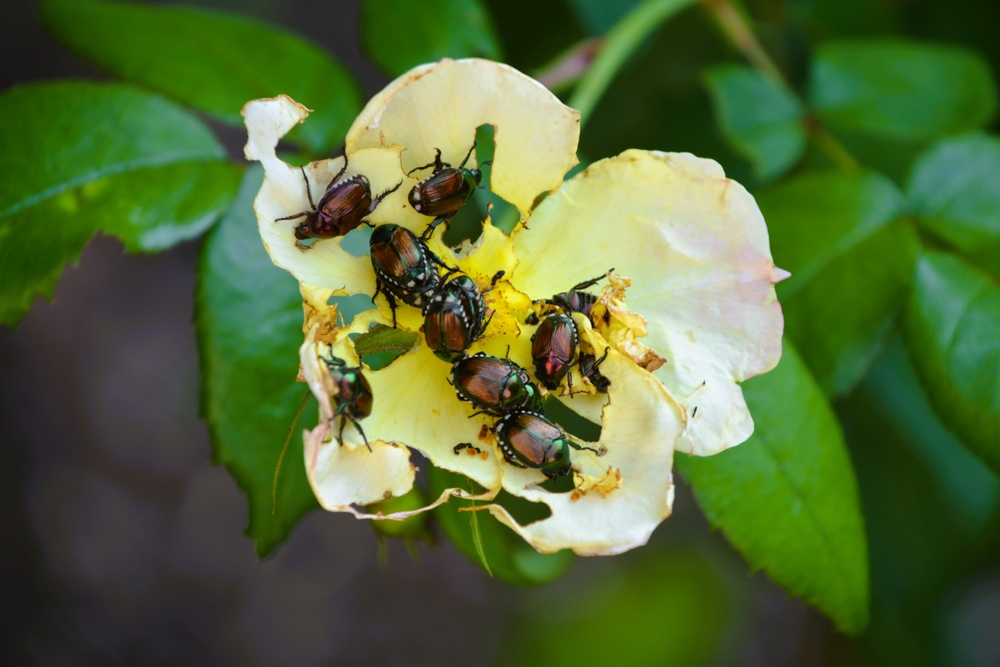
Figure 5. Japanese beetles feed on the petals of a rose flower, leaving behind characteristic skeletonised damage that highlights their preference for tender leaves and light-colored blooms. (Image Credits: Photo: Mike Hill Photography)
Leaves of young and tender growth, especially, are lovelier than darker ones, and beetles attack flowers, too, favoring those of a light tint. Rose, hibiscus, and primrose petals are often torn off as they are trampled in feeding sprees.
There is also a threat from soft fruit, such as raspberries, grapes, and peaches, which frequently suffer direct feeding damage, ruining their appearance and taste.
- The collective effect of such feeding behaviors is colossal, and Japanese beetles are estimated to cause over $ 460 million in damage to crops, fruit orchards, and ornamental landscapes in the United States every year.
Plants Japanese Beetles Avoid (What to Grow Instead)
Not every plant is a target. Japanese beetles consistently pass over a group of species, so if they’re a yearly problem in your yard, leaning new plantings toward these gives the beetles less to land on.
| Beetles love these (susceptible) | Beetles avoid these (resistant) |
|---|---|
| Roses, grapes, lindens | Red maple, boxwood, flowering dogwood |
| Birch, Japanese maple, crabapple | Magnolia, lilac, oak |
| Purple-leaf plum, Norway maple | Redbud, forsythia, spruce, pine |
You don’t have to rip out your roses. It’s about what you add next. If you’re choosing a new specimen tree or filling a bed near plants that already get hammered, picking from the resistant column means you’re not setting another dinner table. A red maple or a dogwood will sit untouched three feet from a rose bush covered in beetles.
Japanese Beetles and Roses: Why Your Bushes Get Hit First
Roses are at the very top of the Japanese beetle menu. If you grow them, they’ll be the first plant attacked and the worst damaged. Beetles are drawn to the flowers’ scent and to the soft, thin tissue of the petals and leaves, and once a few land, the feeding-damage scent pulls in dozens more.
- You’ll see two kinds of damage. On the leaves, skeletonizing: they eat the green tissue between the veins and leave a lace skeleton behind. On the blooms, ragged holes chewed straight through petals, usually starting with the lightest-colored flowers. White and pale pink take more hits than deep red, in my experience.
What actually works on roses, in order of how much I lean on each:
- Hand-pick in the early morning. Beetles are sluggish before the day warms up. Knock them into a jar of soapy water. Do it daily for the two peak weeks and you break the feeding-scent feedback loop that recruits more beetles. Tedious, but on a few prized bushes it’s the single most effective thing you can do.
- Skip the pheromone traps near the roses. This is the mistake I see most. A trap baited with floral lure and sex pheromone pulls more beetles into your yard than it catches. If you use traps at all, put them at the far edge of the property, downwind, never beside the plants you’re protecting.
- Don’t let damaged blooms sit. Deadhead chewed flowers and clear fallen debris. The damage scent is an advertisement, so remove it.
- Consider what’s under the roses. Beetles lay eggs in nearby irrigated turf. A rose bed ringed by lush, watered lawn is a nursery. Letting that turf dry slightly in July makes it a less attractive egg site.
For heavily infested roses where hand-picking can’t keep up, a targeted foliar treatment applied in the evening (when pollinators aren’t active) is the next step. But that’s a call worth making with an arborist rather than blanket-spraying a garden full of beneficial insects.
Chemical Attractants and Pheromones
The scientific version of why beetles are attracted has to do with the synergy of pheromones released by beetles and the chemistry of plants. Releasing aggregation pheromones during feeding and mating can attract beetles over a distance of two miles.
- The release of these pheromones into the environment may increase beetle density by 1000% in feeding sites. Damaged plant material also helps because it produces volatile chemical compounds that serve as attractants, signaling the availability of vulnerable plants to local beetle populations.
A combination of beetle pheromones and plant volatile produces a very strong attraction that can turn one infected plant into a mirage of hundreds of beetles.
Applications of this science in commercial settings include pheromone traps, which use synthetic attractants to lure beetles into collection bags. These traps are effective in checking the population level, they must be placed in a strategic location. If they are incorrectly set near vulnerable vegetation, they may actually escalate the infestation level in the area instead of reducing it.
Why Do I Suddenly Have So Many Japanese Beetles?
A sudden swarm almost always comes down to three things stacking up: a warm, wet early summer that boosted grub survival, an irrigated lawn that gave females an ideal place to lay eggs last year, and a favorite host plant that’s now broadcasting a feeding scent. You’re not unlucky. Your yard is a good habitat, and the beetles found it.
The “where did these come from” question has a longer answer. Japanese beetles aren’t native. They arrived in New Jersey around 1916, almost certainly as grubs in the soil of imported nursery stock, and spread across the eastern U.S. from there. In the Pacific Northwest they’re still a newcomer and populations remain limited, which is exactly why a spike here is worth reporting to your state agriculture department.
But the reason your yard suddenly has a lot of them this year usually traces back to last year:
- You watered through the drought. Females need moist soil to lay eggs. During a dry July, the greenest lawn on the block is the only good nursery around, so every beetle’s offspring ends up in your turf.
- The winter was mild. Grubs overwinter in the soil. A hard freeze kills some; a warm winter doesn’t. More survivors means more adults the next June.
- You already have the plants they love. Roses, lindens, grapes, birches, and Japanese maples all pull beetles in. Once feeding starts, the damaged-leaf scent recruits more, and a handful becomes a cloud within days.
- A neighbor put up a beetle trap. Traps attract far more beetles than they catch. One in the yard next door can seed your garden.
The uncomfortable truth: the beetles you’re fighting in June were decided last August. Real control is a twelve-month game. Manage the grubs in the lawn in late summer, and next year’s swarm is smaller before it ever takes flight.
Lawn and Turf Grass Attraction for Egg Laying
Japanese beetles do not confine themselves to foliage and fruit. Their reproduction causes serious damage to the lawn and turf because females prefer to lay eggs in well-maintained and humid lawns.
Research indicates that more grub population can be supported in an irrigated lawn than in drier regions. Kentucky bluegrass, perennial ryegrass, and tall fescue are particularly popular grass species on which eggs are deposited.
Soil conditions matter as well. Beetles of the female species prefer places where the soil is humid and the temperature does not exceed seventy-eight degrees Fahrenheit, as such conditions are best suited to provide proper growth of eggs and larvae.
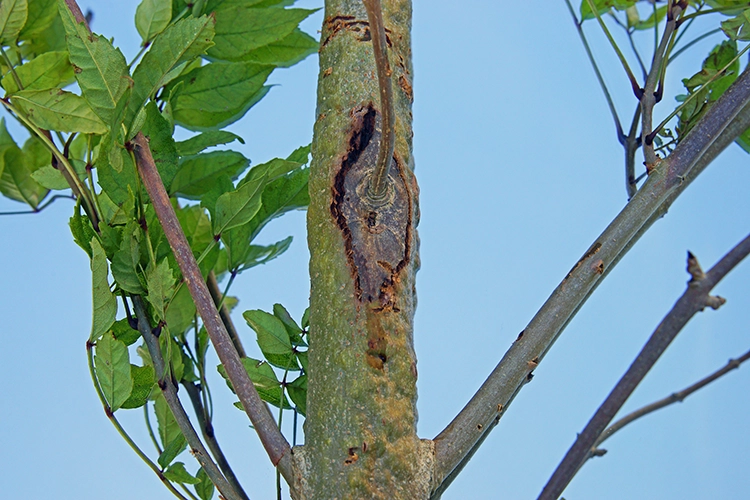
Figure 7. Illustration of the Japanese beetle life cycle, showing how females lay eggs in moist, well-maintained turf during midsummer, with grubs developing underground and feeding on grass roots before emerging as adults.
Eggs hatch in late summer into grubs that immediately start feeding on grass roots, killing them and forming large, brown patches that are easily pulled up by hand. These patches are particularly conspicuous the following spring, when feeding by the grubs increases. To homeowners spending large sums of money to maintain their lawn, the irony is piercing: the greener and more watered the grass, the more appealing it is to egg-laying beetles.
When Are Japanese Beetles Most Active?
Adult Japanese beetles are most active from late June through August, peaking on warm, sunny days between about 9 a.m. and 3 p.m. when temperatures sit in the 80s and the air is still. A single adult lives four to six weeks. The swarm you’re looking at now will be gone by early September, but it laid the next generation in your lawn on the way out.
That midday timing matters more than people expect. Beetles feed in the open, on the sunny side of a plant, and they feed in groups because the damage itself releases plant volatiles that call in more beetles. Go out at 7 a.m. and the same rose bush looks fine. By noon it’s covered.
Here’s the part that catches gardeners off guard. The beetles you see are only the visible half of the calendar. Underground, the grubs run on a completely different clock.
- Late June to August: Adults emerge, feed, and mate. This is the window you notice.
- July to August: Females burrow two to four inches into moist turf and lay eggs, 40 to 60 each.
- August to October: Eggs hatch into grubs that feed on grass roots until the soil cools.
- Winter: Grubs move deeper and go dormant.
- Spring: They rise back toward the surface, feed briefly, pupate, and the cycle restarts.
So if you want fewer adults next July, the move isn’t spraying in July. It’s treating the lawn for grubs in late summer, when the new larvae are small and near the surface. Miss that window and you’re just knocking down adults one handful at a time.
How long do Japanese beetles stay around? About six to eight weeks of adult activity per season in a given yard. The individual beetles cycle through in four-to-six-week lifespans, but overlapping emergence stretches the visible infestation across most of summer.
In the Pacific Northwest specifically, this timeline is worth watching closely. Established populations here are still limited and under state monitoring, so an early-season sighting is worth reporting, not just spraying.
How to Get Rid of Japanese Beetles
Beetles can be eliminated only with the combination of physical, biological, and chemical measures, as soon as they are established. Picking beetles in the cool morning hours is one of the easiest and most effective short-term control measures against them.
Beetles can be completely exterminated by covering plants with row covers or fine mesh netting during times of peak feeding. To control grubs in the long term, useful nematodes, such as Steinernema species, may be introduced into the soil, which decreases the numbers of grubs by 70-80%. Milky spore (Paenibacillus popilliae), a naturally occurring soil bacterium, is the other long-term grub treatment. It works slowly, building up in the soil over two to three seasons, but once established it keeps suppressing grubs for years.
For knocking down adults on contact, products with carbaryl (Sevin) protect for one to two weeks, while pyrethroids such as bifenthrin, cyfluthrin, or deltamethrin hold for two to three. Neem oil (azadirachtin) is the botanical option: it only lasts three to four days, so it needs reapplying, and it should go on after sundown when bees have stopped working. Whatever you use, never spray open blooms, and treat spots rather than the whole yard.
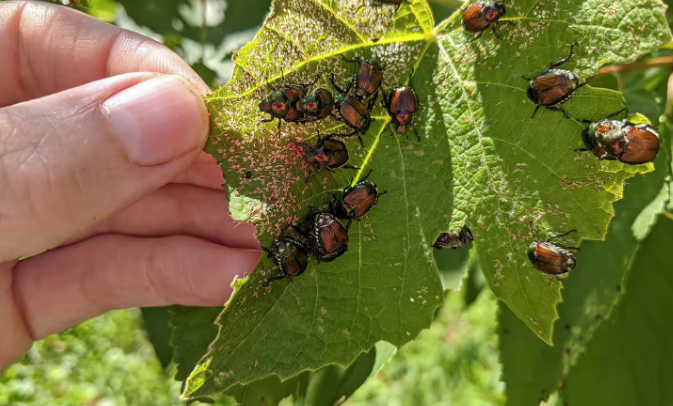
Figure 8. Japanese beetles eating grape leaves, with large-scale skeletonisation damage; this can only be effectively controlled by using a combination of measures, which may include hand-picking, beneficial nematodes, target sprays and proper timing of treatment. (Image Credits: homedepot.com)
Systemic products such as imidacloprid soil drenches offer season-long control of high-value plants, but because imidacloprid is a neonicotinoid that moves into flowers and is toxic to bees, keep it off anything in bloom and off plants pollinators visit. On flowering plants, reach for it last, not first.
Attractive plants should not be put in pheromone traps since they attract beetles to areas where they are likely to be attacked. By combining all these measures at the time when beetles are most active in late June and July, an 85-90 per cent reduction in the population is possible, and the danger of infestations developing in the long term is much reduced.
- What doesn’t work, whatever the internet says: garlic and hot-pepper sprays, orange peels, and companion planting for repellence. University trials have tested these for decades and they don’t hold up. Skip them and put the time into hand-picking and late-summer grub control instead.
Are Japanese Beetles Poisonous or Harmful?
No. Japanese beetles are not poisonous, they don’t bite or sting people or pets, and they carry no venom. They’re harmless to touch and safe to pick off by hand. A dog that eats one might get a mildly upset stomach from the hard shell, nothing worse. The real danger is to plants, not people.
- Where the “dangerous” reputation comes from is the damage they do to a garden. A group of beetles can skeletonize a rose bush or strip a linden’s canopy in a few days, and repeated defoliation over several seasons weakens or kills a tree. So they’re destructive, just not to you.
Two related worries worth clearing up:
- Do they bite? No. Their mouthparts are built to chew leaves, not skin. What feels like a “bite” is usually the tiny hooks on their legs gripping as they crawl.
- Are the grubs harmful? Only to your lawn. The larvae eat grass roots, which is what turns turf brown in patches, but they pose no threat to people or pets either.
If you’re picking beetles off plants with bare hands, the worst you’ll get is the faint smell they release when handled. Soapy-water bucket, no gloves needed.
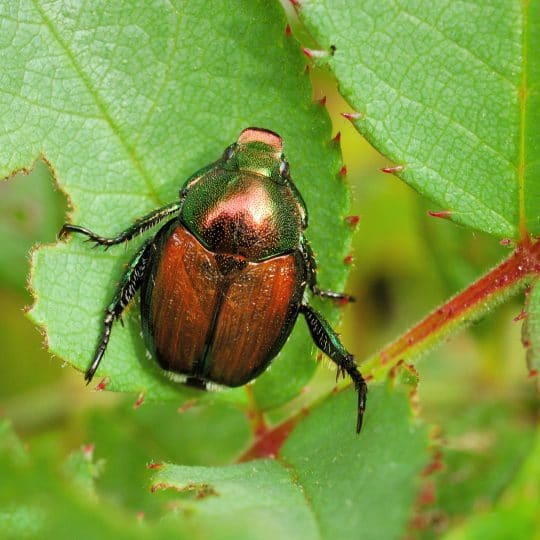
Figure 9. Japanese beetle on a rose leaf; these beetles are not poisonous or harmful to people or pets and present no direct health risk, but can cause serious damage to plants.
The real harm lies in their economic and ecological effects. In addition to depriving farmers of hundreds of millions of dollars annually in agricultural revenues, beetles destroy ornamental and native plants, leaving them vulnerable to diseases and secondary attacks.
They also disrupt the ecosystem by destroying the power of the native vegetation. To the property owners, the impacts include ruined landscapes, damaged fruit harvests, and deteriorated lawns.
Why Do Japanese Beetles Keep Landing on Me?
If beetles seem to swarm you specifically, it’s almost never about you. It’s about what’s nearby or what you’re wearing. Japanese beetles home in on plant scent, the feeding-damage scent from leaves other beetles are chewing, and bright or floral-patterned surfaces that read as a flower. Stand next to a rose bush in a light-colored shirt on a warm afternoon and you’ve made yourself part of the target.
A few things that genuinely change how many land on you:
- Scent. Floral perfumes, scented lotions, and sweet-smelling products mimic the plant volatiles beetles track. Skip them if you’re gardening in July.
- Color. Beetles are drawn to white, yellow, and pale surfaces. Darker clothing gets hit less.
- Location. You’re not the attraction. The plant behind you is. Move away from favored hosts and the “swarm” usually stops.
Are Japanese beetles attracted to light at night? Barely. Unlike June bugs and many other beetles, Japanese beetles are day-active. They feed and fly in warm sunlight and settle down at dusk. You’ll occasionally see one at a porch light, but if a beetle is battering your window after dark, it’s far more likely a June beetle or a masked chafer, which are the classic light-drawn night fliers. That distinction matters for control: nighttime light-trapping does almost nothing for a Japanese beetle problem.
Factors That Reduce Japanese Beetle Attraction
Although most conditions support beetle activity, some of their environmental and management practices have been shown to reduce their attraction. Beetles are also sun-loving insects, and hence, in shaded parts, they are usually comparatively free of infestation. Plants suffering drought produce fewer volatile compounds, and hence become less appealing than those under adequate water conditions.
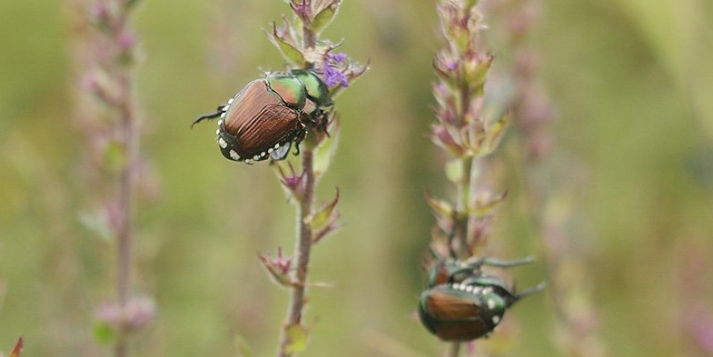
Figure 10. Japanese beetles are also attracted to wild vegetation, especially in shady areas, in drought-stricken situations and when some companion plants are employed, e.g. catnip or chives. (Image Credits: waldwissen.net)
Companion plants emit a scent that repels beetles to a certain extent, which has been found to be naturally repelling when used as companion plants with sensitive species (such as catnip, chives or tansy).
Reducing the chance of infestation can also be achieved by not planting some species that are very attractive to the beetles during the peak beetle season or by planting them in partial shade.
Monitoring and Early Detection of Beetle Attraction
Prevention of large-scale infestations requires the early identification of them. A trap that monitors pheromones can detect the presence of beetles two to three weeks before feeding damage becomes noticeable. This enables homeowners and farmers to take preventive measures before the population gets out of control.
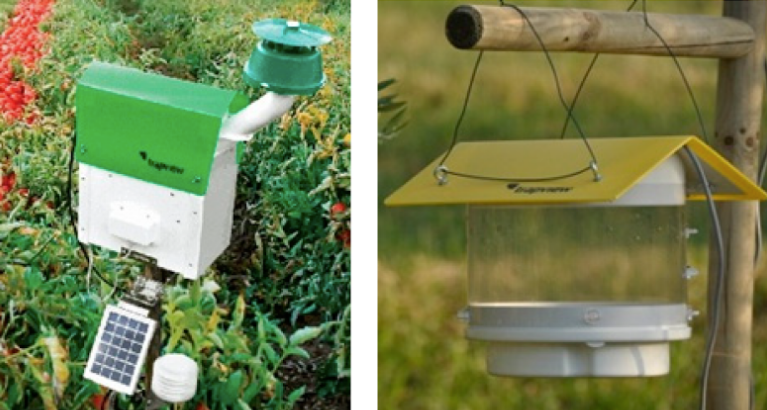
Figure 11. Pheromone trap systems have been used to monitor the presence of Japanese beetles, which can detect beetle presence several weeks before physical damage to plants appears, supporting proactive control treatments. (Credits: mdpi.com)
It is crucial to observe all vulnerable plants (roses, grapes, linden trees) during the summer. When two or three beetles are constantly observed on a plant, then action is generally warranted. It is possible to start the observations at the end of May and continue them throughout the summer, allowing the history of annual beetle activity to be compared and used to predict further population pressure.
FAQs:
What scent attracts Japanese beetles?
Two scents, working together: the natural volatiles from favored plants (roses, grapes, lindens) and the “feeding scent” released when leaves are damaged. Commercial traps add a synthetic floral lure plus a sex pheromone, which is exactly why traps pull in more beetles than they remove.
Do Japanese beetles have eyes? Are they blind?
They have compound eyes and can see, but they rely far more on smell than sight to find plants. So they’re not blind. They just navigate by scent first, which is why removing the feeding-damage scent (deadheading, hand-picking) disrupts them more than anything visual.
What do Japanese beetles eat?
As adults, the leaves and flowers of more than 300 plant species. Roses, grapes, lindens, birches, Japanese maples, and fruit trees are favorites. As grubs, they eat grass roots underground, which is the other half of the damage most people never see.
How long do Japanese beetles stay around?
Roughly six to eight weeks of visible activity per summer, late June into August. Individual adults live four to six weeks; overlapping emergence stretches the season.
Final Thoughts From Our Tree Care Manager: Allen Tate
Pheromones, plant volatiles, environmental factors, and favourite host plants all work together to attract Japanese beetles to landscapes. They are one of the most difficult pests to manage due to their ability to quickly disperse via aggregation pheromones and their selectivity for over 300 plant species.
Learning about the attractiveness of Japanese beetles will help property owners take proactive measures, such as selecting unattractive plants, limiting irrigation during the summer months, and employing integrated pest management methods.
The beetles themselves are not dangerous to individuals or pets, but their potential to cause significant economic and ecological damage makes them an urgent issue that needs to be monitored and prevented. With proper planning and timely intervention, beetle attraction can be reduced, and landscapes can be protected against the devastating impact of the current pest.