The storm season in Seattle takes place between November and March, and annually it causes downed tree parts, closed roads, broken roofs, and emergency call outs all over the metro.
How much safer a tree will be in the season to weather, and how much damage can be costly, frequently depends upon what has been done in the months of September and October. If you want to prepare trees for winter Seattle the right way, timing matters.
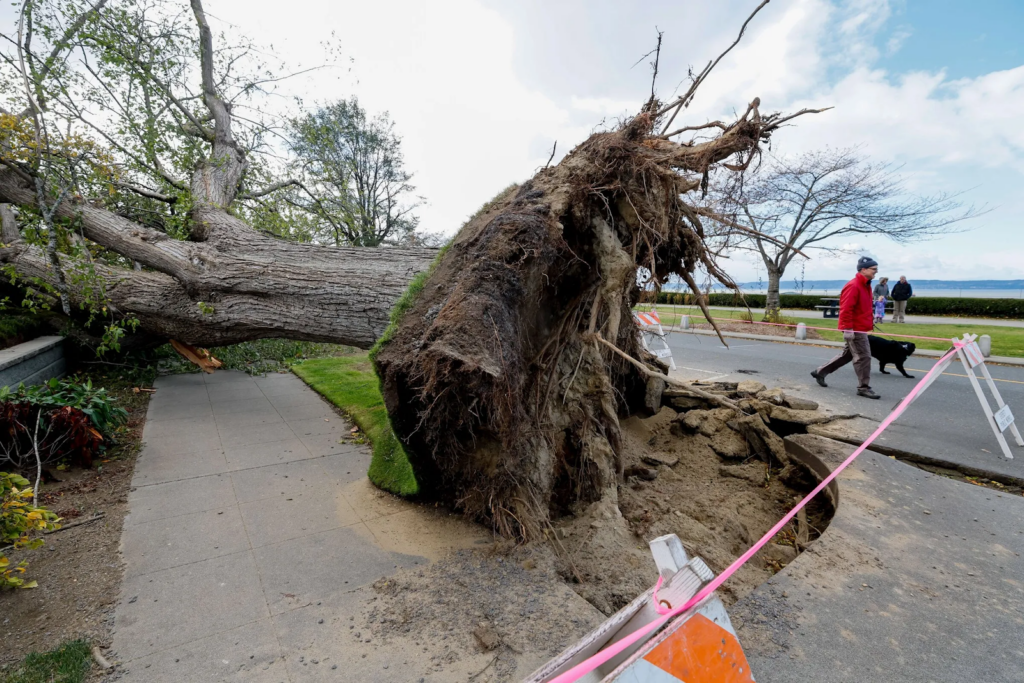
Powerful winds uproot a massive tree in Western Washington, leaving widespread outages and damage in their wake.
This guide walks you through practical, species-specific storm season tree preparation Seattle homeowners can act on before the first November systems arrive.
It is written for Seattle’s soil, terrain, and tree canopy, and informed by 18+ years of local experience from ISA-Certified Arborists who prepare trees across Seattle, Bellevue, and surrounding neighbourhoods every autumn.
Why Seattle’s Storm Season Is Harder on Trees Than Most Homeowners Expect
Seattle is uniquely exposed to wind. Storm systems are channeled and accelerated by the bowl geography of the city which is encircled by Puget Sound and Lake Washington.
West Seattle, Queen Anne, Beacon Hill, and Capitol Hill are exposed neighbourhoods, and regularly record 50 to 70+ mph during major events in November-January.
Thousands of people were left without power and trees were widely damaged in Seattle by the November 2024 bomb cyclone and the 2021 series of windstorms.
The second factor is soil. By late October, Seattle’s heavy clay soils are typically saturated. Saturated soil tree roots lose holding strength, reducing root plate stability just as peak wind arrives.
A tree that stands firm in July can uproot in November under identical wind speeds simply because the ground has changed.
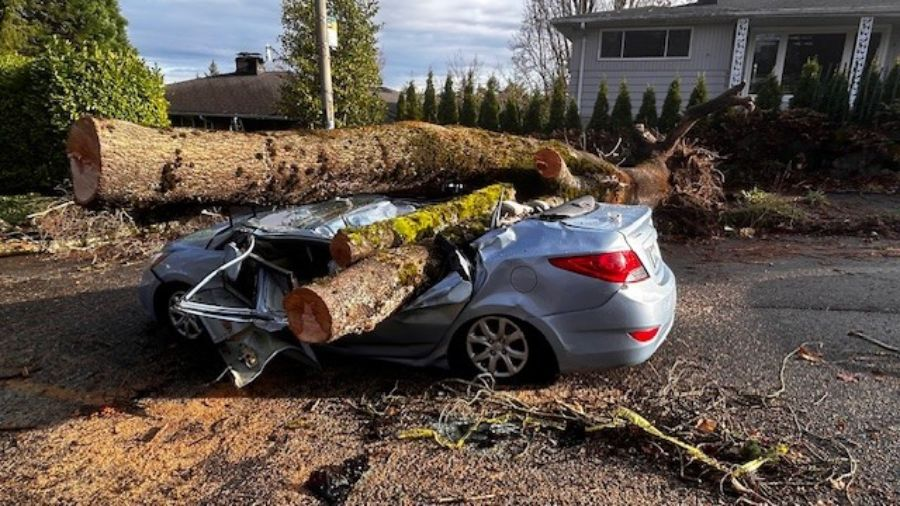
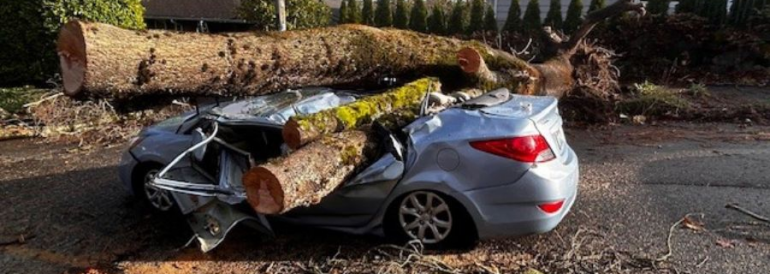
A massive fallen tree crushes a parked car during a powerful windstorm.
Species matter too. Douglas Fir storm risk is high when mature trees exceed 80 to 100 feet near structures. Western Red Cedar wind damage often involves broad canopy exposure. Big Leaf Maple branch failure is common due to aggressive lateral growth and heavy deadwood accumulation.
The cost difference between planned pruning and emergency tree removal Seattle homeowners face after a storm is significant. Emergency crews book out quickly. Preparation always costs less than reaction.
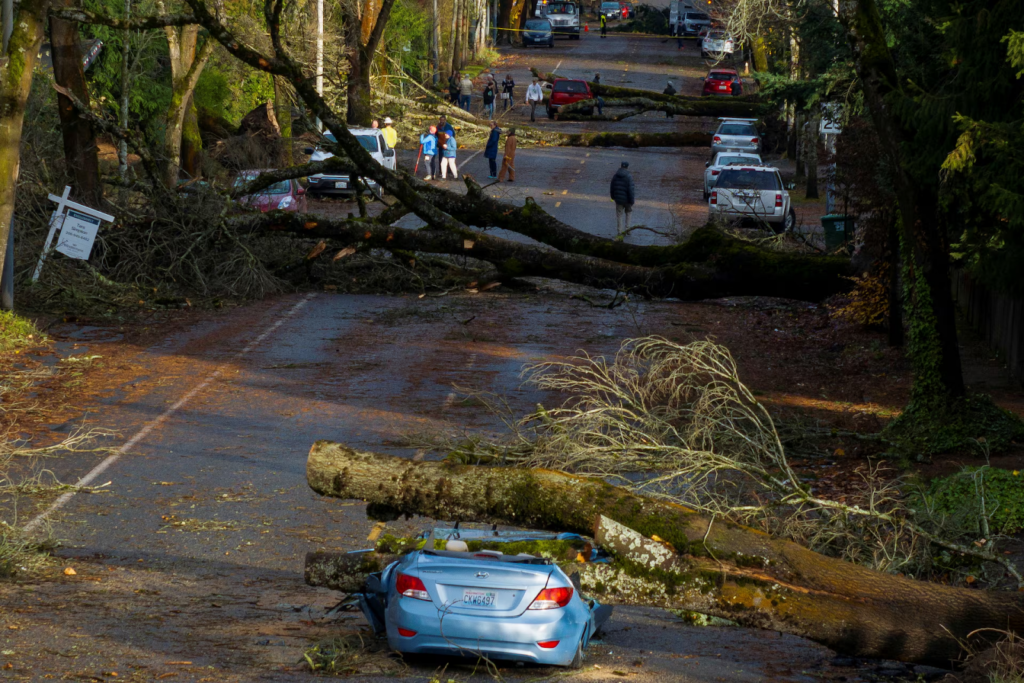
Fallen trees block a neighborhood street and crush a car after a powerful Northwest bomb cyclone.
Storm Season Tree Preparation Seattle: Your 5-Step Checklist
Step 1: Walk Your Property and Identify Potential Risk Trees
Start with observation. In September, walk your property slowly and deliberately. Identify deadwood high in the canopy, branches draped over the roofs or driveways, observed trunk cracks, fresh lean, fungal growth around the base or it is close to the power lines. Record the species, location and concern that you have witnessed.
Pay particular attention to Douglas Firs over 60 feet near structures. These represent the highest consequence failure risk during Seattle windstorm season. Also watch for co-dominant stems, included bark, and sharp branch attachment angles that increase tree failure risk.
If you are unsure whether decline is present, review these signs your tree is dying before booking work. A pre-storm tree inspection starts with knowing what worries you. As soon as you have your list, steps 2 through 5 will demonstrate what you should do before November on it.
Step 2: Remove Deadwood and Over-Extended Branches
The most important pre-storm activity is the removal of deadwood. Dead branches have no flexibility. In high winds, they snap cleanly and become falling hazards. Removing them reduces immediate risk.
Over-extended limbs create a canopy sail effect. Long, heavy laterals increase leverage on branch unions during gusts. Tip reduction pruning shortens these limbs without harming tree health. This is not topping. It is targeted structural pruning that preserves natural form while reducing wind load.
Big Leaf Maple is especially prone to heavy lateral growth and insurance claims linked to branch drop.
Early Tree Pruning and Trimming prior to November will minimise the frequency of emergency calls in mid-winter and maintain a balanced long-term canopy.
Step 3: Consider Crown Reduction for Large or Overhanging Trees
Crown reduction Seattle homeowners request most often involves large trees near roofs or occupied structures. Unlike thinning alone, crown reduction decreases overall canopy height and spread using natural branch unions.
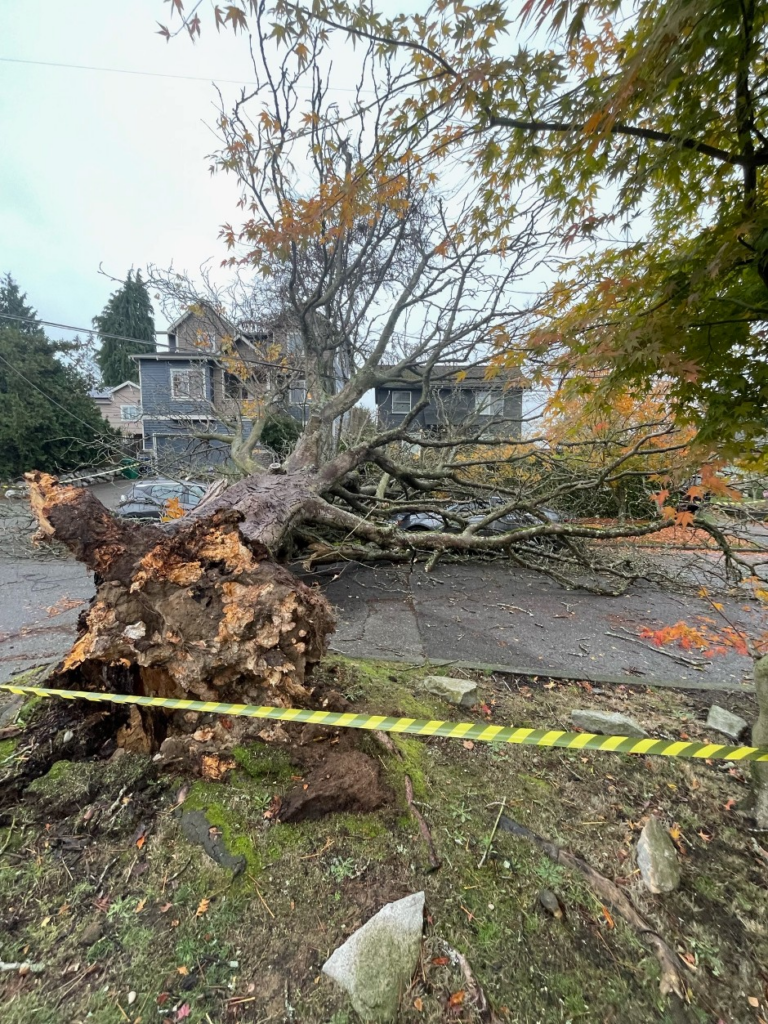
A massive uprooted tree blocks a West Seattle street after a powerful windstorm.
Appropriate candidates include trees over 50 feet with roof overhang, trees with imbalanced crowns, and trees that regrew unevenly after past storm damage. Crown reduction is not topping. An ISA-Certified Arborist performs controlled cuts that maintain structural integrity.
Douglas Firs on steep slopes in West Seattle or Beacon Hill with asymmetric crowns are common assessment candidates. The decrease of the mass of the canopy reduces the wind resistance and increases the stability of the root plate during conditions of saturated soil. Properly applied, it is among the best risk-reduction tools that can be applied.
Step 4: Assess Whether Any Trees Need Structural Cabling
Tree cabling in Seattle properties often need involves installing steel or synthetic cables between co-dominant stems to limit independent movement during storms. Trees with included bark, visible splits, or prior branch drop history are strong candidates for evaluation.
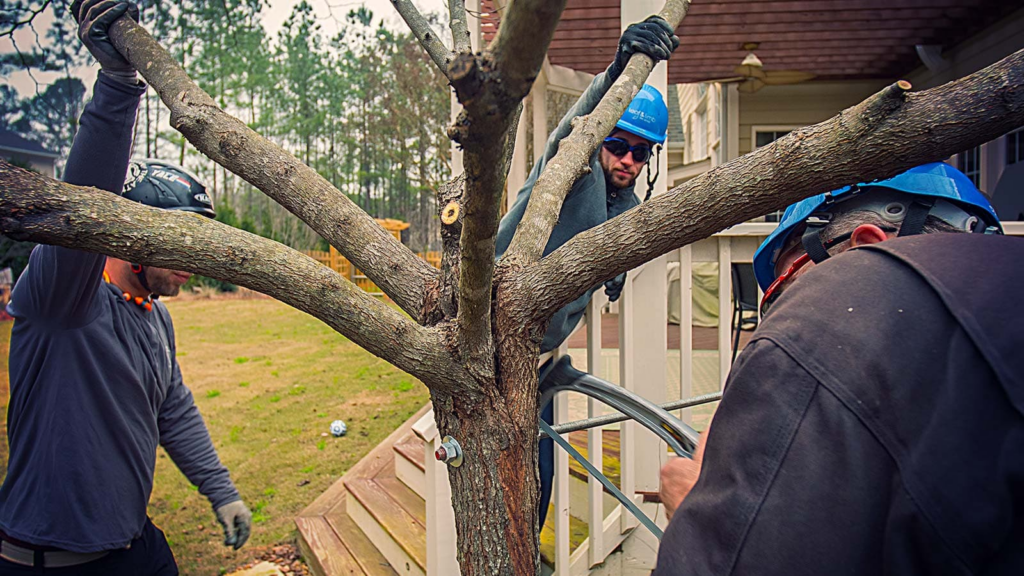
Arborists install structural cabling to strengthen and stabilize a tree before storm season.
Cabling does not make a hazardous tree safe. It reduces failure risk in otherwise structurally sound trees with a specific weak union. Japanese Maples with multiple stems such as Vine Maples and mature Japanese Maples are often known to have co-dominant stems that are known to take advantage of cabling prior to storm season.
The inspection by an ISA-Certified Arborist decides between the intervention of cabling, pruning, or removal. It is aimed at the controlled movement rather than rigidity. Properly installed systems can extend the safe life of high-value ornamental trees.
Step 5: Clear Debris, Gutters, and Storm Drains Around Tree Zones
This is what you can do by yourself. Remove litter from clear gutters and downpipes before autumn heavy rainfall. Obstructed drainage hastens saturation of the soils around the root areas making root hold weak.
Check mulch rings. Cap volcano mulching which is applied on the trunk around the trunk traps moisture and promotes rot. Instead use a breathable mulch layer which is flat.
If a tree risk assessment Seattle visit recommended soil aeration or deep-root feeding, complete it before full saturation. Once soils are waterlogged, treatment effectiveness drops significantly.
Small proactive maintenance tasks reduce compounding stress on trees before the highest-risk months of November through January.
Tree Safety Check Before Seattle Storms: When You Need a Professional Assessment
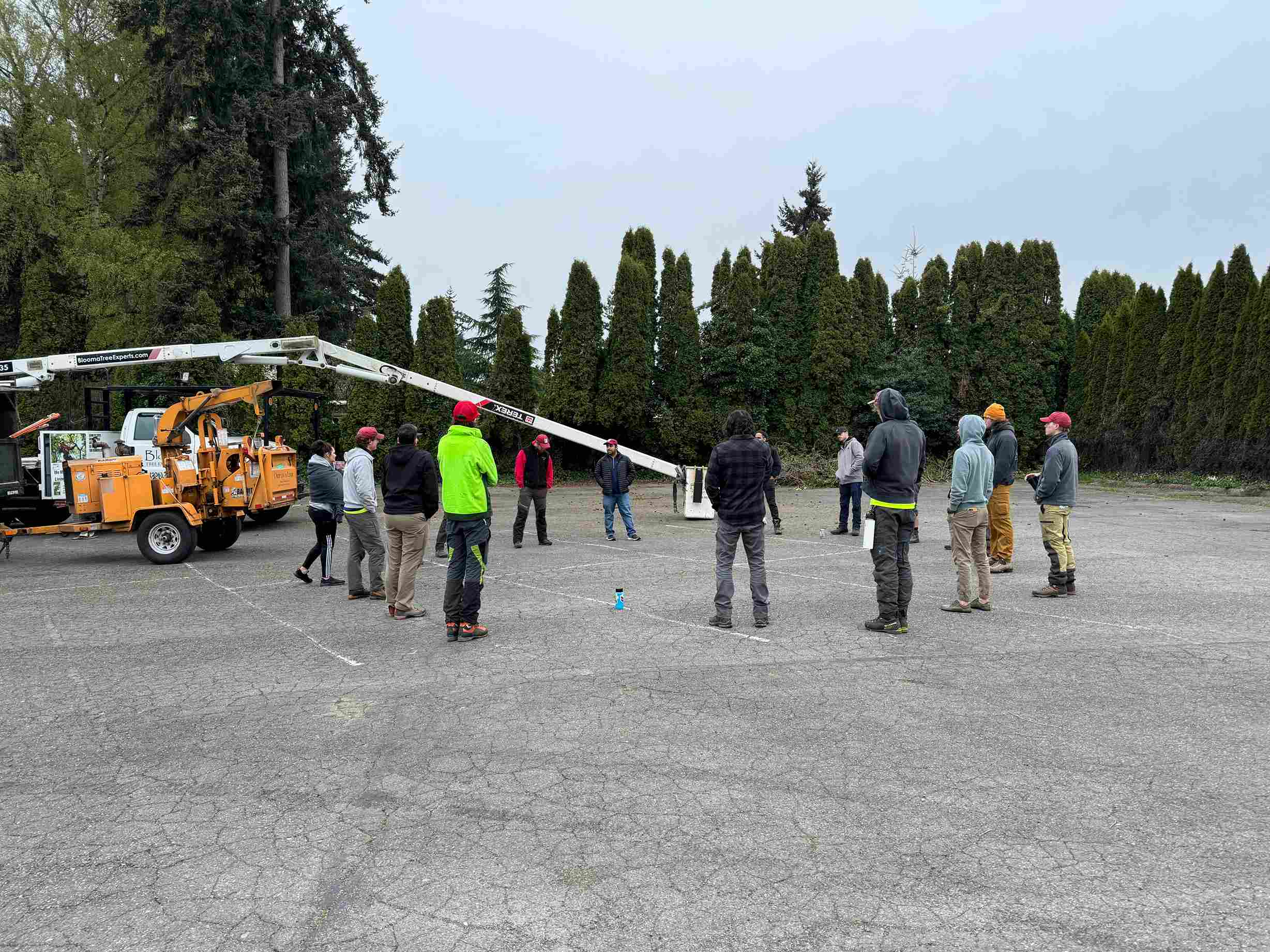
An arborist meets with homeowners to inspect a tree before a fall storm in Seattle.
A DIY walk identifies concerns. A professional assessment diagnoses risk. A pre-storm visit from an ISA certified arborist Seattle homeowners trust involves systematic inspection of canopy structure, deadwood load, branch unions, root health, proximity to structures, and site conditions.
A free estimate typically scopes visible work such as pruning or crown reduction. A formal TRAQ tree risk assessment Seattle homeowners request for high-risk sites is more comprehensive and includes documented findings and prioritised recommendations.
Professional assessment is not optional if you have a tree over 50 feet overhanging a structure, visible trunk cracks, fungal growth, a recent near-miss branch failure, or property within an Environmentally Critical Area. SDCI requirements may apply. Bloomatree is an SDCI registered tree service provider, LIC-TSP-18504, and handles compliance where required.
When stakes are high, a qualified arborist’s evaluation replaces guesswork with documented risk analysis.
Seattle-Specific Storm Risks by Neighbourhood and Terrain
Hillside and Ridgeline Properties: West Seattle, Queen Anne, Beacon Hill, Capitol Hill
Ridgeline homes experience increased wind speeds as they increase across the land. Saturated clay on slopes reduces root plate stability. Large Douglas Firs near homes on exposed ridgelines represent the highest consequence storm risk in Seattle’s residential canopy.
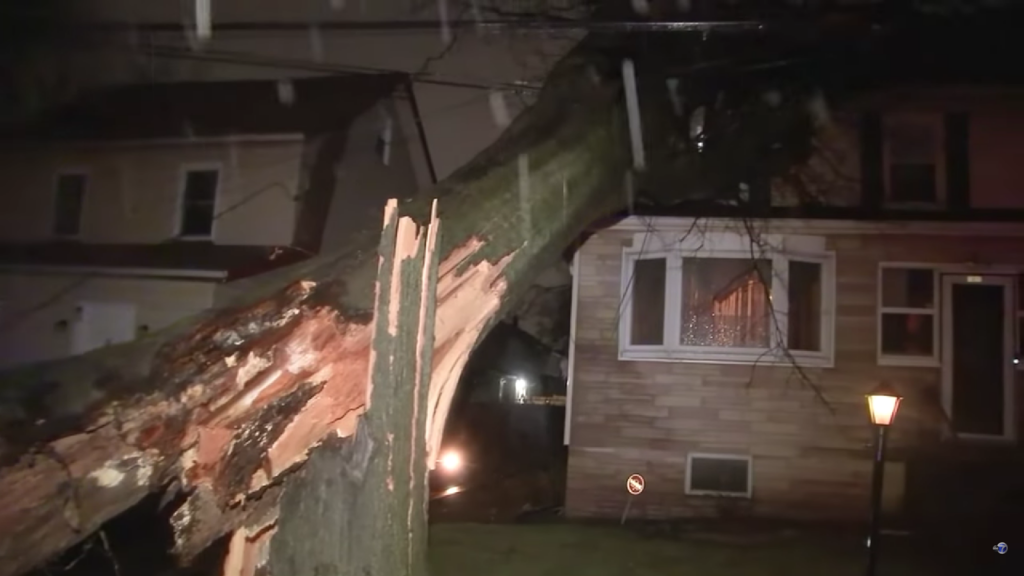
A massive tree collapses onto a hillside home during heavy rain and powerful winds.
Waterfront and Exposed Coastal Properties: Seward Park, Leschi, Magnolia, Shoreline
Water-adjacent properties experience sustained wind with minimal terrain shelter. Western Red Cedars and broadleaf ornamentals develop wide canopy sail effect. Crown thinning and structural cabling assessment are frequent pre-season recommendations.
Urban Flat Lots: Ballard, Fremont, Green Lake, Northgate, Bellevue
Flat lots may appear safer, but compacted soils restrict root zones. Pavement within three feet of the trunk limits anchoring strength. Annual pre- storm inspection should be done on street and boundary trees with history of root disturbance to determine the structural stability of the trees.
Frequently Asked Questions
When should I prepare my Seattle trees for storm season?
September and October. In November, clay soils are normally soaked and the arborist schedules are not long to wait. Prior reservation will provide superior availability and less exposure to emergencies.
Does tree pruning actually reduce storm damage risk?
Yes, when performed by an ISA-Certified Arborist. Deadwood removal eliminates brittle failure points. Tip reduction reduces wind load. Crown reduction on large trees lowers canopy resistance. Improper topping increases risk and should be avoided.
My tree lost a large branch in the last storm — what should I do?
Have an arborist inspect the wound site and remaining canopy. Targeted pruning, cabling, or in some cases emergency tree removal Seattle homeowners must consider may be recommended depending on structural compromise.
Can I prune my own trees before storm season?
Ornamentals less than 15 feet can be handled. The bigger trees work lies close to power lines or pruning with a ladder should always be handled by a qualified arborist because of the risk involved.
Do I need a permit to prune my trees in Seattle before storm season?
Routine pruning usually does not require a permit. Removing more than 25 percent of live crown or removing a tree over 12 inches DSH may require SDCI approval. Review Seattle tree permits requirements here: Seattle tree permits before beginning work.
Book Before the November Storms Arrive
Seattle’s storm season is predictable. The preparation window is not. Preparers of trees in Seattle who prepare their trees before winter always encounter less emergency cases and reduced total expenses, compared to waiters.
If any tree on your property concerns you, the preparation window is open now. It closes the moment the November systems arrive.
Ready to prepare your Seattle trees before storm season? Request a free and no obligation estimate from one of our ISA-Certified Arborists today. We deliver to Seattle, Bellevue, West Seattle, Kirkland, Edmonds, Shoreline and other places.