

The first few winters are critical for establishing healthy, resilient trees. Older trees have more roots, are thicker-barked and contain more energy. Young trees do not, and this is why they will not require less protection as compared to old ones. The initial two winters are decisive in the development of healthy trees that are hardy.
A sapling is a weak tree since the roots are yet to become stable and may end up drying out or being crushed by the freeze-thaw cycles. It has thin bark, so there are higher chances of it being burnt by the sun and of frost cracking. It does not store as many nutrients in its trunk, hence it does not have as much reserve fuel in the event of stress. There are also many young trees that are top-heavy and hence they can be easily rocked along by windstorms.
The actual problem in the Pacific Northwest is the combination of the wet days (mild) and the freezing nights, the powerful storms that occur during the months of November to February, the wet soils that can easily turn hard, and also the presence of ice occurrences that can easily break branches.
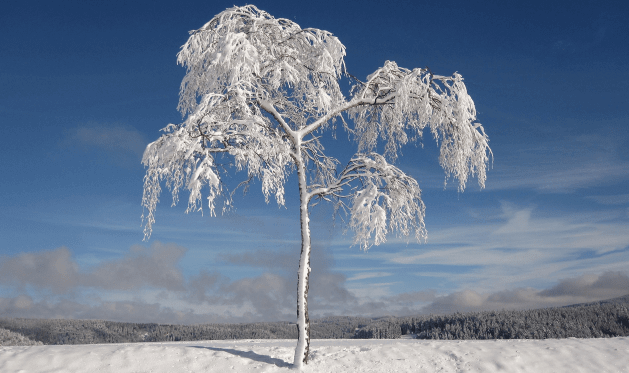
A lone winter tree stands frozen in silence, its ice-coated branches etched against a clear blue sky.
What makes small trees vulnerable in winter
The roots of young trees are shallow and therefore they dry and become frozen quicker than established trees, they can even be heaved up by freeze-thaw cycles.
Bark that is thin is prone to sun scald and cracks caused by frost, particularly when during winter, the trunk is warmed by the sun and then the night is followed by a cold night. The fewest nutrients are stored in the small trunks and therefore the process of recovering a stress is slower.
Most new plantations also have a top-heavy weight as compared to their root system, thereby increasing their likelihood to lean, break or loosen during storms. All these factors are compounded in winter, when growth is retarded and damage is accumulated.
Pacific Northwest winter challenges
The winters of Pacific Northwest tend to alternate between freezing nights and wet days of mild weather.
This causes freeze-thaw stress of soil and bark. Windstorms are frequent and may cause the shaking of small trees, especially when the soil is wet. Wet soil may subsequently stiffen and decrease the uptake of water and the stress on roots.
The ice storms are infrequent but severe due to the weight of the ice that tends to bend young trunks and break the weak branches.
A peaceful winter forest blanketed in fresh snow under a clear blue sky.
Main protection strategies for small trees
Strategy 1: Proper mulching
The best small tree winter protection item is a mulch since young roots are not far away. Appropriate layer of mulch also protects the root zone against temperature changes, soil heave, and thaw freeze, and it also helps in the retention of moisture in dry winters. It also suppresses soil erosion and splash in the heavy rain in the Pacific Northwest.
How to mulch small trees correctly
- Mulch should be applied in late October to early November when the leaves fall but before it hardens.
- Shredded bark, wood chips or old compost may be used. Keep depth at 2 to 3 inches. Make it spread out to the drip line as much as it can, and this may be, in the case of small trees, 2 or 3 feet in diameter.
Common mulching mistakes
- The greatest error is that of piling mulch against the trunk. The second is going too deep. Oxygen may be restricted by more than 4 inches resulting in shallow root growth.
The other sin is a fresh sawdust or very fresh chips added to the soil which, on a temporary basis, may tie up the nitrogen. To ensure the protection of young trees in winter after winter, mulch properly and regularly.
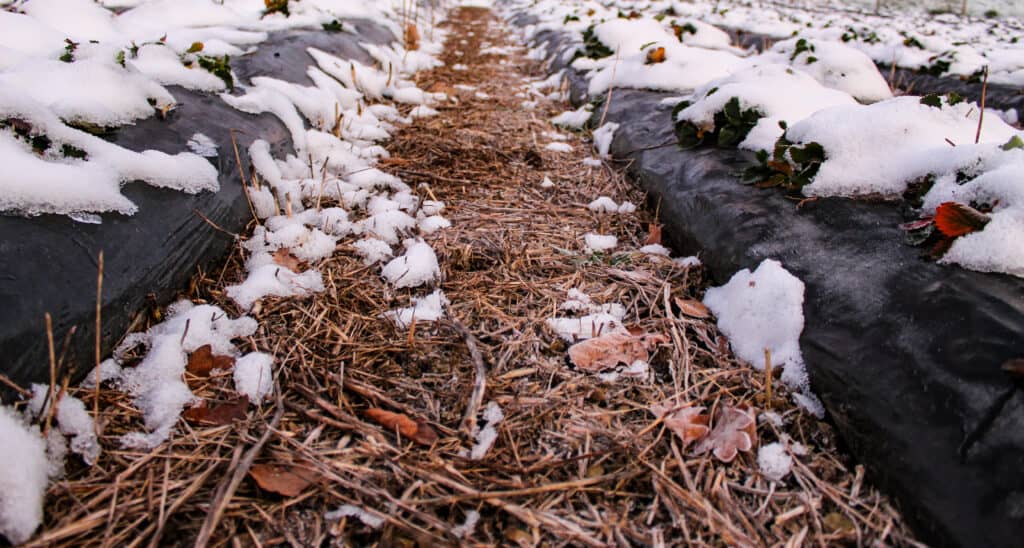
Mulched garden rows lightly dusted with snow, protecting soil and roots through winter.
Strategy 2 Winter watering
Even during a wet winter in the Pacific Northwest, young trees can become dried up. Shallow roots are ineffective to reach deeper moisture wells, evergreens continue losing water by needles and frozen soil may prevent the uptake of water.
When and how to water
- Water when there are dry spells or when the amount of rain has not been enough within 2 or more weeks and the soil is not frozen. The midday, between 10am-2pm, when the ground is more likely to be thawed.
- Use about 5-10 gallons at a slow rate to allow absorption to take place. Recheck after every 2 to 4 weeks in the dry season.
Do a simple soil moisture check
- Insert a finger or screwdriver 3 to 4 inches into the soil in the area of the root zone. In the event of dryness, water is required. Having a wet surface does not assure more moisture.
Strategy 3: Trunk protection from sun scald
Sun scald is damage to winter trunks caused by the warming of the bark of the trunk by the sun on cold days and quick cooling at night. On the PNW it regularly attacks the south or southwest side of young trunks. Most endangered species are those with a thin bark and new plantations.
Which trees are most susceptible
Trees with thin bark are the ones at greater risk. The young maples, cherries, plums, young ash, and some ornamental species are susceptible to many. Newly planted and those exposed to the open are the most vulnerable.
Wrap or paint
You have two main options.
- The fantasy tree wrap is simple and typical.
- Apply in layers, going upwards on top of each other. Seal it so that it is tight, without being too tight so as to hold water.
- A third alternative is the tree trunk paint that is also white in color and is designed to reflect sunlight and minimize the change in heat. Do not use random house paint.
When to apply and remove
Protection should be used in the Pacific Northwest in the month of November and taken off in the month of March before the buds develop and spring growth accelerated. Wraps that are too long may keep the wrap dry and prevent pests.
Focus on the south and southwest exposure
The winter sun is its strongest on that side. The heat shock and cooling down process is the mechanism of injury, and therefore the exposure protection is a prudent step in protect young trees winter plans.
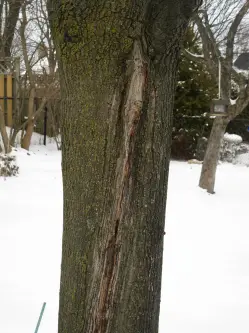
A tree trunk showing a long vertical bark wound, likely caused by winter damage or sun scald.
Strategy 4 Wind protection and staking
Small trees are more concerned with wind than meets the eye. Youthful trees will tend to be top heavy in growth and they have shallow roots thus storms are able to overturn them. This is aggravated by wet soil since roots are not well pegged. Fine roots may be ripped to pieces by repeated rocking and causing leaning.
Proper staking techniques
In case the tree can stand on its own without excessive movement, then do not stake. but when it inclines, or wobbles, or when it is in an uncovered place, prop it in the right way.
- Prepare two posts, which are placed outside the root ball on opposite sides and have flexible ties that can move easily. A three stake arrangement may be found successful in very windy locations, but tension should not be excessive.
The aim is to control the movement. When the staking is too tight, the trunk fails to strengthen and this may result in a weak stump, which is dependent. Tie up the checks in case of winter storms and untie in case of rubbing.
Windbreak options
Temporary windbreak cover, a panel of a fence, or a strategy around bushes can be used in open areas to minimize the intensity of gusts. In order to allow the tree to strengthen, remove or weaken stakes 1-2 growing seasons after.
Strategy 5: Protecting small trees from wildlife
It is snack time in winter among the wildlife. Deer browsing, rabbit chewing, and girdling by voles and other rodents can be found on the base of the bark in the Pacific Northwest. Elderly trees may also be damaged in certain places by elk.
Tree guard options
In the case of deer, tall rigid cylinders or wire mesh fences, typically 3 to 4 feet high, are used/depending on the browsing pressure in a given area. In the case of rabbits and rodents, the lower trunk should be covered with smaller guards or mesh.
Prevent vole damage
Another reason why one should not have mulch volcanoes is that voles like to hide under piles of thick mulch against trunks. Install wire mesh at the level of the soil at the bottom and leave breathing space so that the bark remains dry. Post storm check guards to ensure that they have not slipped and are not rubbing.
A large portion of small tree winter protection is in the protection of wildlife since the damage to bark can permanently undermine or cause death to young trees.
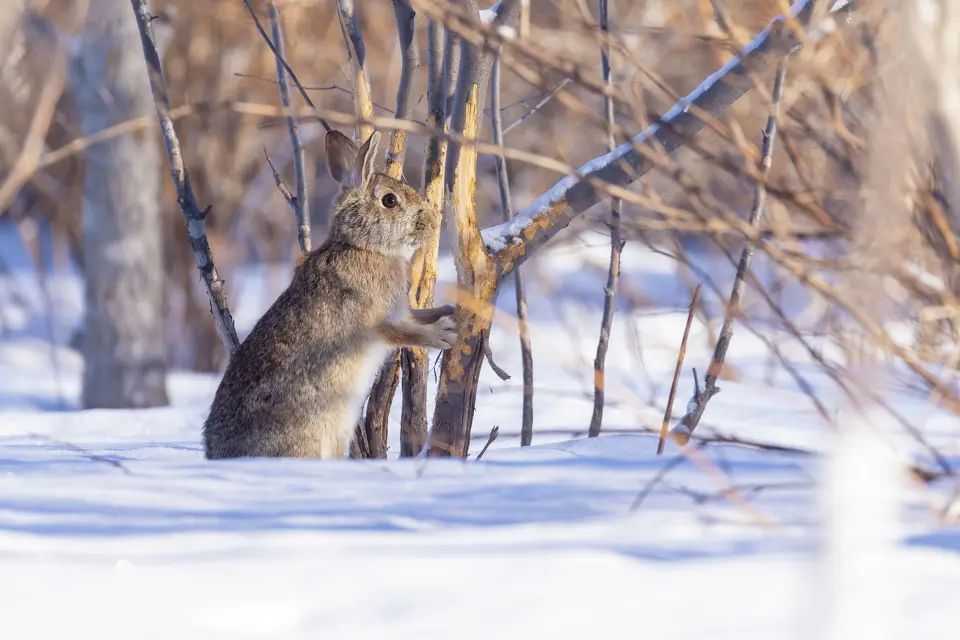
A rabbit gnaws exposed bark from a young tree during winter, a common source of cold-season tree damage.
Strategy 6 Snow and ice management
The Pacific Northwest does not always have snow, but where it falls it is wet and heavy, and this is the dangerous type of snow. Light powder is normally blown off. The heavy wet snow may bend the branches and young heads.
When to remove snow
Eliminate heavy wet snow when the branches are loosening, particularly those of the evergreens.
Proper technique
Do not shake the tree hard. Gently brush downwards with a broom, beginning with the lower branches and then upwards. Vibrations are able to break brittle branches.
Ice storms
Do not try to remove ice. Wood is torn off by ice coated on the branches. Wait for the thaw. When a young tree is bent over you may, in the meantime, make a temporary support by a soft tie and a stake till things get better; then reexamine.
Check branch unions, and the leader of the main, in case they are cracked or split after the storms.
Species-specific winter care
Evergreen trees
Evergreens are evergreen and therefore winter watering is more important to the plant particularly when it is windy and dry. Anti-desiccant sprays can be used in exposed sites although the outcome can vary and it is important to follow the product directions.
Deciduous trees
Bark is bare, and it is prone to sun scald thus, trunk cover is frequently more significant. Most species should not be heavily pruned in winter. The aspect of browsing protection should also be taken into account as buds and twigs are open.
Fruit trees
Spray dormant oils late winter before bud break and according to label instructions and weather conditions. Install additional trunk and wildlife guards due to the frequent fruit trees. Late-season fertilization should be avoided because the tree hardens off in time before the cold weather.
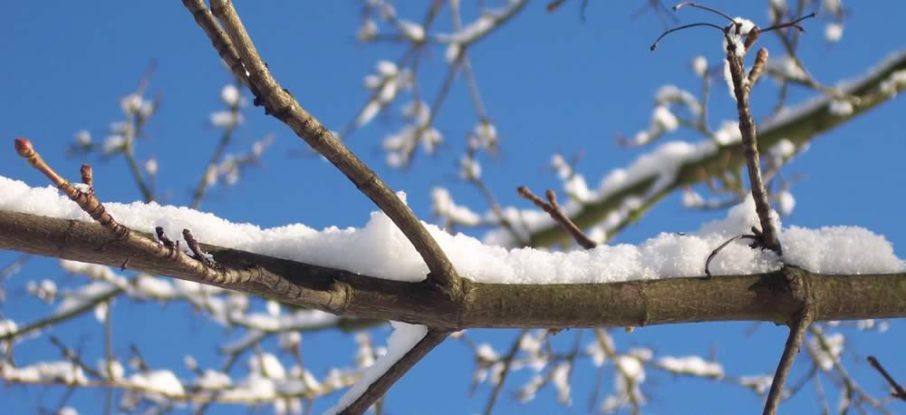
Snow rests on bare branches, highlighting dormant buds and winter stress on trees.
Pacific Northwest winter care calendar
October
Conduct the last serious watering before winter comes but particularly on newly planted trees. Check on damages, weak unions or rubbing branches. Use wildlife guards in case you are experiencing browsing pressure.
November
Act after leaves drop. Wrap trees/ trunk against sun scald. Check staking 1. Stake the checks but do not bind them.
December through February
Watch after storms, protruding, broken branches, and broken fences. Water when there is dry season and the soil has not been frozen. Very carefully brush off heavy wet snow on branches.
March
Take off the tree wrap before bud break. Renew mulch in case it has worn away. The extent of winter damage has been assessed and spring maintenance has been planned such as corrective pruning when the conditions are favorable.
Common winter tree care mistakes to avoid
When the wraps or burlap are left too long, they trap the moisture and are prone to pest or disease. Late season fertilization may continue the growth of the tree at a time when trees are expected to start going dormant.
Overstating causes the trunks to be weak due to hindered movement. Winter watering is a mistake, done to evergreens and newly planted trees. The application of de-icing salt around trees may burn roots and cause soil contamination.
Pruning during inappropriate times may put certain species at risk of diseases. Placing snow around the trunk causes moisture issues and it provides the pests with a safe haven to bark chew.
Recognizing winter damage and when to call an arborist
What to watch for
The fissures formed by frost are vertical cracks in the bark. The sun scald manifests itself as a discoloration of the sunken bark of the south or southwest trunk. Search after storms, destructive and chewed bark by animals, heaving of roots raising the tree, and desiccated evergreen brown.
When to call a professional arborist
Contact an arborist in case of significant branching, trunk fractures, leaning tree, or even a partially rooted tree, and widespread wildlife girdling. If you are not sure that a sapling will survive, expert evaluation would help avoid the recession in the long run.
Conclusion and key takeaways
Small trees require higher levels of winter protection as compared to the mature trees since their roots, barks and structure are still maturing. Long-term health is determined by the first 3-5 winters. Other risk areas of interest in the Pacific Northwest include freeze-thaw cycles, wind storms, wet soil and hard freezes, and the occasional use of snow and ice. Begin with appropriate mulching and winter irrigation, and include trunk shielding, where there is need, wind support, wildlife defenders, and judicious snow management. It is easier to prevent a winter injury rather than to fix it.
Blooma Tree Experts has ISA Certified Arborists who will consult and provide professional services in relation to winter tree care in the Tree Care Services team.