

A crack appears in your driveway. A drain starts running slowly. You see that the land is heaving around a big tree in your yard. To most home owners the first thought that enters their minds is that the tree is causing some sort of damage and that it may either have to be cut.
In most cases is not the right first step.

Properly planted tree with visible root flare and balanced root system compared to a poorly planted tree with buried flare and girdling roots.
The damage of tree roots that the Seattle homeowners are concerned about exists but has been misinterpreted. Many root-related property concerns can be managed without removing the tree. The tree is not even the major problem, in some instances. The first step to making a smart decision would be to understand the behavior of tree roots in the clay soils of Seattle.
You should have a clue on what is going on underground before you dig, cut or call a removal crew.
The Myth vs. Reality of Tree Root Damage
A myth that still persists is that the roots of trees grow straight down like drills, penetrating foundations, sewer mains and concrete slabs.
That is not how most tree roots behave.

Surface roots lifting surrounding pavement, illustrating how shallow lateral roots in compacted clay soils cause hardscape movement rather than deep foundation penetration.
Most of the root system of a tree is developed in the first 12 to 18 inches of soil. Lateral roots go outwards and may reach two to three times around the canopy radius. The oxygen, water, and soil conditions cause the least resistance and they adhere to them.
Roots are concentrated even less deeply in the heavy clay soils of Seattle. Clay compaction reduces down penetration hence horizontal rather than deep root spread. That makes surface rooting and pavement lifting more common here than in sandy regions, but it also makes deep foundation penetration far less likely.
The better question is not “Is the tree causing damage?” It is “Where are the roots going, how extensive are they, and what are the management options?” That is a question for an ISA-Certified Arborist, not a removal estimate.
How Tree Roots Actually Grow in Seattle’s Clay Soils
Understanding root behavior changes how you interpret what you see above ground.
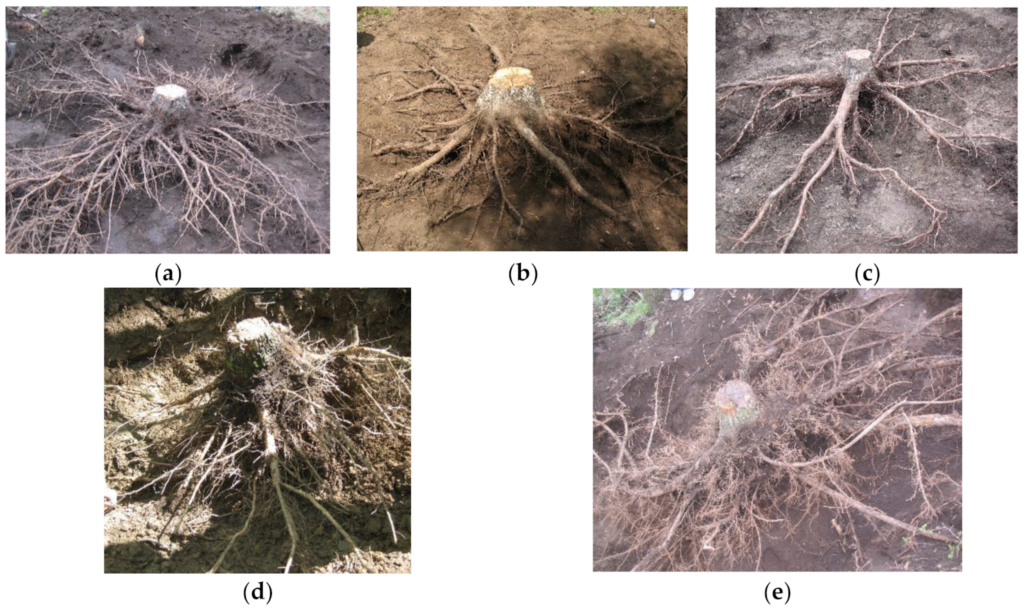
Comparison of root system morphology across five tree species, showing variation in lateral spread, structural root development, and overall root architecture.
Root Depth: Shallower Than Most Homeowners Expect
Under normal soils, the majority of structural roots as well as feeder roots are located within the top 18 to 24 inches. Rooting depth in the small urban clay soils, particularly in areas like Ballard, West Seattle and Queen Anne, in Seattle, is frequently nearer to 12 to 18 inches.
The taproot many people picture is usually only significant in young seedlings. Mature urban trees develop broad lateral root systems instead.
This means roots are not tunneling under your foundation slab. They are spreading outward in the upper soil layers.
Root Spread: Much Wider Than the Canopy
A tree’s root system typically extends 1.5 to 3 times the canopy radius. For aggressive species like Big Leaf Maple, root zone spread can extend even further.
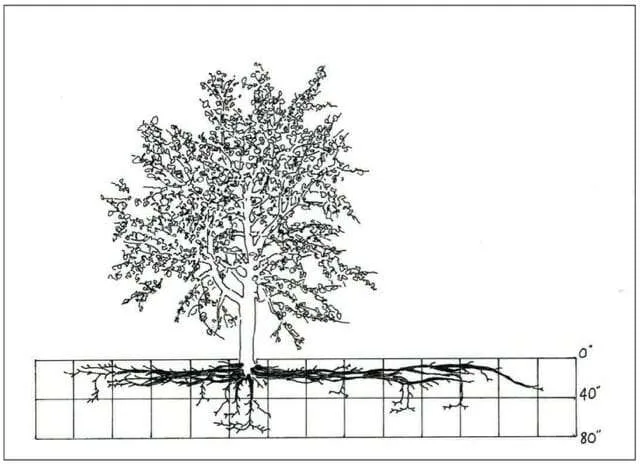
Tree root system extending laterally well beyond the canopy, illustrating how most roots spread wide near the soil surface rather than growing deeply.
The Seattle properties that need to be safeguarded by an arborist are as follows: the radius of the trunk diameter is about 1 foot per inch, which is considered to be the critical root zone. The critical root zone of a tree with a trunk diameter of 12 inches is approximately 12 feet all around the trunk.
In tight Seattle yards in the Fremont or Capitol Hill, it means that roots have a way of going under driveways, pavements and even lawns next door.
How Clay Soil Shapes Root Behavior in Seattle
Seattle clay soils change everything.
First, clay soil compaction pushes roots upward. When soil is too dense for downward growth, roots move toward the surface, leading to the surface roots Seattle yard owners commonly notice.

Shallow lateral tree roots spreading across dense clay soil, demonstrating how compaction pushes roots toward the surface in Seattle landscapes.
Second, clay soils expand and contract dramatically. During July and August dry spells, clay shrinks. In autumn, it swells again with rain. This seasonal movement contributes to cracking and shifting of hardscape independent of root pressure.
In many cases, what appears to be root heave pavement is actually a combination of lateral root growth and hydrostatic clay soil movement.
Long-term root health management, including deep root watering and soil aeration through our Tree & Plant Care Program, can reduce surface pressure over time by improving oxygen and moisture distribution.
Species Root Risk Reference Table
| Tree Species | Root Behaviour | Main Risk | Safe Distance |
| Big Leaf Maple | Aggressive lateral surface rooting | Driveway lift, root heave | 15-20 ft from hardscape |
| Douglas Fir | Deep structural moderate lateral | Low driveway risk, moderate sewer | 10 ft from structures |
| Western Red Cedar | Fibrous feeder roots | Low driveway and sewer risk | 10 ft from hardscape |
| Black Cottonwood | Very aggressive lateral | Sewer pipes, foundations | 30+ ft from structures |
| Japanese Maple | Compact shallow non-aggressive | Minimal hardscape risk | 5 ft minimum |
| Vine Maple | Fibrous moderate spread | Low overall risk | 5-8 ft from hardscape |
| Ornamental Cherry | Moderate lateral surface prone | Path lifting in shallow clay | 10 ft from hardscape |
Tree Roots Damaging Your Driveway or Path in Seattle
The most common complaint related to tree root damage Seattle homeowners report is driveway lifting.
Why It Happens
Roots follow the path of least resistance. Under driveways and sidewalks, soil is often looser due to prior excavation. Moisture collects beneath pavement edges. Over time, roots expand in diameter, exerting upward pressure.
In Seattle clay soils, the seasonal shrink-swell cycle makes this worse. Summer drying creates soil gaps. Autumn rains swell the clay again. Repeated cycles accelerate cracking.
What Makes It Worse
Older driveways poured directly on compacted clay without an aggregate base are especially vulnerable. Many older Central District and Ballard properties fall into this category.
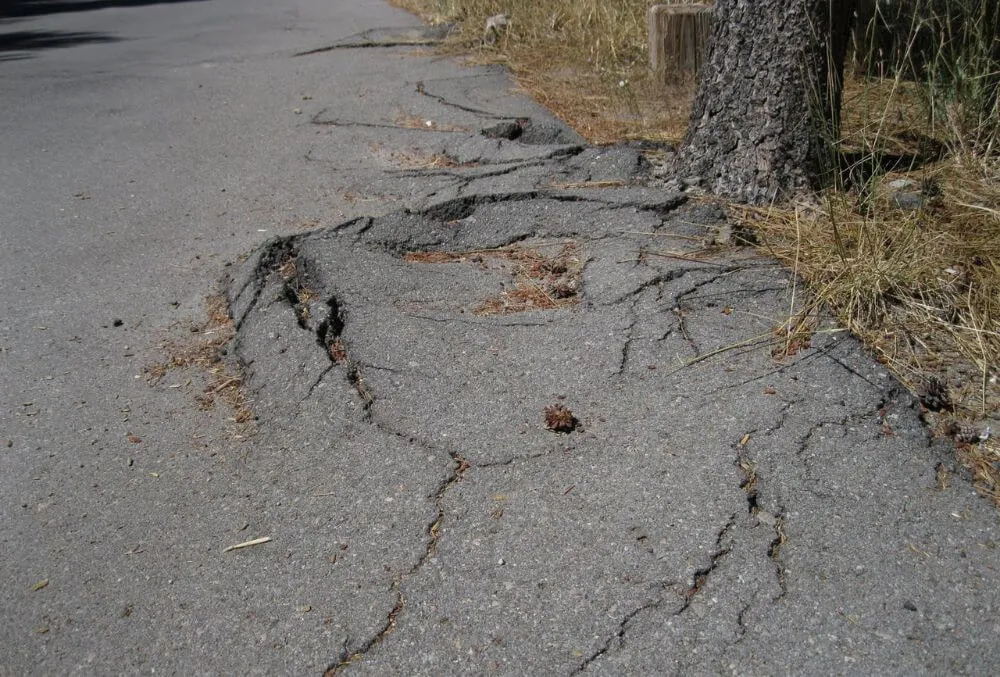
Tree roots lifting and cracking asphalt pavement, illustrating how shallow lateral roots can cause driveway heave in compacted clay soils.
Your Options
Root pruning Seattle specialists can selectively prune specific roots causing lift while preserving structural stability. Not all roots are safe to cut. Structural roots anchor the tree. Feeder roots are often safer to remove with proper technique.
Root barrier Seattle installation during driveway repair redirects future growth.
Porous pavement solutions enable the water and oxygen exchange, which minimizes the pressure accumulation.
Removal is only possible when the tree is in poor condition; root removal will make the tree unstable, and the species is not well suited to the lot. You can never be sure, so you should look at the signs that your trees are dead before concluding they need to be removed.
In most cases involving tree roots damaging driveway Seattle, assessment comes first.
Tree Roots and Foundations in Seattle: What’s the Real Risk?
The phrase tree roots foundation Seattle triggers anxiety for many homeowners.
Direct root penetration of modern poured concrete foundations is rare. Roots do not drill through intact concrete.
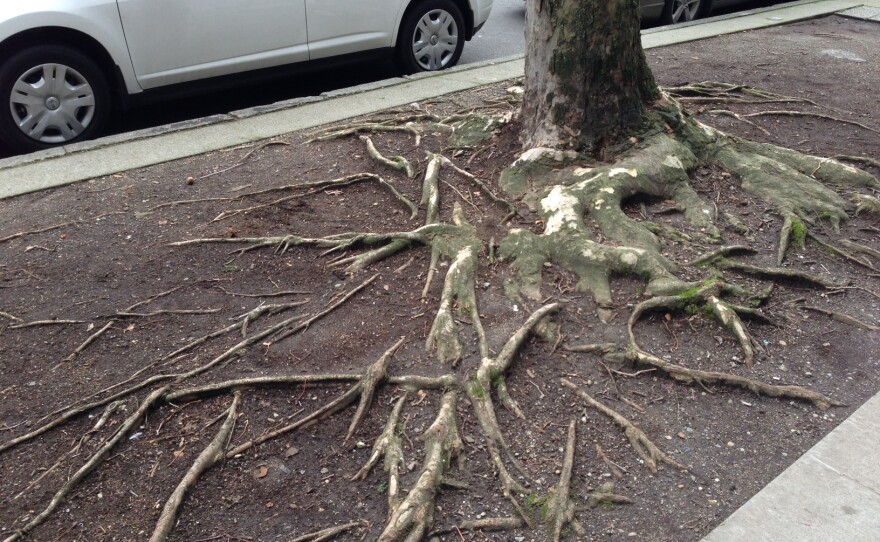
Exposed surface roots extending across compacted urban soil, highlighting trip hazards and the shallow lateral root growth common in Seattle landscapes.
What happens more often in Seattle is clay soil shrinkage. The trees of great size attract moisture to the clay soil in the area in case of prolonged dry periods. As clay dries, it shrinks. If soil pulls away from shallow foundations, settlement or cracking can occur.
Seattle’s wet winters moderate this effect. We are not Texas or California. However, longer summer drought periods in recent years have increased shrinkage patterns.
Older Seattle homes with shallow rubble stone or unreinforced concrete block foundations carry greater risk than modern poured concrete foundations.
The right step is not removal. It is coordinated assessment: an ISA-Certified Arborist to evaluate root behavior and a structural engineer to assess foundation movement.
Tree Roots and Sewer Pipes in Seattle: When to Take It Seriously
Of all root concerns, sewer infiltration is the most legitimate.
Roots enter through existing cracks or loose joints. They do not drill holes in intact PVC pipe.
The homes constructed before 1960 in Fremont, Ballard, Capitol Hill, and some of the Central District tend to have clay-tiled or cast-iron sewer lines, which are weaker.
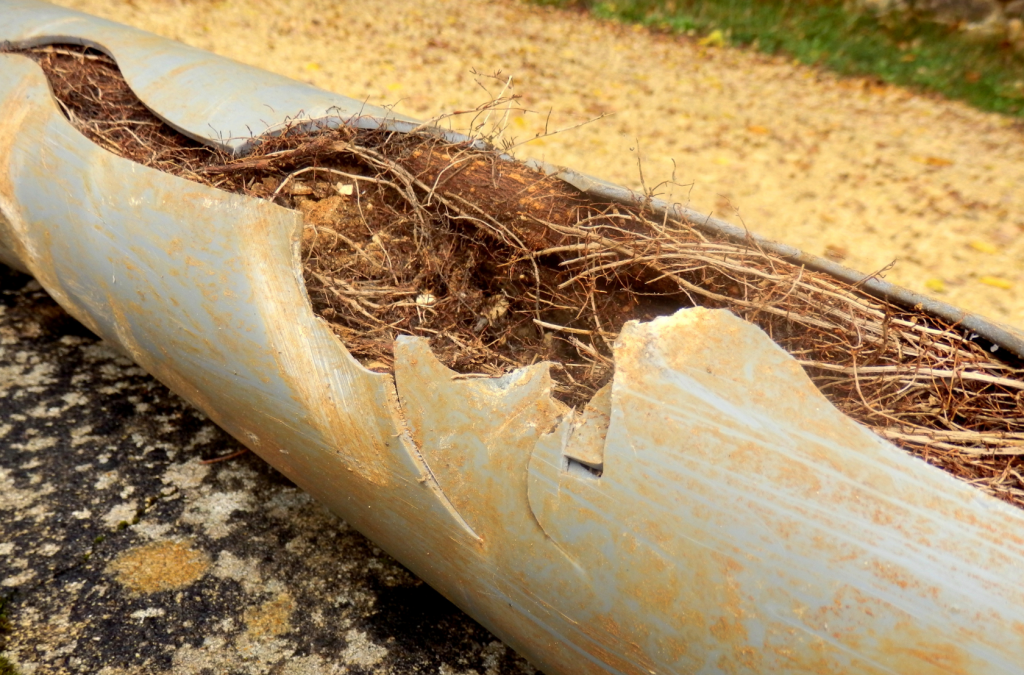
Tree roots infiltrating and splitting a damaged sewer pipe, illustrating how roots enter through existing cracks rather than penetrating intact pipe.
The warning signs are slow drains in the entire house, frequent backups, and sewer stenches outside the house.
A sewer camera inspection is the right choice for the first step. Not removal.
If roots are present, pipe relining or replacement may solve the issue without touching the tree.
Black Cottonwood carries the highest pipe-seeking risk. Big Leaf Maple and ornamental Cherry are moderate. Douglas Fir and Western Red Cedar carry lower risk profiles.
Protecting Tree Roots During Construction and Renovation
In the event of replacement of a driveway, an addition or trenching utilities, it is important to preserve the critical root zone of the trees in Seattle.
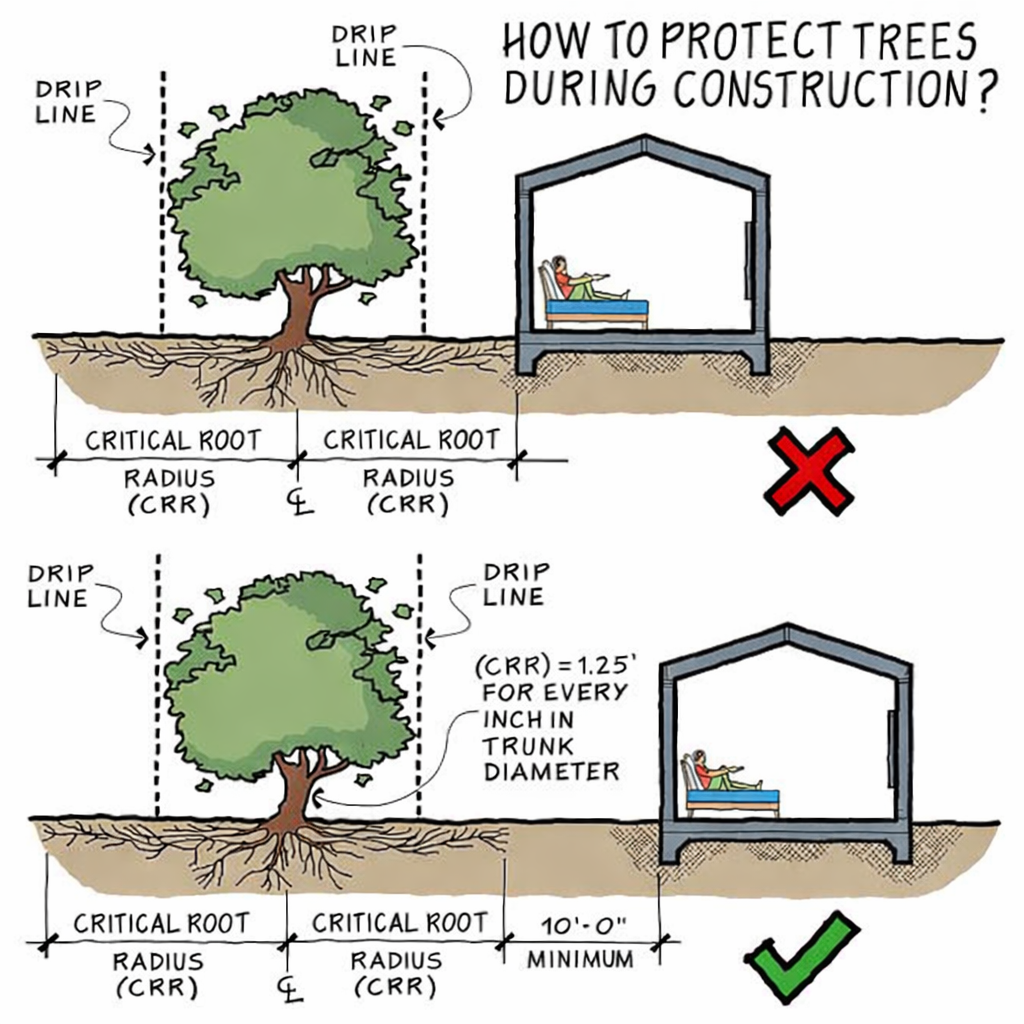
Diagram showing critical root zone protection during construction, emphasizing safe excavation distances to preserve tree stability and long-term health.
Excavation inside the CRZ can cause delayed decline 1 to 3 years later.
The means of protection include; exclusion fencing, soil shall not be compacted, and air spade root excavation needs to be implemented as opposed to mechanical digging near the roots.
For projects near protected 24+ inch DSH trees, SDCI may require documentation. Learn more about Seattle tree permits before beginning work.
A pre-construction arborist report is often required and always advisable.
Frequently Asked Questions
Do tree roots really crack foundations?
Direct penetration of modern concrete foundations in Seattle is rare. The majority of the foundation problems are a result of the shrinkage of the clay when dry. The foundations of older homes are shallow or unreinforced, and thus more dangerous.
My driveway is cracking near a tree. Do I need removal?
Usually not. Most cases of tree roots damaging driveway Seattle properties can be managed with selective root pruning and driveway repair with root barrier installation.
How far do tree roots spread in Seattle clay soil?
It is usually one and a half to three times the radius of the canopy. Roots in compacted clay soils remain in the upper 12 to 18 inches and propagate outwards.
Should I cut the roots lifting my pavement?
Not without assessment. Cutting structural roots can destabilize a tree. An ISA-Certified Arborist determines which roots are safe to prune.
Can tree roots damage sewer pipes?
Yes, particularly older clay tile or cast iron pipes. The first step is always a sewer camera inspection, not removal.
Conclusion
Tree roots in Seattle’s clay soils behave differently from roots in sandy or arid climates. Surface rooting and driveway lifting are common, but foundation penetration is rare. The majority of issues that are associated with roots can be addressed through informed intervention.
Poor decisions come in when the homeowners cut down the healthy trees or cut roots without any knowledge of the root system.
When it comes to the Seattle tree root problem, whether it be cracking pavement, sewer, foundation or building plans, the last thing to consider is removal. It is an assessment.
Book your free arborist consultation today. An ISA-Certified Arborist assessment is faster, safer, and more informative than a removal quote, and it is always the right place to start.