It is difficult to imagine the urban forest of the city is strained when walking virtually anywhere in Seattle (Fremont, Madrona, West Seattle, Magnolia). Imposing Douglas Firs over sidewalks. Western Red Cedars frame backyards. Vine Maples soften the edges of older homes. It still feels like the Emerald City.
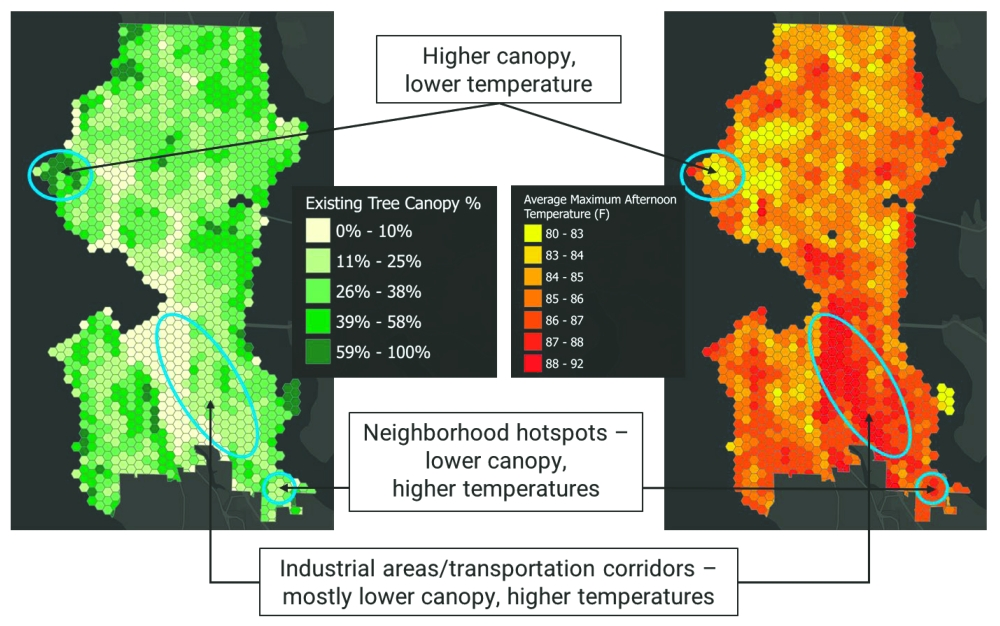
2021 Seattle data shows neighborhoods with lower tree canopy experience significantly higher temperatures, especially in South Seattle.
And yet, Seattle tree canopy loss is real. The city of Seattle also reports that by 2021, Tree Canopy Assessment showed that the city lost 255 acres of tree canopy, which is approximately the size of Green Lake, between 2016 and 2021. The fall is not simply a planning fact. Its implications are felt on neighbourhood heat and storm water, property value and long-term viability of the Seattle urban forest.
As certified Arborists allowed by the ISA standards to operate in the urban forest of Seattle daily, we feel that homeowners can be provided with an accurate and straightforward explanation of what the data indicate, what the Seattle tree ordinance of 2023 has altered, and what can be or cannot be done by individual property owners.
The Numbers: What Seattle’s Tree Canopy Assessment Actually Found
The latest Seattle Tree Canopy Assessment, released by the Seattle Office of Sustainability and Environment in March 2023, was a canopy assessment of the entire city that used high-resolution aerial imagery.
Here is what it found:
In 2021, the canopy cover in Seattle was 28.1 in comparison with that of 28.6 in 2016. It is an absolute fall of 0.5% and a relative fall of 1.7%. The city has lost what was felt to be 255 acres of canopy over the past five years; it is equivalent to Green Lake.
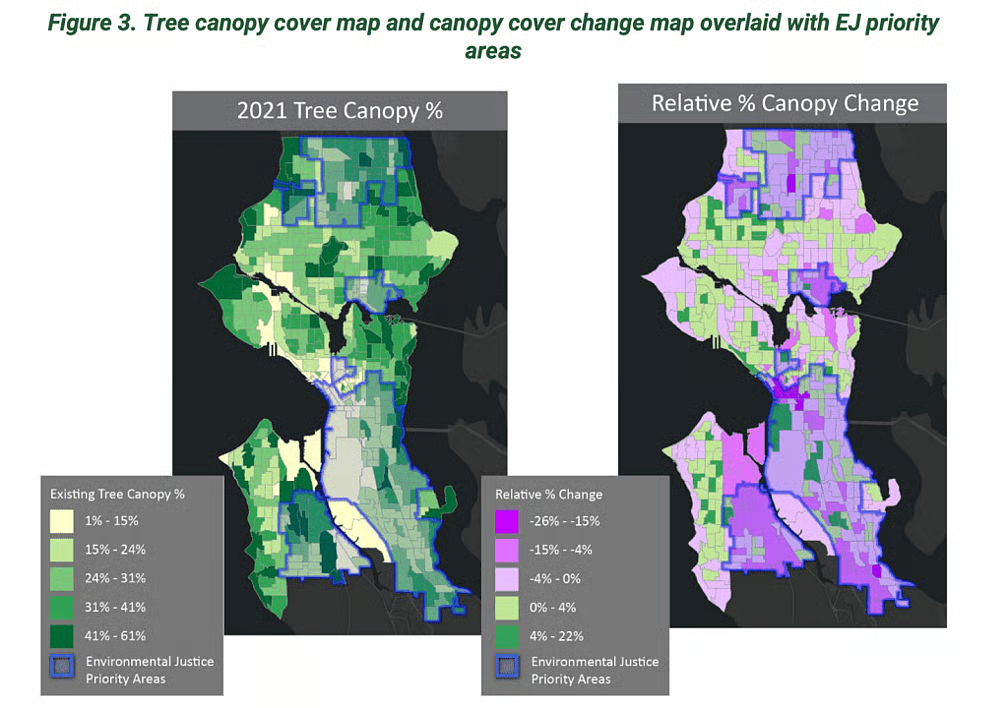
2021 canopy data shows where Seattle’s tree cover remains strongest and where losses have been concentrated, particularly in Environmental Justice Priority Areas.
The defeat was not equally spread. In the Parks Natural Areas 5.1%. of the entire canopy was lost, or 43%. of the total loss of 111 acres. Residential areas of the neighbourhood took 34% of the total canopy loss of 87 acres.
Two-thirds of Seattle’s current urban forest grows in residential zones. That means the private residential canopy Seattle properties host is the dominant contributor to citywide coverage. Individual homeowner decisions collectively shape the outcome.
There was also an equity gap as depicted in the assessment. Racially and economically disadvantaged neighbourhoods had 31% less canopy in 2021 as compared to more privileged neighbourhoods and the gap has only increased since 2016. The Seattle tree canopy equity is still being pursued in the One Seattle Comprehensive Plan and the tree canopy 30% target by 2037.
In 2024, Tree Action Seattle reported over 2,000 trees removed citywide, with construction on infill lots identified as the single largest driver.
Seattle’s official goal remains 30% canopy cover by 2037, equitably distributed. Whether that target is reached depends heavily on private landowners.
What Seattle’s Tree Code Says and What Changed in 2023
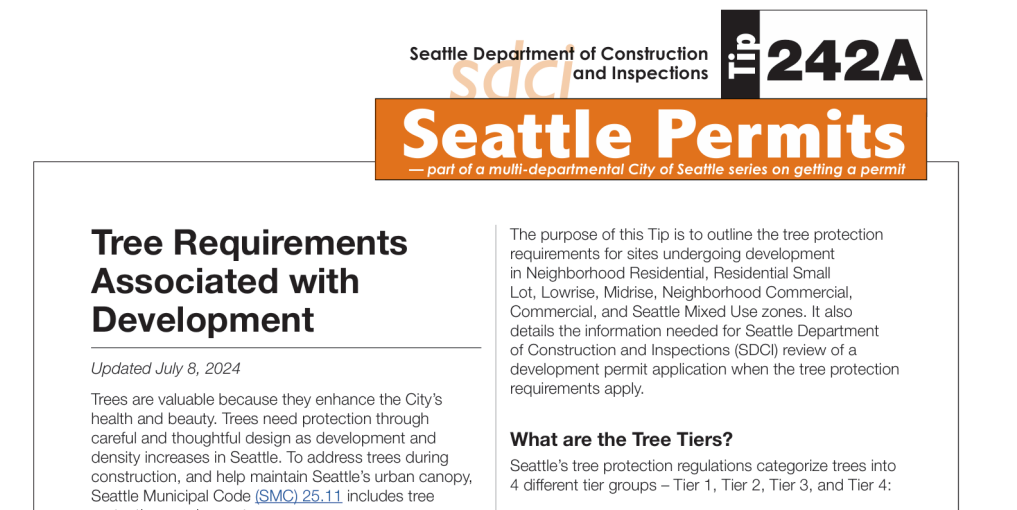
Seattle’s updated tree protection requirements outline permit and development rules under SDCI Tip 242A.
The Seattle tree ordinance 2023, also formally Ordinance 126821, became effective July 30, 2023, and changed the regulatory landscape.
1. The 2023 Tree Protection Ordinance
Under the updated code, any tree on a developed private lot measuring 12 inches DSH (diameter at standard height) or larger requires SDCI review before removal. Trees 24 inches DSH or larger, often referred to as significant or Tier 2 trees, require a formal permit, replacement planting, or payment into the City’s Tree Fund.
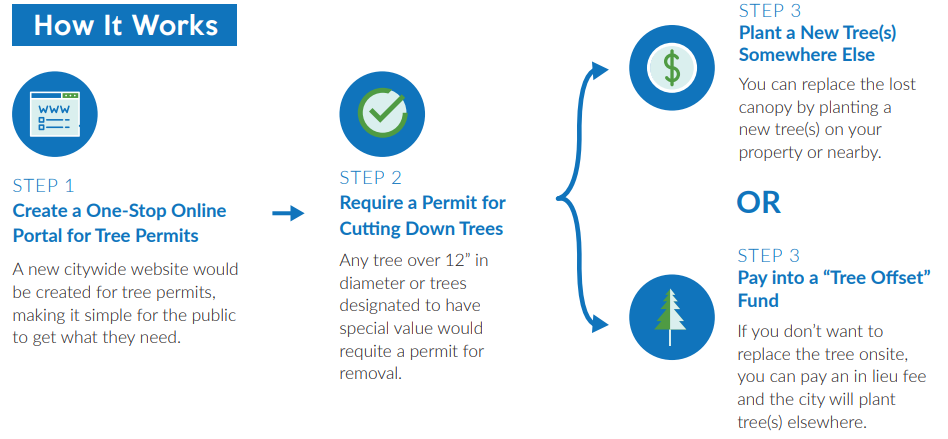
Proposed ordinance changes would require permits for tree removal and mandate replacement planting or payment into a tree offset fund.
In practical terms, the removal of larger trees now triggers either mandatory replanting of Seattle native trees or a fee. The perspective is to preserve the mature canopy and avoid needless loss of the outstanding tree specimens in Seattle which involve relatively disproportionate ecological worth.
This guide to Seattle tree permits is a good place to offer a clear description of thresholds and the process in case you are not sure how the rules are applied.
2. What the Ordinance Does Not Cover
No permit is needed in the event that the pruning is carried out on a regular basis and no more than 25% of the live crown is cut at a time. Responsible arborist tree care also included structural pruning, reduction of crowns and removal of deadwood as a part of the ISA-certified arborist tree care.
There should be emergency removals which are allowed in cases where a tree poses a serious danger, but there should be documentation and notification of SDCI.
Bloomatree manages SDCI tree removal permit applications and compliance as part of our service. The regulatory process is detailed, but homeowners do not need to navigate it alone.
3. The Ongoing Debate
The 2023 ordinance has generated debate. Critics, including Seattle’s Urban Forestry Commission and advocacy groups such as Tree Action Seattle, argue that developer-related exemptions weakened protections in certain residential zones.
Early 2024 data showed over 600 significant trees removed in the months following implementation, according to reporting by Biophilic Cities and Tree Action Seattle.
It is not our role to take a policy position. What matters for homeowners is this: the regulatory environment is complex and evolving. Professional arborist guidance before any major tree work is now more important than ever.
Why Canopy Loss Matters More Than Most Homeowners Realise
Seattle tree canopy loss is not abstract. It affects daily life in measurable ways.
Heat and Urban Cooling
The 2021 Tree Canopy Assessment found that a 13% increase in canopy is associated with a 0.5-degree reduction in neighbourhood temperature. With a heat wave, trees in Seattle have the potential to cool the neighbourhood temperatures by as much as 20°F (Tree Action Seattle).
In June 2021, the heat dome in the Pacific Northwest took the lives of more than 400 people in Seattle. The patterns of the urban heat islands in Seattle revealed that low-income neighbourhoods (with less than 12% canopy cover) had increased exposure.
Stormwater Management
Seattle’s street trees intercept over 10 million gallons of stormwater runoff annually, according to SDOT. Trees reduce runoff, a $1.8 billion infrastructure challenge for Seattle Public Utilities.
Douglas Fir urban canopy Seattle landscapes benefit from year-round interception. Western Red Cedar drought stress is a concern in summer, but conifers remain exceptional at stormwater runoff urban trees management in winter rainfall.
Air Quality and Carbon
Seattle’s street trees remove nearly 30 tons of air pollution annually, primarily fine particulate matter. Urban trees also contribute to carbon sequestration urban forest benefits by storing carbon in wood and soil.
Mature tree preservation in Seattle matters because older trees provide exponentially more carbon benefit than newly planted saplings.
Property Value
Studies have always indicated that well-established and well-kept trees add value to residential properties in the range of 3-15% depending on the context of the neighbourhood. One healthy, well-sited mature tree can provide quantifiable aesthetic/market value.
Destruction of a safeguarded tree can also attract substitution obligations in a Seattle tree permit examination, making conservation cost-effective in most circumstances.
Protecting Trees Seattle: What Homeowners Can Do Right Now
Seattle’s canopy future depends largely on private residential stewardship. Protecting the trees Seattle homeowners already have is the most impactful action available.
1. Keep Existing Mature Trees Healthy
The most effective action that would have the greatest impact is the preservation of mature trees. The 100-year-old Douglas Fir is of more benefit to the canopy in a single year than the planting that is just a few decades old.
Routine inspection by an ISA-Certified Arborist, selective structural pruning, and summer watering of tree species like Western Red Cedar are some of the practices that would help minimize the chances of mortality.
Bloomatree’s Tree & Plant Care Program is designed specifically for long-term health management of established trees across the Seattle urban forest.
2. Understand Which of Your Trees Are Protected
Any tree 12 inches DSH or larger requires SDCI review before removal. Trees 24 inches or larger require a formal permit.
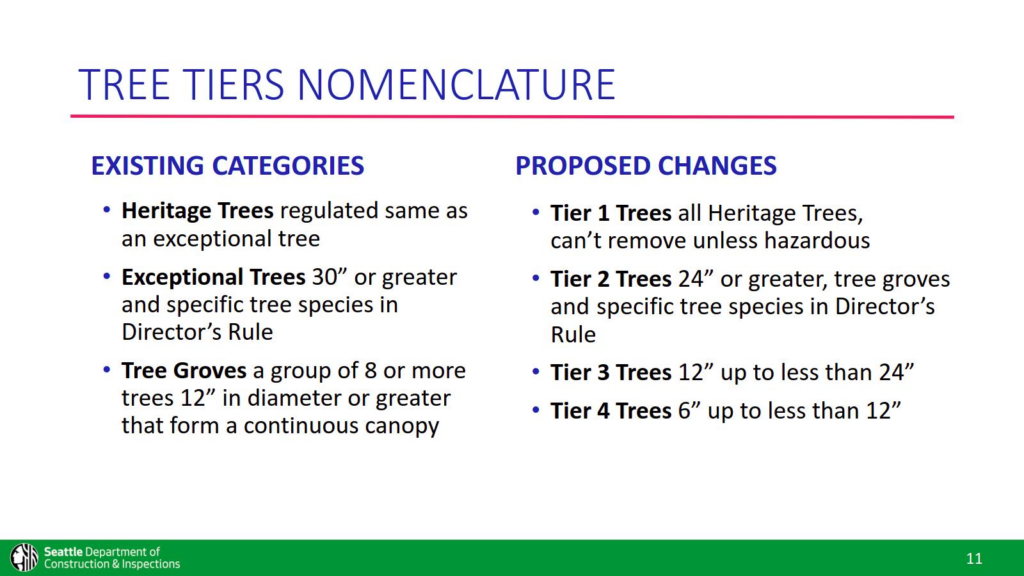
Seattle’s updated tree tier system categorizes trees by size and significance, with stricter protections for larger and heritage trees.
Many homeowners do not realise which trees meet these thresholds. A documented arborist assessment identifies Tier 2 significant tree Seattle status and clarifies obligations before renovation or landscaping work begins.
By knowing this early, it will prevent fines, time waste and unwanted loss of canopy.
3. Plant the Right Tree in the Right Place
The Seattle homeowners interested in trees make a direct contribution to the 30% canopy target when they select them carefully.
The selection of species should consider soil, sunlight, the area of the lot and the potential of canopies in the long-term. Western Red Cedar, Pacific Dogwood, Vine Maple and properly located Big Leaf Maple have their place in the world.
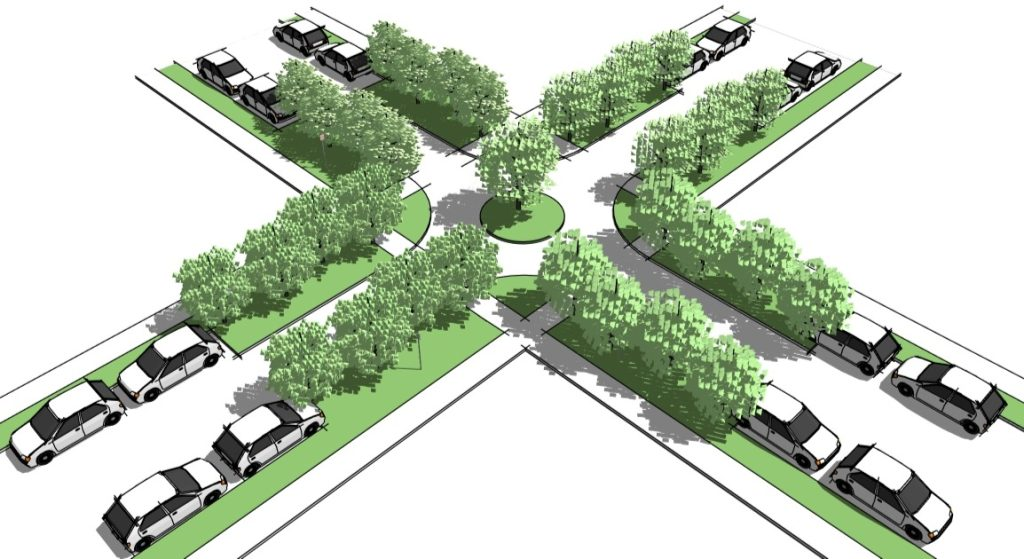
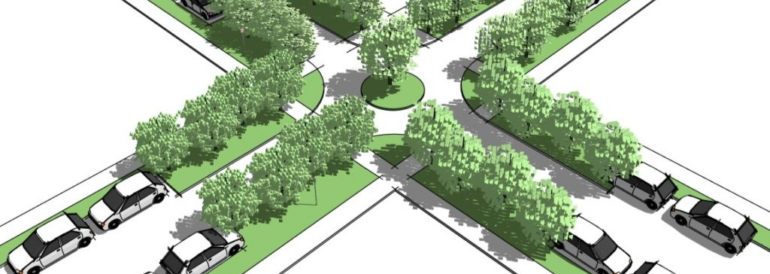
Concept design showing how converting street parking to tree hubs could expand canopy coverage at Seattle intersections.
Planting consultation also means that trees are planted in a manner that will sustain long-term growth and contribute to the canopy to the maximum.
4. Be Cautious About Removing Trees Unnecessarily
Not every stressed tree requires removal. The partial dieback, or even brown foliage can speak of some problems that can be treated.
Make sure that you are aware of the symptoms that your tree is dying beforehand and that you involve an ISA-Certified Arborist. It is often retainable, and an ecological standard of a mature tree cannot be easily recreated.
Bloomatree is known for advising preservation when possible. Removal is sometimes necessary, but it is not our default recommendation.
5. Support Seattle’s Urban Forest Beyond Your Property
The Seattle Tree Canopy Network and Seattle Parks Foundation coordinate efforts to expand the canopy in Environmental Justice Priority Areas.
SDOT offers free and subsidised street tree programs. A tree outside your property can also be requested on the street, which is also contributing to canopy equity.
The South Seattle, Rainier Valley, and the Chinatown-International District have community activity to bridge the expanding canopy gap as reported in the 2021 Seattle Tree Canopy Assessment.
Frequently Asked Questions
How much tree canopy has Seattle lost?
The amount of canopy lost in Seattle amounts to 255 acres in 2021 alone and 2016 alone, which is approximately the size of Green Lake. The canopy cover decreased to 28.1%. The desired canopy percentage of the city is 30% to be achieved by 2037, fairly distributed.
Why is Seattle losing its tree canopy?
Residential development, tree death due to drought and climatic stress and tree removal on infill construction sites are the main drivers. In 2024, there was a fire that cleared more than 2,000 trees and infill construction was quoted as the primary reason.
Can I remove a tree from my Seattle property?
An SDCI review is necessary for any 12-inch DSH or bigger tree. Trees that are 24 inches or more are to be formally permitted and replaced. The status of your tree and compliance control can be approved by an ISA-Certified Arborist.
What trees should I plant to help Seattle’s canopy?
Western red cedar, Pacific dogwood, Vine maple and native conifers are highly effective in achieving the aim of the canopy when sited well. Selection has to be based on lot size, soil and closeness to structures.
Does removing a tree hurt Seattle’s canopy goals?
Yes, but especially when the tree is old. New replenished plantations take decades to equal the canopy, cooling and stormwater benefits.
The Future of Seattle’s Canopy Is Largely Residential
The tree cover in Seattle is a civic asset, the majority of it being on residential land. The choices that homeowners can make will decide whether the city will achieve its canopy target of 30%.
The greatest effect that might be made by any Seattle homeowner is to maintain the old trees that are in good health, well-shielded and well-maintained. It is not the loss of the Seattle tree canopy. It represents cumulative decisions.
In the case of having mature trees on your property, the most important thing that you can do is to call in an expert to examine the health and condition of your trees. Bloomatree has ISA-Certified Arborists who offer free arborist estimates and tree health consultation throughout Seattle, Bellevue, West Seattle, Kirkland, Edmonds, Shoreline, and the Seattle region.