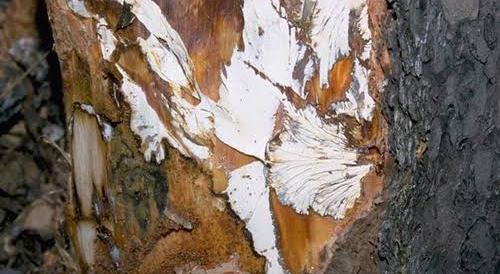
A tall Douglas fir can be perfectly healthy throughout the summer and then start to turn brown from the top. A November windstorm rolls through, and the massive tree crashes across a driveway, revealing a tiny, rotted root ball underneath. This is exactly how laminated root rot and Armillaria root rot behave in the Pacific Northwest. They are silent killers. These two fungal pathogens hollow out conifer root systems long before the canopy shows stress. Here is how to identify these diseases and manage the severe safety risks they create on your property.
What is laminated root rot?
Coniferiporia sulphurascens is a fungus that causes laminated root rot of conifer roots. It is the most important root disease in the Pacific Northwest, affecting mainly Douglas fir. The fungus tends to split the wood rings, creating a hollow structure in the wood roots, making them very susceptible to sudden uprooting.
This pathogen is known to survive in old stumps in the soil for up to 50 years according to the USDA Forest Service. If there is contact between a healthy root and an infected stump, the disease will be transferred. It spreads slowly outward in an expanding circle through the soil. These are known as “disease centers” in the eyes of foresters, which are areas that trees slowly die over the decades. A homeowner may not even realize that the decay has taken place until a tree blows over in a gentle wind.
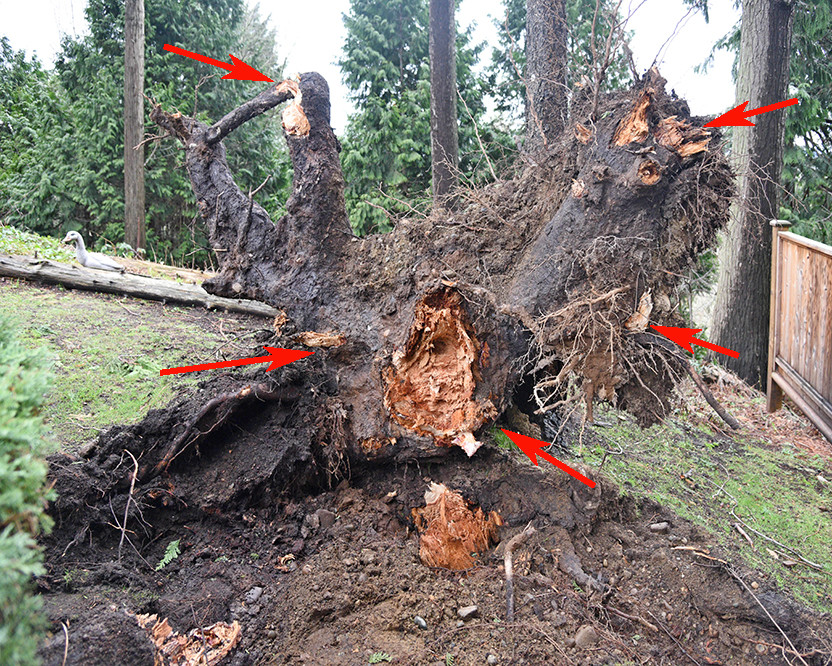
Laminated root rot breaks the wood of the roots away cleanly between the annual growth rings.
What is Armillaria root rot?
Armillaria root rot is a fungal infection caused by Armillaria ostoyae which causes the death of Douglas firs, true firs and pines by root to root contact. It yields separate honey-colored mushrooms and black “shoestring” rhizomorphs, which extend under the bark, killing the tree at the base.
Armillaria is not a completely hidden disease like laminated root rot. When you remove the bark from the base of a dying tree you will see thick white mycelial fans tightly adhering to the sapwood. It attacks true firs and pines, but is strongly resisted by some species such as western larch and incense cedar, according to the Pacific Northwest Pest Management Handbook.
You can read more about these specific resistant species in our guide to evergreen trees in Seattle.
What are the signs of root rot in a tree?
The four physical signs that indicate a coniferous tree has root rot are heaving, tip dieback, yellow needles and mushrooms emerging directly from the base of the trunk.
The tree also can’t pull-up water as the root system physically decomposes underground. Slowly the canopy is starved. These underground anchors are critical to the massive trunk’s stability and are likely to come unstuck without them.
Look for these seven specific physical warnings:
- Yellow (chlorotic) leaves throughout the canopy or thinning leaves throughout the canopy
- Dieback that starts at the top of the tree and works its way down
- A “distress” cone crop (a sudden, unusually heavy production of small cones)
- Honey-colored mushrooms clustered heavily at the trunk base in the fall
- White mycelial fans or black shoestring-like threads under the bark
- Thick resin bleeding or oozing near the root collar
- Multiple trees dying in an expanding circular pocket in a forested yard
The distress cone crop is a fascinating biological panic response. The tree senses its root system failing and dumps all remaining energy into reproducing before it dies. We cover more general fungal symptoms in our guides on mushrooms growing on your trees and identifying and treating tree fungus. Be careful not to confuse root rot with foliage issues like Swiss needle cast, which only affects the needles and leaves the roots perfectly healthy. You can review general decline symptoms in our broad guide to the signs of tree disease.
Laminated root rot vs. Armillaria: how to tell them apart
Wood rot distinction between Armillaria and laminated root rot is made by examining the decayed wood and looking for fungal structures. Laminated root rot will split the wood easily by the annual growth rings, while Armillaria will produce honey mushrooms, black rhizomorphs and white mycelial fans beneath the bark.
Wood that is properly identified determines how the wood should be treated and what can be safely replanted.
| Feature | Laminated root rot | Armillaria root rot |
| Pathogen | Coniferiporia sulphurascens | Armillaria ostoyae |
| Tell-tale sign | Delaminating wood rings | Honey mushrooms, white fans |
| Spread | Root contact; persists in stumps | Root contact and rhizomorphs |
| Primary hosts | Douglas fir, grand fir | Douglas fir, true firs, pines |
| Resistant trees | Cedars, pines | Western larch, incense cedar |
On a property in Sammamish last October, a homeowner asked us to install a support cable in a leaning Douglas fir. The tree had pushed out a massive crop of tiny cones. I dug four inches into the soil at the base and found thick white mycelial fans wrapped completely around the root collar. It was advanced Armillaria. Tree cabling was not possible as there were no remaining solid roots to hold up the tension. The next day we had to take it down with a crane.
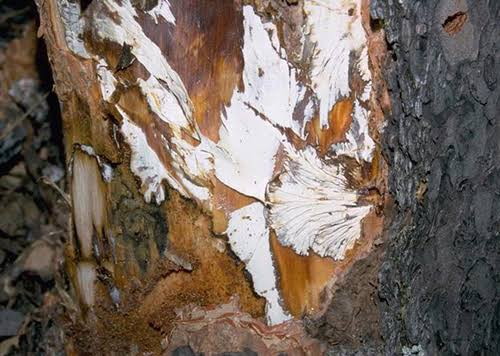
If you cut away the bark at the base of a tree with Armillaria infection, you will find thick white mycelial fans blocking the water flow.
Can root rot in trees be treated?
There is no chemical cure or treatment that reverses established root rot in Pacific Northwest conifers. Management strictly involves confirming the diagnosis, assessing the tree’s failure risk, removing hazardous trees, grinding out infected stumps, and replanting the area with highly resistant or immune tree species.
This is a hard truth in arboriculture. If a canvassing tree service offers to sell you a fungicide soil drench to “cure” your dying Douglas fir, they are stealing your money. The decay lives deep inside the structural wood of the roots where surface chemicals cannot physically reach.
Once the infection takes hold, the only safe path forward is mechanical. Then you cut down the tree and then you aggressively get down on the stump and grind. In our stump grinding service, the root mass that is infected will be broken up and will be able to rot more quickly in the ground, leaving no long term food source for the fungus. Afterward, you must practice smart replanting. You cannot plant another susceptible conifer in that exact spot. Instead, choose resistant species. The western red cedar and many Seattle native trees like red alder or bigleaf maple naturally resist these pathogens.
What should you do if you suspect root rot?
- Never dig blindly: Never cut roots without someone knowing exactly where you are; if you cut into an already unstable tree, the tree will fall very soon.
- Observe for signs: Honey mushrooms in autumn, heavy canopy dieback or an unusual distress cone crop.
- Hire a TRAQ arborist: Get a professional to evaluate the remaining structural holding wood safely.
- Verify the pathogen: Wood samples may be taken and submitted to the WSU Plant & Insect Diagnostic Lab to identify the specific fungus.
- Remove the hazard: If the roots are heavily infested, have a professional tree removal service remove the tree right away.
- Grind the stump: To remove the block of affected wood and prevent spread to surrounding healthy trees.
- Replant properly: Plant resistant broadleaf and cedar species that won’t absorb the residual disease.
Frequently Asked Questions
Is there any hope for a tree afflicted with root rot?
No, a well-established root rot of Armillaria or laminated root rot cannot be cured in a mature conifer. The pathogens permanently destroy the structural wood in the root system. After becoming established, the damage is permanent and the tree will die or topple over.
Can root rot spread to other trees?
Yes. Root rot is very transferable amongst susceptible tree species. Spread occurs by root to root contact of healthy trees with infected roots or stumps, allowing the roots to come into physical contact with one another. It works its way outwards in a circular fashion, developing into large disease centers.
What trees are resistant to root rot in the Pacific Northwest?
Western red cedar and incense cedar are very tolerant of laminated root rot and Armillaria root rot. Laminated root rot seems to have no effect on some hardwoods like red alder, bigleaf maple, and Oregon white oak and are good replanting species for contaminated soils.
Do I have to remove a tree with root rot?
If the tree is large and is going to fall on a house, driveway or power line, it should be removed if the tree is in the process of root rotting. Root rot robs the tree of its structural support and may make it a hazard to steer clear of during windy weather.
Are the mushrooms growing at the base of my tree poisonous?
Honey mushrooms growing around the base of a tree are signs of late stage Armillaria root rot. The mushrooms are not the root cause of the tree’s death, but they are the fruiting bodies of the fungus that is doing the damage to the tree’s root system, which means that the tree is in a critical condition.