Washington is an Emerald Ash Borer hotspot for all EAB enthusiasts. On August 19, 2026, WSDA confirmed the first detection in the state in Vancouver. This insect is traveling directly up the I-5 corridor to Seattle. Owners of green ash or Oregon ash trees are out of the grace period. Learn the indications of distress and why you need to preserve your home safe and secure and out of the stage of being unrepaired
What is the emerald ash borer?
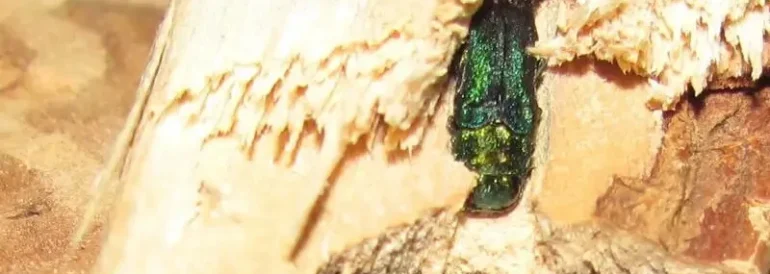
The emerald ash borer (Agrilus planipennis) is an insect species that has been introduced to North America and is a metallic green beetle that attacks and kills all true ash trees (Fraxinus species). Eggs are laid on the bark by the adults. Larvae hatch and feed upon the cambium layer inside the tree. This hidden watering will result in the tree’s death.
Already tens of millions of trees have perished throughout North America. In the Pacific Northwest our local Oregon ash and the common ornamental green ash are very susceptible. The adults are very small. These are only half an inch long and don’t do the damage. The actual damage is caused by the larvae which are out of sight. They kill the phloem tissue below the bark, thus slowly suffocating the host.
How do you identify an emerald ash borer infestation?
These are physical indications of larval damage and stress and are indicators of an Emerald Ash Borer infestation:
- Exit holes in the bark that are D-shaped and about 1/8 inch wide.
- Canopy die-back that starts in the top third of the tree
- Feeding galleries well under bark with an S shape appearance when seen close-up.
- Epicormic sprouts (new and bushy sprouts from the trunk base)
- More woodpecker activity and “blonding” (shredded, light colored bark)
- Vertical splits running down the trunk
You cannot rely on spotting the beetle itself. We highly recommend reviewing the Washington Invasive Species Council’s look-alike guide, as several harmless native metallic beetles get easily mistaken for EAB. Look at the tree’s symptoms instead.
- “On a recent call in Bellevue, a homeowner thought the heavy vertical bark splits on their green ash were a guaranteed sign of emerald ash borer. We peeled back a section of loose bark and found zero larval galleries, the tree was just splitting from severe, unmanaged drought stress.”
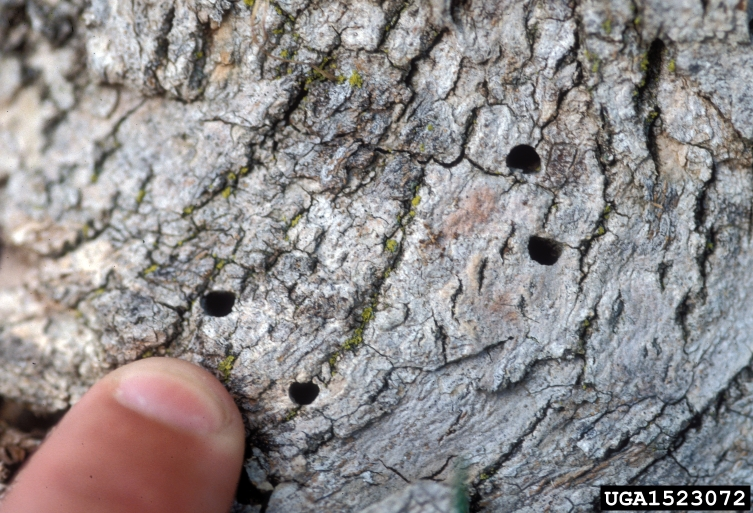
The D-shaped exit holes beneath the bark are obvious signs of emerald ash borer activity.
Is it EAB or just drought stress?
Seattle summers are getting hotter, and shallow-rooted ash trees often show serious canopy die-back simply from lacking water. You might see yellowing leaves or dead branch tips in August and assume the worst.
The main difference is how the tree fails.The leaves are likely to scorch at the edges and to drop early, and may be uniform throughout the canopy with drought stress. Emerald ash borer (EAB) injury causes spurts of panicked new growth to emerge from the base of the trunk (epicormic sprouting) as the top third of the tree’s canopy dries up. Before watering if your tree is looking thirsty, try a slow, deep watering to help first, which we talked about in our guide: How to water your Seattle trees during the dry summer.
How do you treat a tree for emerald ash borer?
Emerald ash borer treatment is made with a systemic insecticide applied stem injected into a tree containing emamectin benzoate. The chemical is applied to the trees by a licensed applicator in the spring and is carried up the vascular system to kill feeding larvae. One treatment protects a healthy ash tree for two to three years.
According to a Washington State University Extension guide (FS384), you should begin preventive treatment once EAB is confirmed within 15 to 30 miles of your property. Do not bother with DIY soil drenches found at hardware stores. Those formulations are weak, wash away in our spring rains, and often fail to reach the upper canopy where the beetles attack first.
- Treatment is highly effective, but it only makes sense for healthy trees. The general rule from the Arbor Day Foundation and the WSDA is that if an ash tree has already lost more than 30% to 50% of its canopy to borer damage, it cannot absorb the insecticide. At that point, you have to cut it down.
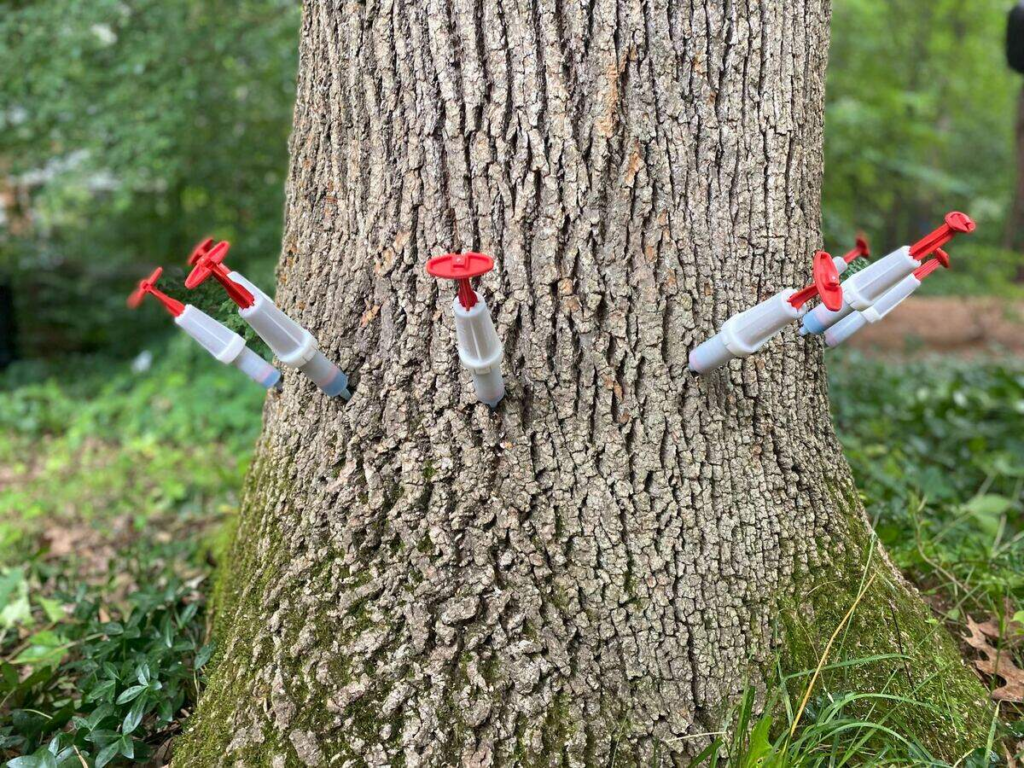
Stem injection chemicals are introduced directly into the trees’ vascular system for up to 3 years protection.
When should you remove an ash tree instead of treating it?
Borrowers kill ash trees and leave them to dry out, making them very brittle within months. Branches snap unpredictably.
If your tree is already showing heavy canopy die-back or severe woodpecker blonding, skip the insecticide. The structural wood is failing. You must schedule a hazard evaluation immediately. Delaying the removal of a dead ash makes the job exponentially more dangerous and expensive, as climbers cannot safely anchor into rotten wood.
- “It wasn’t long ago that we inspected a dead ash in Queen Anne that was so brittle due to structural rot that our lead climber could not set an anchor safely, and instead had to use a 60 foot spider lift and dismantle the canopy from the outside, which completely changed the scope and cost of the job.”
If you are unsure whether your tree has crossed the threshold, start by reviewing when to remove a hazard tree or looking for general signs your tree is dying in Seattle. We evaluate the structural integrity first before discussing plant healthcare options.
What should Washington homeowners do right now?
- Inventory your trees. Identify if you actually have a true ash. (Look for opposite branching and diamond-ridged bark).
- Inspect for damage. Check the trunk for D-shaped holes and the canopy for top-down die-back.
- Confirm your findings. Any suspected beetle should be placed in a plastic bag, frozen and submitted to the WSU Plant & Insect Diagnostic Lab.
- Report it. Contact the WSDA or use the WA Invasive app to report a sighting.
- Hire an expert. Contact a licensed applicator to begin stem injections if your tree is healthy, or schedule a removal if the canopy is failing.
Do not move untreated firewood under any circumstances. A statewide quarantine went into effect in August 2026 for exactly this reason.
If you manage a property with multiple susceptible species, it pays to understand the broader threat landscape. For instance, European white birches face a similar but distinct threat, you can learn how we handle that in our guide to bronze birch borer control and treatment. If you want a professional assessment of your ash tree, check out our Tree Plant Care Program or our Tree Removal services.
Frequently Asked Questions
Is emerald ash borer in Seattle yet?
As of August 2026, Emerald ash borer has been detected in Vancouver, Washington and is not yet confirmed in Seattle. The bug, however, can be readily spread by infested firewood and state officials are predicting that it will be moving fast up the I-5 corridor.
Will trees survive emerald ash borer?
Emerald Ash Borer (EAB) will kill an ash tree if it is not assisted by humans. Larvae feed on the vascular tissue, causing death of untreated trees in 2-4 years. Injections to save ash trees with a systemic insecticide are the only means of saving them.
What is the cost of EAB treatment?
Emerald ash borer (EAB) trunk injection treatments are estimated to cost between $10-$15 per inch of trunk diameter at breast height (DBH). Approximate costs of treating a healthy 20” ash tree for 2-3 years are $200-$300.
What trees does the emerald ash borer attack?
Emerald ash borer infests and kills all forms of ash (Fraxinus), including green ash, white ash, black ash and Oregon ash, a native plant of the Pacific Northwest. Does not attack mountain ash, a completely different species.
Should I remove my ash tree before it gets infested?
It is not advisable to prune an ash tree in advance if it is not in bad health, if it has structural defects, or if it is in an unsuitable location. Mature, healthy ash trees offer vast shade, property value and can be successfully protected by systemic treatments.