
As you stroll through your Seattle home, you see a steady and unflagging line of very large black ants following up the sides of a mature Douglas Fir or a large Big Leaf Maple. The first feeling you probably have is one of anxiety. Most homeowners assume these insects are actively feeding on the wood, eating the tree from inside to out, and the remedy for the problem is to call an exterminator to spray the trunk.
But for the arborist, the ants are not the disease, they are the smoke giving warning of a fire quietly burning within. In the tree care industry, finding carpenter ants in trees is a sign of the problem that exists within the tree itself, not a cause. This guide will enable you to understand what they can tell you about the health of your tree, when to turn to them for the warning signs, what types of problems they can alert you to, and how to plan appropriately and have an arborist help guide you through the action.
What Are Carpenter Ants, and Why Are They in Your Tree?
The first “mistake” that people make about these insects is that carpenter ants don’t eat wood. Carpenter ants, not like termites, eat the cellulose component; instead they chew through wood to create clean galleries, in which they build a carpenter ant nest in the wood system. They don’t even bother to eat the ground-up wood, instead foraging outside on the protein of insects and the sweet honeydew secreted by aphids.
The Attraction to Pre-Existing Decay
Carpenter ants are very opportunistic as they have to chew out their homes by hand. It is very difficult and strenuous to dig out solid, healthy wood. Rather, they seek soft, hollowed or weakened wood that has already been damaged due to long-standing wetness, fungi, and wood-rotting diseases.
Carpenter ants in the Pacific Northwest will warn you they are living in a native tree such as a Red Alder, if you notice that the tree is already infested with advanced decay. Wood rotting fungi, being a hotspot of wood pests, are provided an unlimited supply of wood materials for their activity in the cool and wet winters of the region and its humid microclimates. If they have decided to nest in your tree, they are giving you a true indication of its internal stability.
Signs of Carpenter Ants in a Tree: What to Look For
As long as the fungus is detected early (in the host), it may be possible to save the plant through structural measures instead of making provisions for emergency removal. There are a number of things that homeowners should pay attention to in a tree during a typical walk-through inspection to determine if carpenter ants are present.
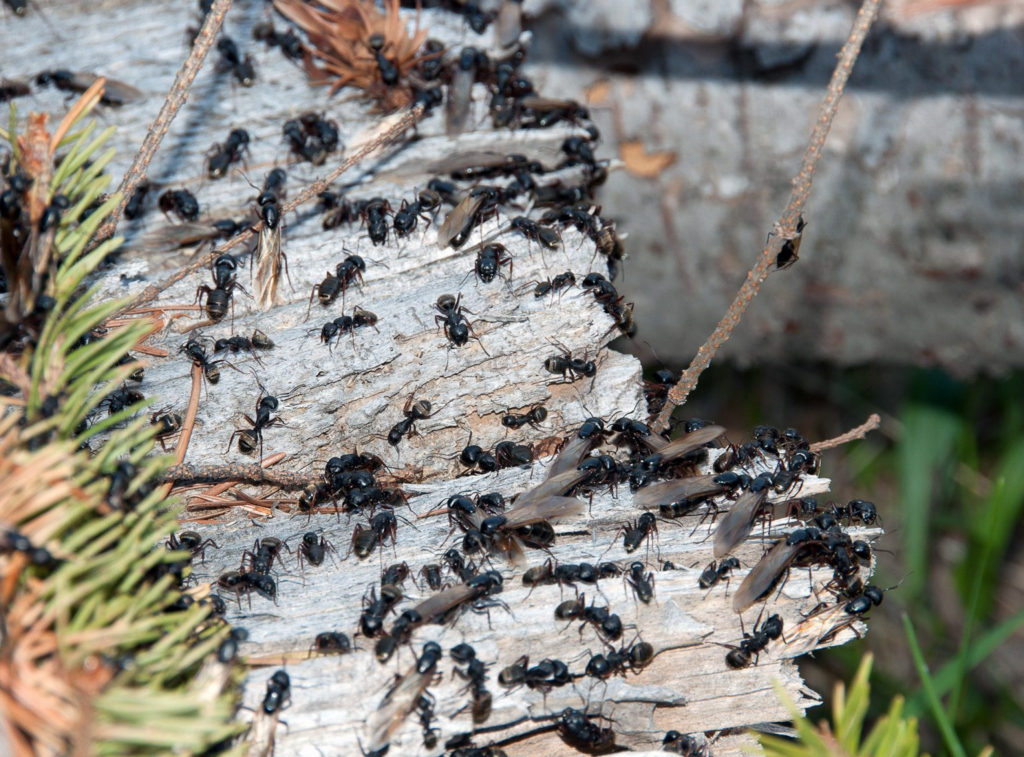
A high point of the foraging worker ants moving up the outer bark layer of the tree.
Established Foraging Trails: Even and well organized lines of large black or dark red-black ants (6-13mm in length) moving up and down the primary scaffolding branches or main trunk. This activity occurs in huge numbers at dusk and at night.
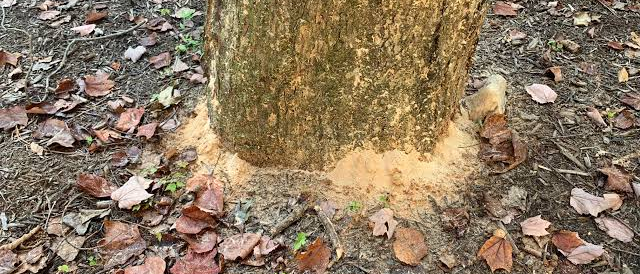
Feeding debris (some Frass collected): the most positive sign of an active nest. Carpenter ants don’t eat the wood, so they have to continually expel the small pieces of wood chewed out of the galleries. This creates a distinct sawdust type pile (frass). Inspect small heaps of frass and tree debris in deep bark crevices, branch junctions or right around the base of the tree where the root flare is. Often there are minute pieces of dead insects in this sawdust.
Deep rustling or crinkling sounds (audible) may be heard on a quiet day when a mature, well-established colony is standing quietly against the trunk of a tree as a thousand or more worker ants pass by their galleries.
Clean, Smooth Internal Galleries: When dead or loose outer surface bark has been removed, inspect the exposed wood surface. Carpenter ant tunnels are very smooth, clean and without any dirt, mud or debris, as if they had been cut with a fine woodworking chisel.
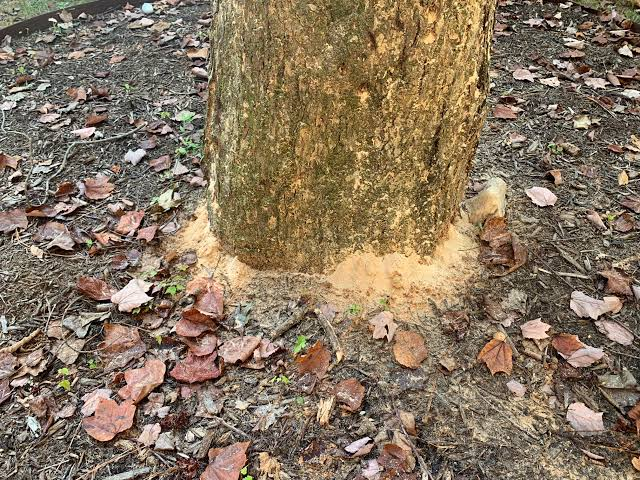
A trunk flare with internal excavation confirmed by the accumulation of coarse frass on the crevices.
Winged Swarmers: Mature colonies in the spring give rise to large winged ants referred to as swarmers. If these winged ants are emerging out of holes or cavities within the trunk or out of cracks, it means that there is a present multi-year colony in the heart of the trunk.
More Woodpecker Activity: As local woodpeckers make intense tapping on a sound looking area of a trunk, they are likely to be searching for fat ants in the outer wood.
Do Carpenter Ants Kill Trees? The Real Risks Explained
The straight biological answer to the question “do carpenter ants kill trees” is no. The ants will not kill or cause a tree to die directly, because they do not consume living vascular tissue (cambium and phloem tissue) which transports water and nutrients throughout the tree.
The Hidden Danger of Internal Structural Failure
The true danger lies in the physical acceleration of carpenter ant damage tree structures. As the colony grows, workers expand their smooth galleries deeper into the heartwood. The dense, structural core that keeps the tree upright. By carving out a network of tunnels through already decayed wood, they rapidly compromise its remaining structural integrity.
A tree suffering from advanced heartwood decay combined with an expanding ant colony is at a significantly higher risk of experiencing sudden, catastrophic limb casting or complete trunk failure. This presents a severe physical hazard, especially if you have carpenter ants in tree near house positions, or near driveways, active walkways, and overhead power lines.
Moreover, the large colony is located adjacent to your house, which is a clear indication of invasion threat. These insects regularly form satellite nests, a nest trail on a nearby branch can easily bring right into the crawl space, rooflines, or wooden decks of your home, particularly in the event that there are undetected issues of moisture or drainage in the structures. Only an experienced arborist will be able to assess whether or not there is enough sound wood in the trunk to withstand severe weather or if the decaying wood in the trunk makes it a direct threat to safety.
Carpenter Ants vs Termites vs Other Wood Pests: How to Tell the Difference
It is important to recognize the exact wood-boring insect infesting the structure so the treatment method and long-term structural impact varies greatly. Homeowners often mistake the clean galleries made by ants for those of subterranean termites or wood-boring beetles, which can cause damage to the wood.
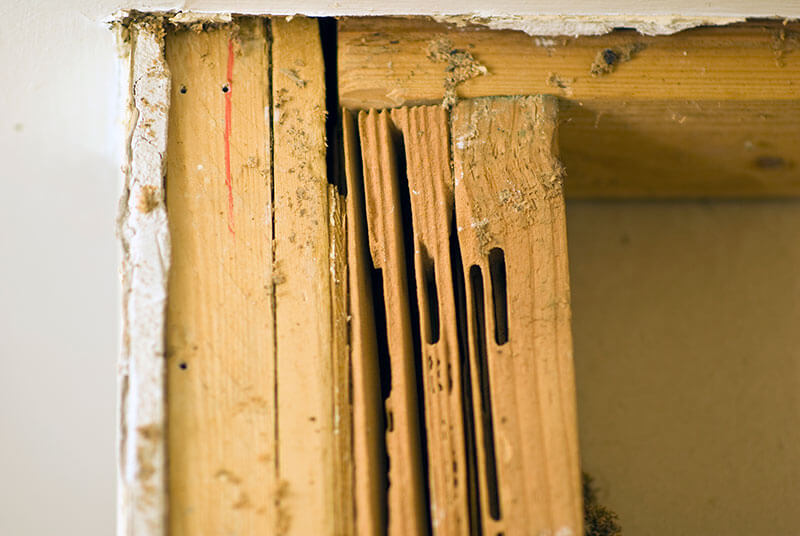
Clean, sandpaper smooth galleries cut only in the softened & damp heartwood parts.
Wood Pest Identification Reference
| Identification Feature | Carpenter Ants | Subterranean Termites | Wood-Boring Beetles | Bronze Birch Borer |
| Do they eat the wood? | No. They excavate clean galleries for shelter, pushing the chewed wood out as coarse frass. | Yes. They actively consume cellulose as their primary food source, leaving structural hollows. | Yes. The larvae bore into the wood and are known as tunnelling grubs. | Yes. Larva feeds exclusively on cambial tissues and interferes with the flow of nutrients. |
| Physical Appearance | Large, distinct black/red bodies (6-13mm), pinched waist, bent antennae. | The insect is creamy white, soft-bodied, unpinched and with straight antennae. | They are tiny, hard shelled beetles, with the adults seldom encountered in the wood. | The beetles have a slender, olive-bronze, iridescent appearance, with distinct larvae. |
| Definitive Visual Sign | Piles of clean, wood-colored frass; smooth, sandpaper-like internal tunnels. | Rough, muddy tubes up trunk base; galleries filled with soil and grit. | Round or oval exit holes; fine dust from wood. | Specialized D-shaped exit holes, and progressive thinning of canopies from top to bottom. |
| What it reveals about health | The wood is already structurally decayed, damp, or dead. | Represents active wood destruction; rarely found in living trees. | Suggests severe stress or drought weakened, or beginning to die tree. | Assesses that the birch tree is under severe stress and direct attack. |
| Primary Tree Threat Level | Accelerates structural weakness within pre-existing decay zones. | Rare in living trees; poses a massive structural threat to nearby buildings. | Usually acts as a secondary factor accelerating ongoing decline. | Lethal. Can completely kill a mature birch tree within 1 to 3 years. |
| Pacific Northwest Prevalence | Extremely Common. | Uncommon in healthy, living trees. | Common in dead or heavily drought-stressed wood. | Highly prevalent; requires specialized birch tree treatments. |
| The Right Professional to Call | ISA-Certified Arborist to assess tree stability, plus pest control if needed. | Structural Pest Control Specialist or Exterminator. | Professional Arborist to evaluate and improve underlying tree health. | ISA certified arborist for systemic micro-injection treatment. |
What to Do If You Find Carpenter Ants in a Tree
When you notice an activity on your property, it is crucial that you have a systematic and professional approach. Symptoms-only treatment may result in a dangerous and unstable tree.
1. Avoid Spraying Insecticides on the Trunk
Using an over-the-counter can of pesticide and spray the visible workers on the bark is cosmetic only. It does absolutely nothing to address the structural decay hidden inside the tree, and the main queen hidden deep in the core will simply ramp up egg production or move the satellite nest to another section of your property.
2. Inspect the Base for Signs of Decay
Circulate around root flare and inspect for weak points. Look for open trunk cavities or old flush-cut pruning cuts that did not heal over, structural cracks or fungi such as conks or mushrooms protruding from the wood. If the trunk leans over high traffic areas such as your roof, sidewalk, driveway etc. note this.
3. Schedule a Professional Hazard Assessment
This is the most critical step. An ISA-certified arborist looks past the ants to evaluate the physical stability of the tree itself. Using diagnostic tools like resistograph drills or sonic tomography, an arborist can measure the exact thickness of the remaining sound wood. By focusing on the structural integrity of the tree rather than just pest eradication, our Tree and Plant Care Programme helps determine whether a specimen can be safely retained.
4. Implement a Targeted Structural Management Plan
Depending on the arborist’s findings, you can choose from a few different structural options:
- Pest Mitigation: Using targeted, self contained insecticidal baits that operators carry deep into the colony to kill the colony without cross-contaminating the surrounding environment.
- Structural Support: In areas where the internal wood structure is sound but with specific weakness, physically tree cabling and bracing can be used to secure heavy limbs that are in a high-risk position.
- Pruning: Cutting of old and overgrown outer branches to enhance wind resistance and weight.
When Does a Tree With Carpenter Ants Need to Be Removed?
If an ant nest is found, it doesn’t necessarily mean a tree must be cut. Slight internal hollows are acceptable and will not kill many mature specimens and are likely to persist for decades. When structural integrity of the tree is at risk due to underlying wood rot, though, it becomes a necessity to protect your property.
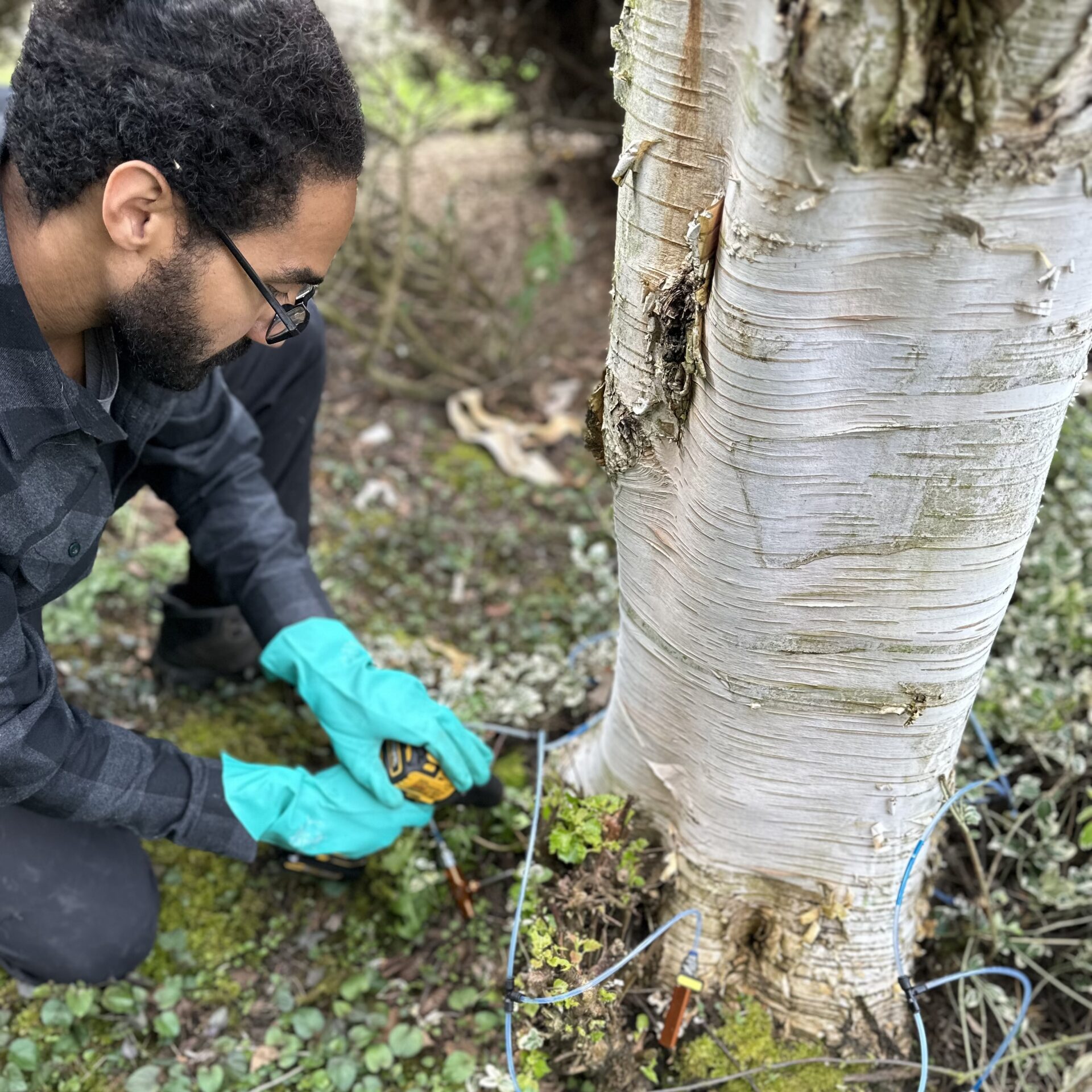
A certified arborist assessing a trunk flare to determine the amount of heartwood decay.
A tree should be seriously evaluated for tree removal under the following conditions:
- The trunk is extensively hollowed with the outer shell of sound wood being 30-35% of the trunk diameter or less.
- The root flare of the tree is soft, crumbling or the soil near the base is lifting, which is sign of a more severe root rot.
- Tree leaning to one side rapidly, large cracks in the main trunk, or large masses of dead branches above a house or public property.
Removing a tree before it is blown down and causes damage is much better and less costly than waiting for a storm to blow up a tree that is causing damage. If u need to take it out, then it is strongly advised to follow it with professional stump grinding. When the roots are large, and overgrown, they can serve as an ideal nesting site for carpenter ants, giving them a good environment to keep expanding into healthy trees around them or to other buildings.
Fact Check: Common Myths About Carpenter Ants in Trees
Claim 1: “Carpenter ants are eating my tree and destroying the healthy wood.”
- Verdict: FALSE. The ants don’t contain cellulose-digesting enzymes and are known as incapable of digesting cellulose. They bite only in wood to provide nesting material, and try to burrow in moistened and rotted wood.
Claim 2: “If I spray the trunk and kill all the ants, my tree is safe.”
- Verdict: FALSE AND DANGEROUS. Killing the ants will eliminate the warning but not the wood rot. The fungus will keep decaying the tree and continue to spread in the heartwood making your tree unstable and dangerous.
Claim 3: “Every tree with carpenter ants must be cut down immediately.”
- Verdict: FALSE. Naturally, many trees can isolate damaged regions in the tree using a process known as compartmentalization. It is usually safe to retain a tree with a hollow if there is enough new and healthy wood surrounding the center of the tree to keep it structurally sound.
How to Prevent Carpenter Ants in Your Trees
The most effective approach to preventing pest problems is to have trees in superb health so that the fungal decay is naturally resistant.
- Protect Tree Health: Deep water during periods of drought and fertilize based on the following: Keep tree healthy and vigorous. Fungi are inhibited by natural chemicals produced by the healthy trees.
- Use Proper Pruning Cuts: Make sure that cuts are made correctly as lateral cuts and not by leaving long dead stubs which rot out. Do not engage in unethical tactics such as tree topping or why improper pruning practices damage trees as unsightly wounds will lead to wood rot and pests.
- Watering and Mulching: Avoid over watering the root zone, but avoid mulching too close to the bark so as to prevent moisture from accumulating around the trunk and the trunk becoming soft. Correct mulching will not cause this to happen.
- Water Wisely Around the Base: Make sure that your lawn sprinklers don’t water the trunk continuously, thus keeping the bark moist and susceptible to infection. Apply water correctly to ensure uniform watering.
- Conduct Regular Inspections: An arborist can detect structural issues that may be a problem before it happens, so you can take corrective action before they become an issue.
Worried About Carpenter Ants in Your Tree? Get It Assessed.
If you have spotted a trail of carpenter ants moving up a tree trunk on your property, the safest response is not a temporary chemical spray, it is a professional evaluation of the underlying wood health. At Bloomatree, our team of ISA-certified arborists can analyze internal trunk stability, determine the exact extent of any wood rot, and design a balanced plan to keep your yard safe. We believe in the importance of preserving healthy mature trees across our communities, balancing environmental care with home safety.
Whether you need a proactive health checkup, structural cabling, or professional tree pruning and trimming to clear away dead wood, our team is here to help. We serve the greater Seattle area with honest advice and clear options.
Call Bloomatree today at 206-714-9835 to schedule your free on-site estimate.