
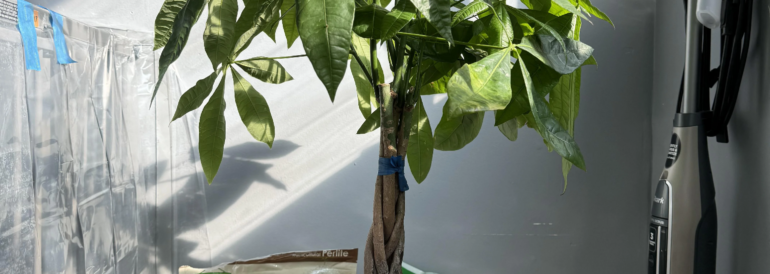
The money tree plant (Pachira aquatica) is one of the world’s most popular and gifted Houseplants and is a plant that is known for its deep rooted reputation in Feng Shui as a powerful symbol for positive energy and financial prosperity, and its elegantly braided trunk, lush glossy leaves. However, the money tree is often touted as an easy-care, tough plant, but countless trees fail to thrive too early in the home and office setting. This occurs not because of poor fortune, but due to a handful of specific, entirely preventable environmental and care mistakes.
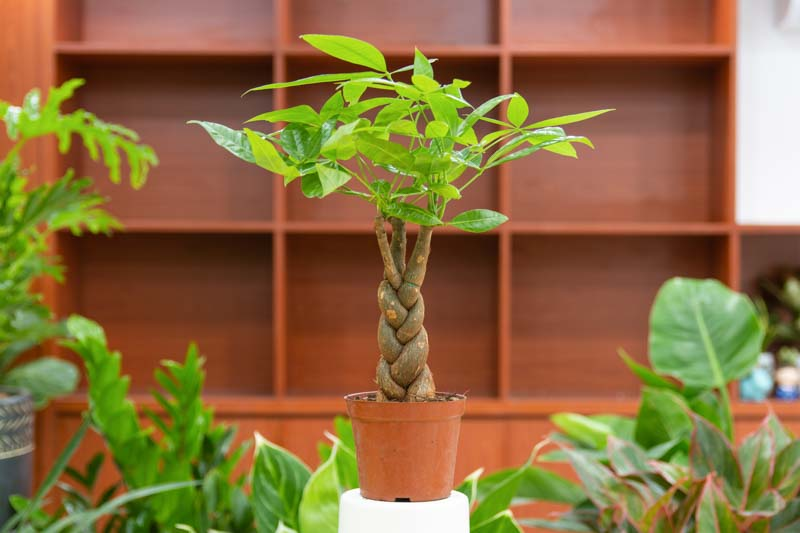
Learning how to care for a money tree plant simply requires shifting your perspective from general houseplant care to fundamental tree biology. In Bloomatree’s care, our ISA certified arborists understand that the physiology of trees at high elevation on a mountain top is the same as trees growing on a desk in our office. A thorough solution to all the key environmental variables, watering methods, soil types and trouble-shooting tactics needed to ensure your tree lives for years to come.
What Is a Money Tree Plant? (Pachira aquatica: What You Need to Know First)
Money tree plant care is rather confusing due to the many different families of plants that have been named money tree. The plant in this guide refers to Pachira aquatica, a tropical wetland species of tree native to Central and South America occurring in swamps and river banks. It’s a totally different plant from succulent Jade plant (Crassula ovata), another name for the same plant is the Jade plant.
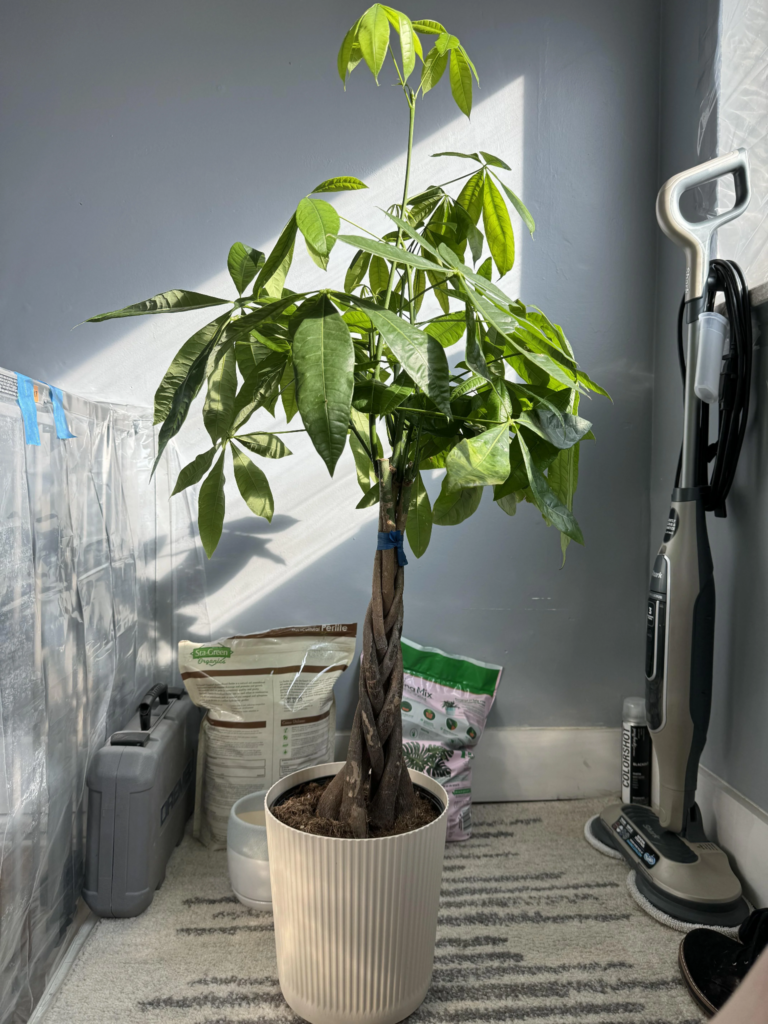
A stunning, colorful money tree plant with a showy braided trunk and five-leafed fronds.
The Origin of the Money Tree Braided Trunk
A Pachira aquatica plant in its natural river environments may grow to 18 m tall. The miniaturised houseplant design in your living room is cultivated with great care in nurseries. The iconic money tree braided trunk is not a natural mutation. Instead, commercial growers place multiple young, flexible seedlings, typically between three and seven, closely together in a single pot. The saplings, as they grow upwards, are carefully interwoven with green stems. As the bark grows older and dries, over time the braided texture becomes permanently fused.
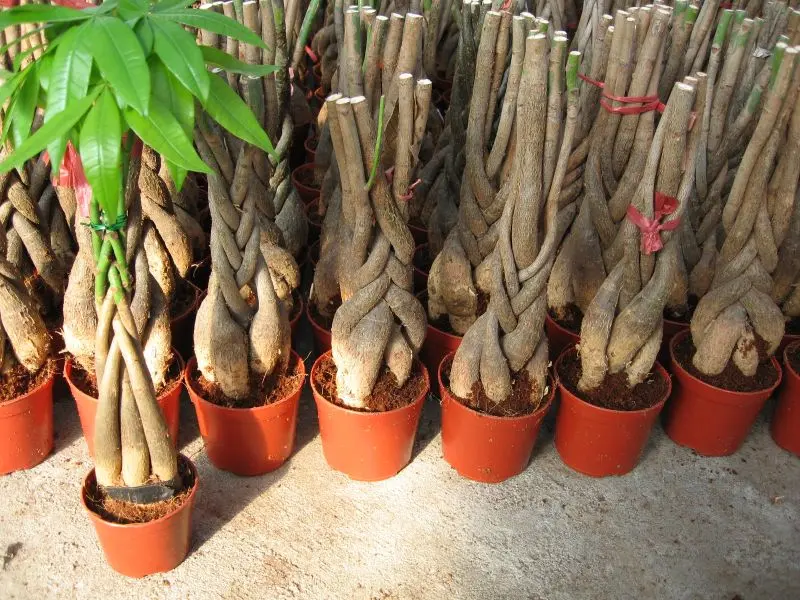
Cross section of a healthy, mature, braided trunk system.
The five lobes of the palmate leaves represent the five elements (earth, fire, water, metal and wood) of balance in Asian culture and the interlocking braids are believed to metaphorically “trap” prosperity inside the folds. When kept as an indoor house plant, the well-grown money tree will rarely exceed 1.5 to 2 m in height. For those wishing to add other exotic miniature trees to their indoor plant collection you can also check out our bonsai care guide for instructions on how to style bonsai trees!
Light Requirements: Where Should You Place Your Money Tree?
The most important variable in your tree’s health is the proper structure placement in your home. Photosynthesis requires light and all the power it produces goes to the roots; a plant in a dark corner can’t be saved by learning how to water it, and all the chemical fertilizer will do is to make it more slowly die.
The Golden Standard: Bright, Indirect Light
When trying to create a money tree’s light requirements successfully, the ideal light source is bright, indirect light. Imagine the sunlight that is let through a thick tropical rainforest.
- Best Place: Tree should be located within 1-2 metres of a large south or east facing window. Sheer curtains help to reduce harsh lighting.
- Alternative Placements: A west facing window is ideal, but always make sure to look at the leafy parts in the summer so that the heat of the day doesn’t damage them.
- Things to Avoid: It’s too dark if it is facing a north window or a dim hallway. If not enough energy, the plant will cease growth and drop leaves.
Can Money Trees Handle Direct Sunlight?
The money tree will need soft, direct light in the morning but cannot withstand strong afternoon sun. Exposing this tender foliage to unfiltered UV rays will burn it and cause the leaves to turn white or straw-like and will fall off. On the other hand, if the tree is deprived of light it will grow “etiolated”, with long, weak, lop-sided branches that develop huge spacing between the clusters of leaves as the tree scrambles for the closest light source.
The pot should be turned 90 degrees every two weeks to keep the canopy full, balanced and perfectly symmetrical. Money trees will grow towards a source of light and frequent rotation will allow the structure to grow in a balanced way on all sides.
How to Water a Money Tree Plant Correctly
The number one reason why houseplants fail is due to chronic overwatering. The money tree has a very thick, swollen trunk base which contains a large amount of moisture and starch, making it very susceptible to root decay should the soil be kept constantly wet.
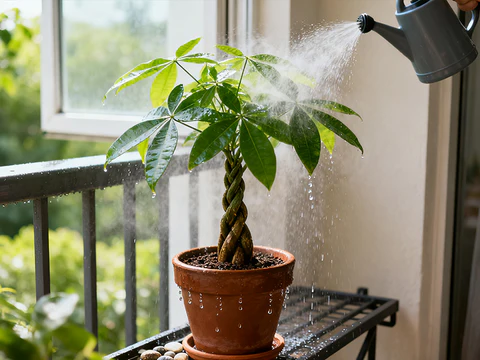
Slowly and evenly pouring water over the whole soil surface to water the roots thoroughly.
The Correct Watering Method
When executing money tree watering, discard fixed, calendar-based schedules entirely. Rather, apply the easy finger test to 2 to 4cm in the soil substrate. If it is cool and damp, move out of the area. When dry and crumbly at that depth, it’s time to water.
If it is time to water, water it thoroughly. Water slowly over the whole soil surface, so that water is allowed to dribble out through the drainage holes at the bottom of the pot. This ensures that the whole root ball is filled and won’t have any hidden dry spots. Empty catch saucer within 30 minutes after water has drained. It is important not to leave the pot in still water as this will soon cause the roots to rot.
Adjusting for Seasonal Cycles
Moneytree needs watering every 7 to 14 days in the spring and summer (warm months) and every 14 to 21 days in the winter (cold months). These timelines are variable depending on the environmental conditions, such as the containers’ material and the heating or air conditioning of the interior of the container.
Do not use the same watering level all year long. This is the same deep watering and soil checking that our arborists employ when working on large landscapes to deal with varying seasonal conditions.
The Best Soil and Pot for a Money Tree (And When to Repot)
Pachira aquatica is native to the wild on the riverbanks with continuous water flow. This means that it is able to have root systems which can grow in very well drained, well oxygenated soil. When restricted to a container, providing an aerated medium is absolutely essential to prevent root rot.
Designing the Best Money Tree Soil
Compact soils do not provide oxygen to the soil, and over time, a standard dense potting soil will become compact. The key is to use an organic base to provide the money tree soil with structural coarse aggregates:
- Optimum Recipe: 60% Organic Potting Compost (peat free) + 40% Perlite or Coarse Horticultural Sand.
- The Quick Alternative is a high quality, ready-mixed soil mix that is formulated specifically for cactus and succulents, and is fantastic for fast drainage and root aeration.
Use a pot with holes in the bottom. If you prefer a highly decorative outer ceramic pot, but don’t want holes, use a plastic nursery pot liner. Take the liner apart completely when watering and put it back in the decorative outer pot after it is drained.
If the time comes to paint over, pick a pot that is just larger than the one you already own (about 5cm larger in diameter). When a plant is placed in a very large, too large pot, there is a large ring of soil that cannot be reached by the plant’s roots. This soil when allowed to fall into disuse becomes so water-logged that it is ideal for fungal diseases for weeks.
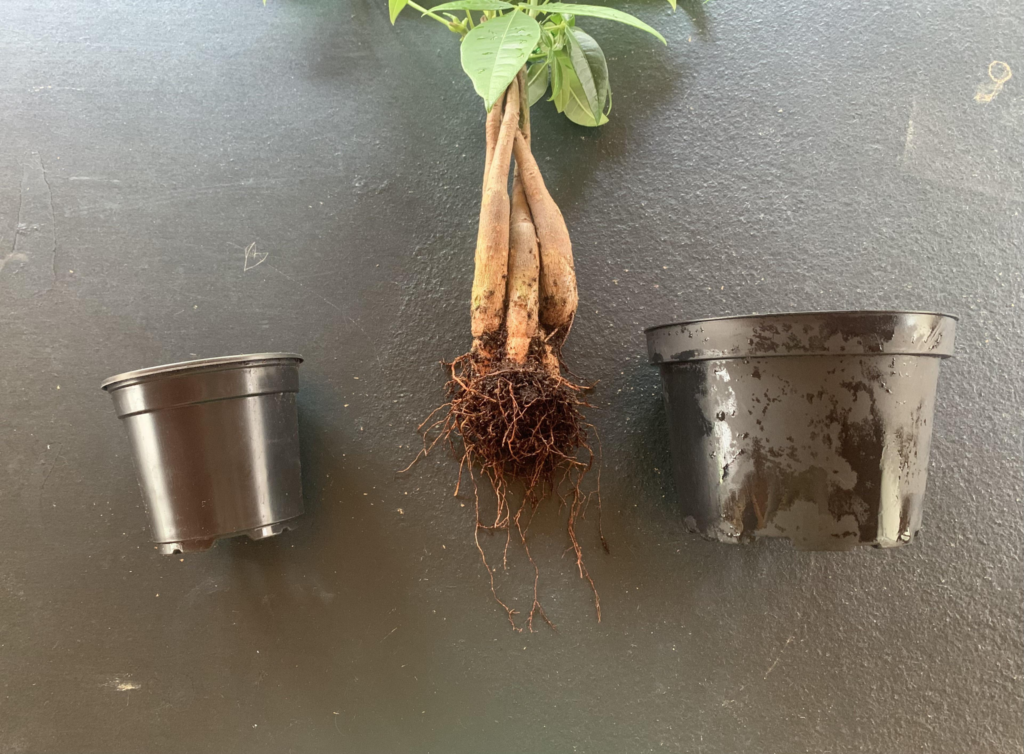
Transitioning a money tree into a slightly larger pot filled with loose, aerated substrate.
A step-by-Step Money Tree Repotting.
Repot the money tree in early spring, every 2 to 3 years, as soon as it starts to emerge from its winter dormancy.
- Carefully remove the pot from the existing container.
- Loosen soil particles around edges with fingers or small root rake.
- Carefully examine the roots. A healthy root will be pale, firm and tan. Use sterilized shears to make clean cuts in order to remove all mushy, foul-smelling roots.
- Center the tree in its new container, fill with your new soil and gently pat down the sides of the container to settle the soil.
- Water well and set in indirect, bright light.
This fine art of root-zone management is based on the same biological principles our team applies when assessing tree root system function and planting young trees.
Fertilizing Your Money Tree: How to Feed It Without Overdoing It
Money Trees are moderate feeders. Their soil mix drains easily and over time nutrients leach out and need replaced when growing.
Use a well balanced liquid houseplant fertilizer with equal amounts of N, P and K (10-10-10 or 20-20-20) diluted to half its normal strength. Apply this liquid solution once a month from April through September.
Stop all fertilization completely during autumn and winter. As light decreases, the metabolic rate of the tree becomes lowered and it is unable to use additional nutrients. Fertilizing at the above mentioned times may result in salt accumulation in the soil that can burn the root tips and also result in browning edges of the leaves. If white crust is visible at soil surface, flush with plain water to remove excess salts. These basic nutrient dynamics match the principles found in our guide to tree fertilisation, which forms the foundation of our residential Tree and Plant Care Programme.
Humidity, Temperature, and the Money Tree’s Tropical Comfort Zone
Pachira aquatica is a tropical wetland plant and require a stable and warm room environment to thrive.
Humidity: Humidity above 50% is preferred for money trees. The typical indoor air levels in winter are very dry, at about 30%. The leaves turn dry and brown at the tips due to this dryness. Place the container on a shallow tray with polished river stones and water to increase the level of humidity, ensuring that the pot’s bottom is safe above the water level.
Temperature:Maintain an indoor temperature of 18°C – 27°C. Do not allow temperatures below 10°C, because it will be a shock to the plant if it is exposed to a sudden cold draft from the air conditioning vent or the window.
Common Money Tree Problems: Diagnosis and Fixes
If the money tree is having trouble, it will say so via its leaves. If these distress signals are spotted early, then it is possible to make changes to the environment before damage occurs which may be permanent. This diagnostic process is identical to the skills our arborists use when reading distress signals in trees across larger urban landscapes.
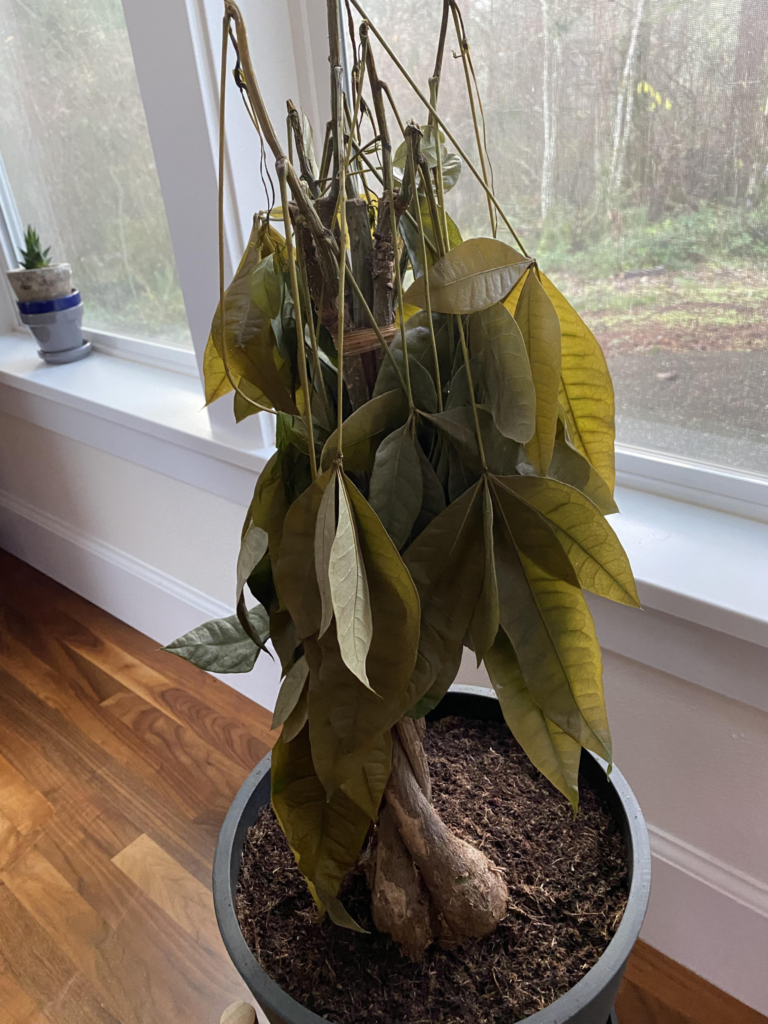
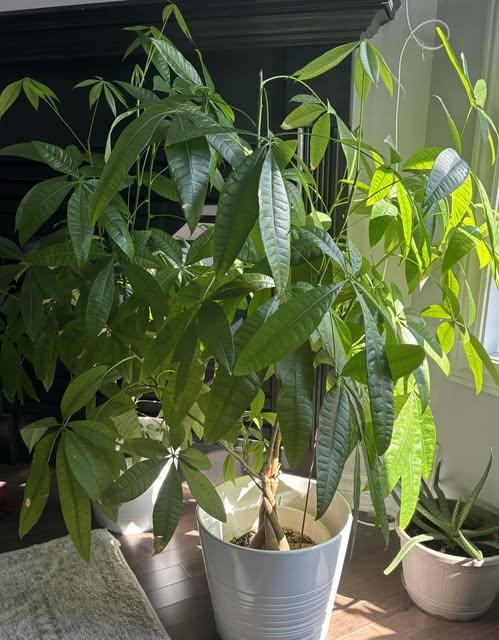
A clear side-by-side visual contrast highlighting the physical signs of overwatering stress.
Money Tree Problem Diagnosis Table
| Symptom | Primary Root Cause | Secondary Contributor | Immediate Tactical Action | Long-Term Prevention Strategy |
| Lower leaves turning yellow | Overwatering / early structural root rot | Natural shedding of old, inefficient foliage | Stop watering; check the lower roots for mushy tissue. Repot if needed. | Wait until the upper 4cm of soil is dry before watering. |
| All leaves turning pale yellow | General nutrient deficiency | Severely root-bound container constraints | Apply a balanced liquid fertilizer; check if the roots are circling. | Feed monthly during the summer; upgrade the pot every 3 years. |
| Crispy, dry brown leaf tips | Very low ambient room humidity | Salts and fertilizer build-up or fluoride deposition | Have a pebble tray/humidifier nearby; water the soil thoroughly. | Fill with filtered water or water that has been allowed to sit overnight. |
| Money tree drooping leaves | Prolonged underwatering | Advanced money tree root rot killing intake pathways | Test the soil depth; water thoroughly if dry. Check for rot if wet. | Use a wood chopstick or moisture meter to verify root dryness. |
| Sudden, rapid leaf drop | Exposure to cold drafts or rapid temperature drops | Major root shock from recent moving | Move tree from doorways, vents and uninsulated glass. | Keep the room temperature constant and above 15°C all year round. |
| Pale, bleached leaf patches | Severe afternoon leaf sun-scorch | Over-fertilization with chemicals | Place away from direct sun and into bright indirect light. | Place the tree behind a sheer curtain close to windows. |
| Leggy, stretched growth | Insufficient ambient light levels | Nitrogen application rates are too high. | Move near an effective window or use a special light for growing. | Light must be even; rotate pot 90 degree every 2 weeks. |
| Soft, mushy stems or trunk base | Advanced fungal rot from overwatering | Pot lacking functioning drainage holes | Remove the decayed roots and transplant into a completely dry soil mix. | Do not allow to stand in water, test drainage. |
| Fine webbing or sticky leaf residue | Spider mites or mealybug infestation | Drought stress plant due to dry indoor air. | Exclude the tree; thoroughly spray the foliage with organic neem oil. | Maintain humidity levels >50% and check leaves frequently. |
Fact Check: Common Myths About Money Tree Plant Care
Claim 1: “Money trees love neglect; they are low-maintenance plants.”
- Verdict: MISLEADING. A money tree is not as particular as a delicate fern, but it does have very definite requirements. Often it’s considered as “low-maintenance” which means owners leave it in a dark corner or in poor soil which results in a gradual deterioration.
Claim 2: “Misting the leaves daily is the best way to keep humidity high.”
- Verdict: INSUFFICIENT. Misting for a few minutes only does not increase humidity, and can at times leave water on the leaves that can evoke fungal problems. A pebble tray or a small humidifier will give more consistent long-time moisture.
Claim 3: “Money trees need to be watered exactly once a week.”
- Verdict: FALSE. Root rot is often caused by rigidly fixed weekly schedules. The rate of evaporation varies depending on the conditions and needs of the weather, so it is always recommended to check the soil moisture with the finger before watering.
How to Propagate a Money Tree Plant
When you get the hang of it, you can easily duplicate your plant with stem cuttings. This sub-topic is an excellent way to add to your collection or give away healthy, start up trees.
Stem Cutting Propagation (The Most Reliable Method)
- Take a healthy, green and colourful stem in spring or early summer, ideally with two or three different leaf nodes.
- With sharp, sterile shears, cut clean just below a leaf node. Never cut into the main braided trunk; only take cuttings from individual branches growing above the braid. To see how making clean, precise cuts prevents disease entry, look into how professional tree pruning protects larger plants.
- Cut off the bottom leaves, only a cluster or two at the very top of the cutting.
- Let the raw end of the piece dry for 45 minutes to form a callus on the end.
- Dip the callused end in rooting hormone powder and place in a small container of damp, perlite free, potting sand.
- Cover with a clear plastic bag that is not tight-fitting to retain moisture, set in bright, indirect light and make sure the mix stays moist. New roots will begin to grow in 4-8 weeks.
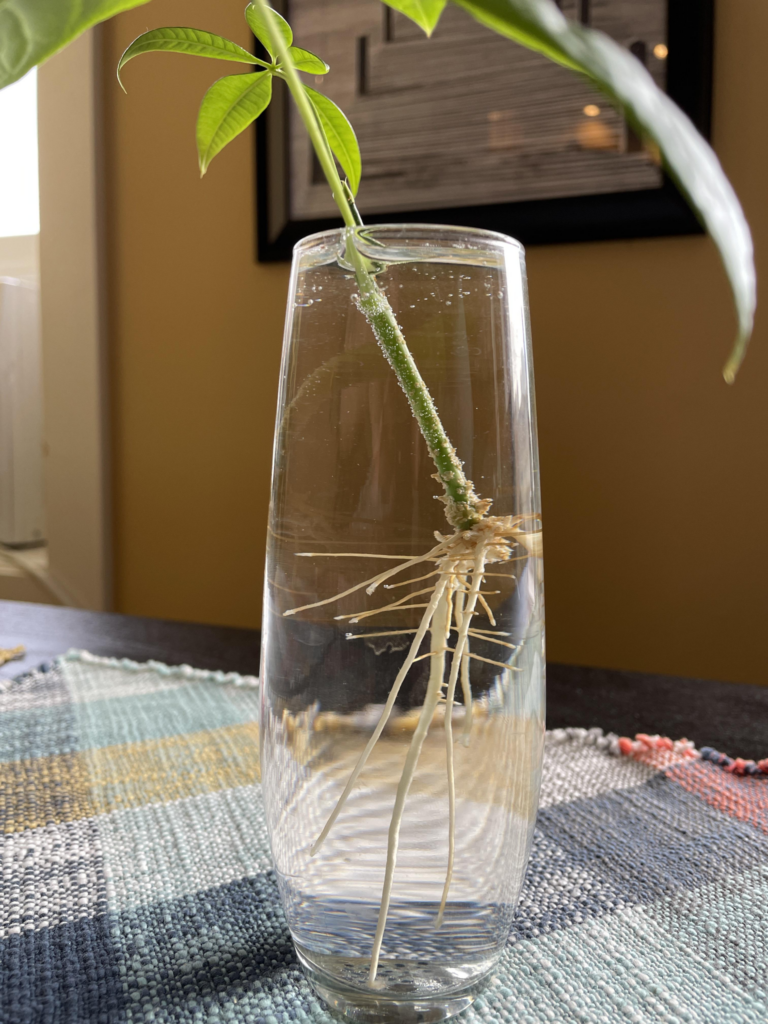
Root systems emerging from a clean stem cutting using the water propagation method.
Water Propagation
Then, you can either mix your own stem cutting solution or insert your prepared stem cutting into a glass jar of filtered water. Place in a warm, sunny area, where the light is indirect and change water every 5-7 days to prevent bacteria from accumulating. When healthy, white root networks are at least 3 cm long, gently transfer the cutting to a new container with draining soil.
Seasonal Money Tree Care: What to Do and When
Spring (Rejuvenation Phase)
- As the tree gets into active growth, water more frequently.
- Feed with a balanced houseplant fertilizer diluted to ½ strength again once a month.
- If roots are starting to grow out of the pots, repot it into new soil.
Summer (Peak Growth)
- Be sure to keep an eye on soil moisture; pots dry out faster in warm summer days.
- Monitor indoor humidity when using air conditioning.
- Regularly check undersides of leaves for spider mites or mealybugs, which are the same basic approach to dealing with pest pressure on plants.
Autumn (Decline Prep)
- Reduce and discontinue fertilizations slowly, ending in October.
- Reduce watering frequency as temperature drops and growth decreases in the house.
- Bring your money tree inside before night temperatures fall below 15°C if you have it outside for the summer.
Winter (Resting Phase)
- Stop all fertilizer applications until spring returns.
- Water sparingly, watering only when necessary, or by using the “finger test” to avoid overwatering.
- Just like preparing outdoor trees for seasonal changes, keep the tree away from drafty windows and heating vents to prevent it from drying out or being exposed to a sudden temperature change.
From the Money Tree on Your Desk to the Trees in Your Garden
From a small tropical species in the office to historic, mature trees on your home, the basic needs of plant health are the same: protected root systems, well-aerated soil mixes, and proper watering practices. Growing some indoor plants reminds us of the natural world that is all around us, and why healthy trees are important at all scales. For those who want some greenery that will grow quickly outside their homes, refer to our recommendations on fast-growing trees for yards.
When the mature canopy in your yard requires expert care, Bloomatree’s team of ISA-certified arborists is here to assist. We offer a full suite of services, including crown care, health evaluations, and professional tree removal services across the region.
Contact Bloomatree today at 206-714-9835 or connect with us online to schedule your free on-site estimate.