
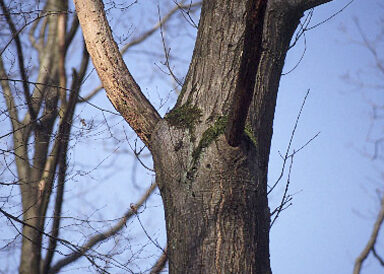
You may be wondering why your maple tree is dying, so relax. The panicked question from homeowners around King County comes to us weekly. An ugly towering bigleaf maple (Acer macrophyllum) doesn’t necessarily spell the end, nor does a finicky Japanese maple (Acer palmatum). Many maples appear to be in terrible condition when they are reversibly stressed by adverse environmental conditions.
When leaves shrivel up in August, people tend to take the most dire view. Let’s come along and see what is going on with your tree and how to properly assess the physical symptoms, as well as what you can do to prevent permanent decline.
Why is my maple tree dying?
The major killers of maple trees in Seattle include: severe drought stress, Verticillillum wilt, Armillaria root rot, girdling roots and insect borers. Poor pruning is also a significant cause of decline, as well as in the case of tree topping. Once the exact stressor is known, this will clarify whether a deep-watering, soil treatment, or removal of the tree is necessary.
Some similarities will be observed if you have just read our guide about why your birch tree is dying. Maples have fungal enemies and structural weaknesses of their own, however. These factors are greatly affected by the climate of the Pacific Northwest. A long dry summer followed by a wet winter provides the ideal situation for water stress and soil pathogens.
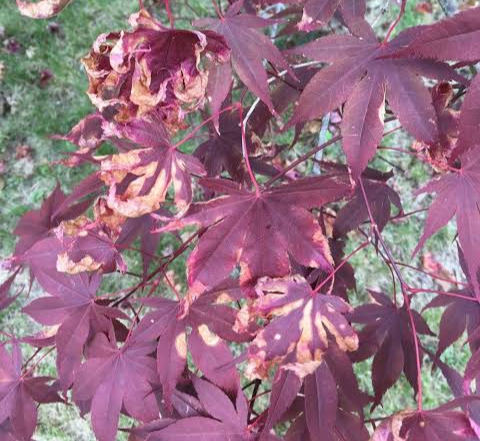
In late summer, instead of dropping leaves, the Japanese maple can show browning leaf edges that are dry.
What are the signs of a dying maple tree?
To determine if your maple is dying, look for the sudden leaves to turn color and the trunk to be damaged. Symptoms of physical decline in the tree that are most likely to indicate maple trees that are actively declining include:
- Dry, brown and crispy edges to leaves – leaf scorch.
- Sudden wilting on just one side of the tree or a single branch
- A sparse canopy with pale, yellowish, or undersized leaves
- Dieback starting from the top of the crown and working downward
- Vertical bark cracks or sunken cankers on the main trunk
- Clusters of honey mushrooms growing directly at the base of the trunk
- Failure to leaf out at all in the spring
You must look beyond normal seasonal color changes. Maples drop their leaves in the fall. If your tree drops its leaves in July, you have a problem. For a broader look at how these symptoms compare across other species in your yard, review our general checklists on signs of tree disease and general signs your tree is dying in Seattle.
Common reasons Seattle maples decline
Seattle maples typically decline because our increasingly hot, dry summers clash heavily with the natural water demands of the species. Soil-borne fungi and physical root restrictions compound these seasonal stressors. We categorize these threats into environmental, fungal, and physical damage. Let us break down the specific issues attacking your yard’s canopy.
Drought and heat stress
Summers in Seattle are becoming warmer. Maples are very sensitive to heat and their roots tend to dry out rapidly. Japanese maples glimmer swiftly in the afternoon sunlight or when illuminated by heat-reflecting concrete. Leaves become brown and crispy along edges. They eventually drop off completely.
This is an environmental reaction, not a disease. You can manage this by reading up on drought stress recognition and prevention and following our exact protocol on how to water your Seattle trees during the dry summer. Slow watering, deep watering, not a daily garden hose spray.
Verticillium wilt
Verticillium wilt is a destructive soil borne fungus (Verticillium dahliae) which enters the roots of the tree and blocks the vascular system. Performs a physical blockage of water transport up the trunk that deprives the canopy of water even when soil is moist, according to a 2024 WSU Hortsense fact sheet.
The typical symptom is wilting on one side. The whole branch or half tree will suddenly wilt or die while the other side of the tree is healthy. Dark, olive-green streaking in the sapwood can often be seen when the bark of a dying branch is removed.
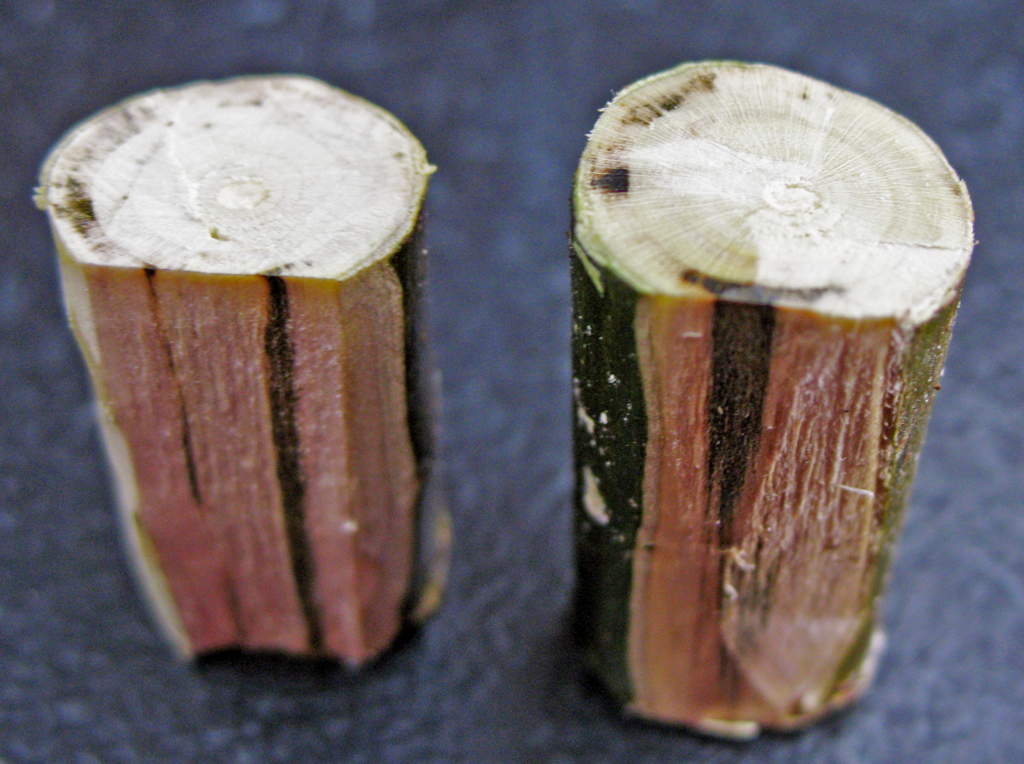
In branches with Verticillium wilt, the sapwood can be dark olive-green with a narrow band of disease causing hyphae.
Root rot (Armillaria)
Armillaria is a fungal root rot that is a common disease of bigleaf maples. The fungus kills the extensive structural roots that hold the tree in place. Fall clusters of honey mushrooms (small, yellowish-brown) are an indicator of an active root system rot. This is a threatening structural issue. The tree might look green up top while losing its physical grip on the soil.
Girdling roots
Maples grown in containers will frequently have circling roots. As the tree grows the roots grow thicker and narrow the base of the trunk. They behave like a tight belt, and block out the flow of water and nutrient.
This disease gradually suffocates the tree over a number of years. You will notice the canopy getting thinner and the leaves getting smaller each spring. Understanding how tree root systems work and learning how to care for newly planted trees properly prevents this entirely.
On a recent call in Ballard, a homeowner thought their weeping Japanese maple had a deadly wilt disease because half the canopy browned out overnight. We pulled away the heavy “mulch volcano” piled against the trunk and found a massive girdling root strangling the collar. We severed the root with a specialized chisel, and the tree bounced back completely the next spring.
Borers and pests
When stressed, maples can attract Ambrosia beetles and other insects that bore into wood. They make small holes in the bark, forcing out sawdust that resembles toothpicks. Refer to our guide on how to get rid of bark beetles for management tips.
Many panicked homeowners call us assuming the highly publicized emerald ash borer is killing their maple. It is not. That pest strictly attacks ash trees. If you have an ash on your property, read our emerald ash borer identification guide, but rest assured your maple is completely safe from that specific insect.
Improper pruning and topping
Homeowners often hire discount cutters to chop the tops off large maples to control their height. This starves the tree of its food source and introduces massive fungal decay through the open wounds. A topped maple will rapidly push out weak, hazardous water sprouts before rotting from the inside out. If someone recently hat-racked your tree, read why tree topping is bad to understand the biological damage they caused.
Bigleaf maple vs. Japanese maple: different problems
The size, genetics and placement vary in what the dangers are to bigleaf maples versus Japanese maples. The two main problems of bigleaf maples are root rot from fungus and drought, while the two major issues of ornamental Japanese maps are sunburn and shallow watering, and girdling roots.
We manage these two trees completely differently. You can read more about their specific roles in your yard in our guides to Seattle’s native deciduous trees and the best ornamental trees for Seattle.
| Feature | Bigleaf Maple | Japanese Maple |
| Typical Size | 60-100+ feet | 10-25 feet |
| Top Threats | Armillaria root rot, drought | Leaf scorch, Verticillium wilt |
| Most Common Complaint | “Massive dead branches falling” | “Leaves turning brown and crispy” |
| Savability | Hard if decay is advanced | High if caught early |
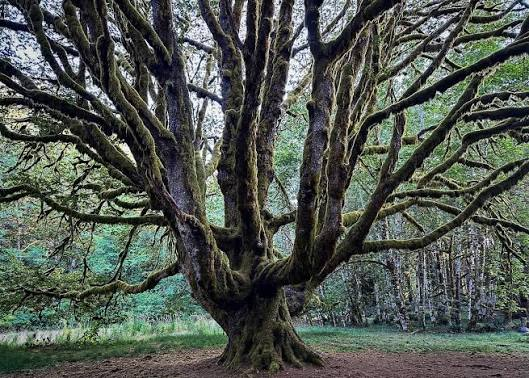
Native bigleaf maples offer massive shade but require significant root space, making them highly susceptible to drought stress in urban environments.
Can a dying maple tree be saved?
A tree that is dying because of a problem that can be prevented by the environment, such as early stage girdling roots, drought or soil compaction, can be saved. Anytime a maple tree has lost over 50% of its foliage or has advanced root rot such as fungus, it is too late to save it.
Your sense of urgency depends on the size of the tree. The Japanese maple is truly an eye-sore when it’s in the throes of death. An overhanging 80 foot bigleaf maple that is dying is very serious. See our guide to when to immediately remove a hazard tree to protect your property if your large maple has significant dead wood, cracks in the trunk or fungal conks at the base.
How do you save a stressed maple?
Immediately adjust your watering schedule if your maple is stressed to slow, deep watering. Mulch with organic wood chip mulch and avoid shade tree pruning and engage an ISA certified arborist to dig out the root collar and diagnose soil pathogens.
Begin at the ground level. Maples grow in moist, well-drained soil that is cool. Know how to mulch a tree correctly. Maintain 2-3 inches of mulch around the trunk but be sure to remove all mulch from the base of the trunk to avoid base rot. Don’t fertilize until you have determined the problem. Feeding nitrogen into a tree that is suffering from a drought will only result to the burning of the remaining roots.
Wait until the dormant season to remove any dead wood. You can review the ideal timeline in our guide on the best time to trim trees. For professional diagnosis, our Tree Plant Care Program will test soils and treat them for disease pathogens on your behalf. Our Tree Removal team can safely take down the tree if it is not salvageable, before it may fail in a winter storm.
Frequently Asked Questions
What causes maple leaves to turn brown in summer?
Maple leaf browning in summer is primarily due environmental heat and drought stress. The edges of the leaves will scorch, turn brown and roll inwards when the roots are not able to draw up water to replace moisture lost through the leaves in the intense heat of the afternoon sun.
Is there a possibility of a maple tree recovering from verticillium wilt?
A mild infection from Verticillium wilt will not kill a healthy tree with other diseases or disorders. No chemical control is available for this soil fungus. Avoiding high nitrogen fertilizers, pruning out dead branches and deep watering during drought will all aid the tree in overcoming the pathogen.
Why isn’t my Japanese maple leafing out?
Not leafing out in spring may be due to late spring frosts, killing buds, water-logged soil, or root suffocation by girdling roots which has occurred in the winter. If the twigs are brittle and snap easily, the area of the tree is dead.
Should I remove a dying bigleaf maple?
If a big leaf maple is considered to be at a high risk of failure according to the judgement of an ISA certified arborist, the tree must be removed. As these age, large and heavy branches drop from big leaf maples. If the root rot is severe or there are very large hollow areas in the tree, it can present a hazard and should be removed.
Will emerald ash borer kill maples?
The emerald ash borer does not kill maple trees. It is a highly destructive and invasive beetle which requires ash trees (Fraxinus species) as host and food. If there is sawdust pushing through or holes in the bark of a maple tree, then it is likely attacked by another pest, such as an Ambrosia beetle.