
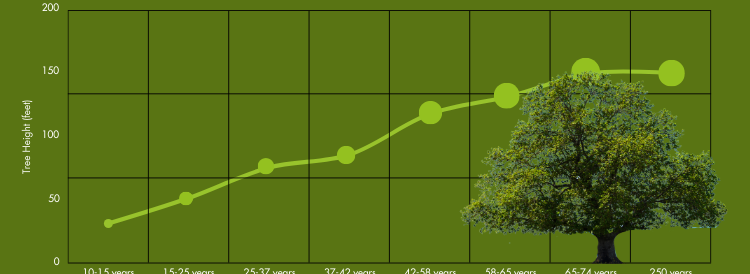
Envision the sunny morning you see the bright leaves of a newly planted Japanese Maple in your Seattle front yard. You selected the ideal location, carefully excavated the hole and placed it in the new location. As spring days become mild, though, and the Pacific Northwest turns to a dry summer, a familiar dread arises. What comes next? What will you do to help this lovely addition last through the seasons?
The first three years are crucial to a newly planted tree. When done correctly, you will end up with a tree that will be around for decades. If they’re incorrect, the investment is gone. The care provided to newly planted trees is not about all day, every day tough labour in the yard, it is about being there at the most appropriate time and place in order to provide the proper care. Year-by-year, this guide covers everything you need to know about watering, mulching, pruning and seasonal protection to guide your young tree to maturity safely.
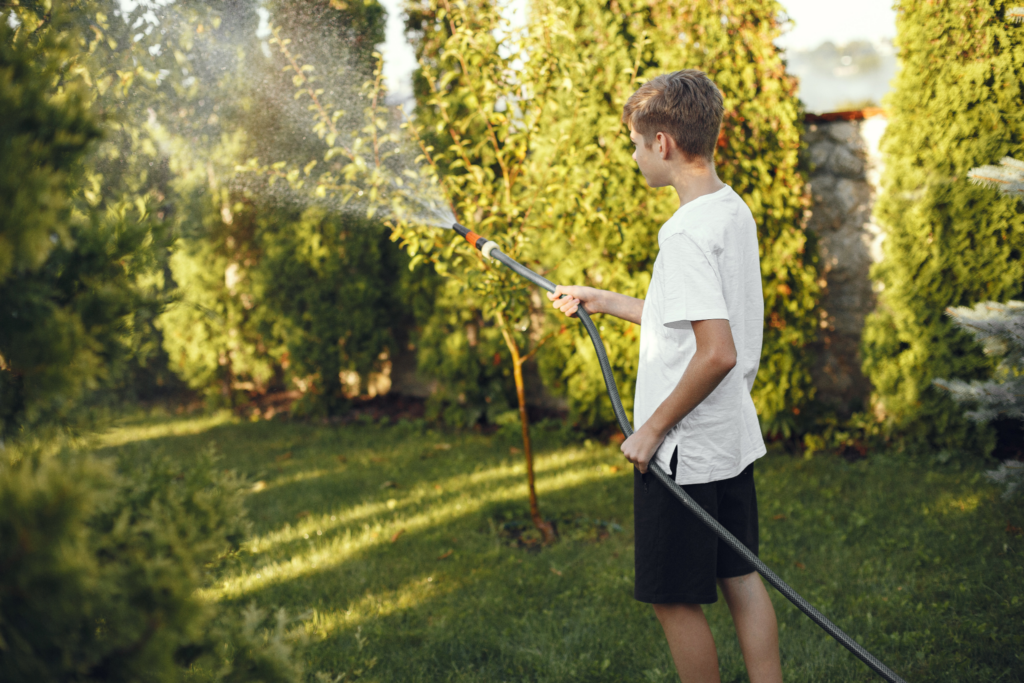
Deep and intentional watering of newly planted tree during the first spring.
Why the First 3 Years Are the Most Critical for a New Tree
Understanding what is occurring under the ground is beneficial before turning on a hose. A tree dug up at a nursery will have up to 90% of its root system removed. After replanting in a yard, it is in the tree establishment phase. In this time the tree uses its scarce energy to grow new roots, not to extend its big canopy.
A young tree is very sensitive to transplant shock tree stress due to a severely damaged root system. The physiological shock may present as wilting or premature leaf fall or stunted growth. Good news: A “minor” case of transplant shock is a normal reaction but a long period of stress can cause failure.
A good horticultural “rule of thumb” for estimating the amount of time your tree will require “handling” is:
- The Establishment Rule: A newly planted tree requires approximately one year of dedicated establishment care per inch of trunk diameter.
In this case, a tree with a 2″ diameter on its trunk will take approximately 2 years to establish and a 3″ diameter will take the entire 3 years. For our distinctive Northwest climate, it is important to know this. In winter, our wet weather keeps our soil juicy and fresh, but our surprisingly dry summers (July – September) is the most critical time for young trees. Native species are particularly well suited to deal with these ever-changing conditions, and as we detailed in our guide to trees native to Seattle, there are some native species that can benefit the garden.
- The three-year period is the best time to invest: it will yield returns for the lifetime of the tree. It requires minimal maintenance after established and you can sit back and enjoy its shade and beauty while the extra supplemental water and intensive care requirements become minimal. Furthermore, tree health promotion is a great way to tackle the recent loss of tree canopy in the region and the importance of planting and keeping trees alive in Seattle.
Year 1: Establishment and Survival
The primary objective of year one is survival. The root system is shallow, weak and limited to the original root ball of the tree. These first twelve months will determine whether or not the tree catches on or fails.
How to Water a New Tree in Year 1
It is important to note that watering is the most important in your tree care first year checklist. Correct application demands changes in how moisture is applied: from repeated, shallow applications to more concentrated applications.
Your tree should be deep watered 2-3 times per week for the first month following planting. After 1 month, water thoroughly once a week during the rest of the first growing season and then twice a month for the rest of the growing season. Proper watering is accomplished by watering slowly to a proper depth of soil (12 to 18 inches) and not just watering the surface.
A rule of thumb is to provide approximately 10 gallons of water for each inch of diameter, per week, during dry spells. For instance, a 2″ wide trunk will need 20 gallons a week of water.
This is especially important for homeowners in their neighborhood. The Seattle area experiences little rain from July through mid-September. Passing summer showers will not do the job, water needs to be done on a regular basis. Watch the leaves for problems. Yellowing leaves that drop easily are an indication of overwatering while leaves with dry, brittle or curling tips are a sign of tree that is seriously underwatered. Read our guide on watering your trees during Seattle’s dry summer for a more detailed approach to summer watering.
How to Mulch a New Tree
Mulching is the best protector of a new tree and watering is its most critical lifeline. A well laid mulch will help to retain soil moisture, control soil temperature and prevent unwanted lawn weeds and grass from displacing existing plants.
The correct way to do this is to apply 2 to 4 inches of organic mulch (wood chips or shredded bark) in a large ring around the root area. Important: Begin the ring 2 – 3 inches away from the trunk itself. Mulch should not come into contact with the bark. A mulch volcano” is the arch of mulch that piles up against the trunk, which is a common gardening error that leads to moisture building up against the bark, which causes tissue rot, encourages the destructive boring insects, and invites fungal diseases.
Best protect the roots by extending this mulch ring out to the drip line (outside of the leaf canopy). Over time, it is likely that the ring will deteriorate due to the breakdown of Organic Matter, so please change the ring annually. If you need more information on proper mulching methods, see our illustrated mulching a tree step-by-step guide.
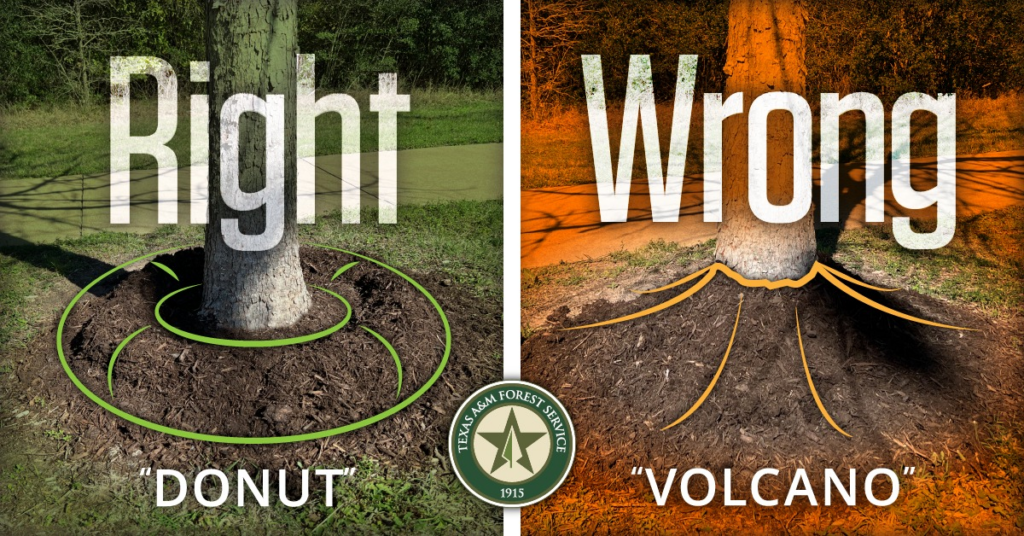
A textbook example of a correct “donut” mulch ring, keeping the trunk clear to prevent rot and bark disease.
Staking: When It Helps and When It Harms
When installing trees, it is easy for many homeowners to think that all trees require staking, but more harm can be caused by unnecessary staking. Stake your tree only if it is too tall to stand on its own in a gentle wind, located on a steep slope that is unstable or if it is too large to stand on its own.
Staking: If necessary, place 2 good stakes across from each other away from the soft root ball. Tie tree to stakes with wide, flexible, smooth horticultural ties. Avoid using nylon rope, electrical cord or bare wire, as these can rip through soft bark.
Most importantly, take out all ties and stakes after 12 months. Allowing them to stay on for too long will not allow the tree to develop its own strength. The wind will cause slight sway to a young tree, which should result in wood being more sturdily formed and trunk thicker in the young tree.
What NOT to Do in Year 1
- Fertilizer: Do not fertilize – do not fertilize in the first growing season. Rapid canopy growth is too much for the root system to handle.
- Do not prune heavily: Keep your shears at bay. Do not take branches from trees unless they are completely dead, diseased or broken from transport. Each healthy leaf that is taken takes away energy-producing photosynthesis from the roots.
- Never disturb the root zone: Avoid digging near the root ball, compaction of surrounding soil using heavy machinery, or planting competitive ground covers directly over the root ball.
- Don’t neglect your trees: Trees that have been planted are not “set it and forget it” landscape items. Neglect during year one is the single leading cause of tree mortality. If your young tree is near a driveway or busy walkway, you also might find yourself with tree sap on the surfaces around the tree if a neighboring old tree drips onto them.
Year 2: Building Strength and Resilience
Your tree has crossed that first year and now has roots extending to the native soil by year 2. Risk of sudden failure decreases, but your young tree care activities move to creating a sturdy structure and long-term stability.
Adjusting the Watering Schedule in Year 2
The second year, less watering can be done, starting with that year, but remember to water deeply! Water in summer, in hot, dry periods once a week, but with a deep watering so that it trickles down into the soil.
Naturally grown trees in healthy, organically amended soil will typically only need supplemental watering during Seattle’s dry summer months after the 2nd year. Run the hose only after doing a quick manual check; as you push a finger or long screwdriver 2 to 3 inches into the ground near the root zone, check for any damage. If dry, water deeply to this depth. Wait a few days and re-evaluate if it is still cool and damp.
Fertilizing a Newly Planted Tree in Year 2
Generally, most landscape trees become lightly fertilized in Year 2. The best time to fertilize a newly planted tree will depend upon the time of the year it was planted; it is best if it is waited until just before the new leaves begin to unfurl in the early spring.
Use a good slow release balanced fertilizer. The use of high levels of nitrogenous fertilizer can cause “flushing” of green tops that are not supported by the root system and are very important to avoid. Also, avoid late summer and fall fertilization; it tends to stimulate late season flush growth that will not sufficiently harden off before the winter frosts.
As each yard can have varying soil properties, the professional touch guarantees the best results. Bloomatree’s Tree and Plant Care Programme is a comprehensive assessment and nutritional program that includes an in-depth soil evaluation and customized plant nutritional planning for the Pacific Northwest landscape.
First Structural Pruning Check in Year 2
The first structural health check should be carried out when the child is in year two. Look for crossing and rubbing branches, dead wood and co-dominant leaders (two main trunks competing for dominance of the tree).
This will allow light and highly selective corrective cuts to be performed without major life problems later on. Don’t remove more than 10% to 15% of the total canopy of a young tree in one pruning season. When in doubt about what to do with your tree, it is helpful to understand the distinction among trimming and pruning to make sure you’re using structural techniques instead of merely tidying up the outside.
Year 3: Transitioning to Long-Term Tree Care
After three years, your tree should have at least some growth of shoots and be well established. Your tree is growing up and is now a mature member of your garden. Your role now is to guide its long-term shape and monitor for underlying health issues.
Watering and Soil Care in Year 3
After three years, on a well drained soil, a tree should require only supplemental water during prolonged periods of regional heat or drought. The main soil chore is to just maintain the organic mulch ring checking it each spring and adding on to stabilize it to a depth of 2 to 4 inches.
If you find that your tree isn’t growing as well as it could or if the foliage is not as bright or dark in color as it should be when watered properly, it may be better to have it tested by a professional to determine nutrient deficiencies.
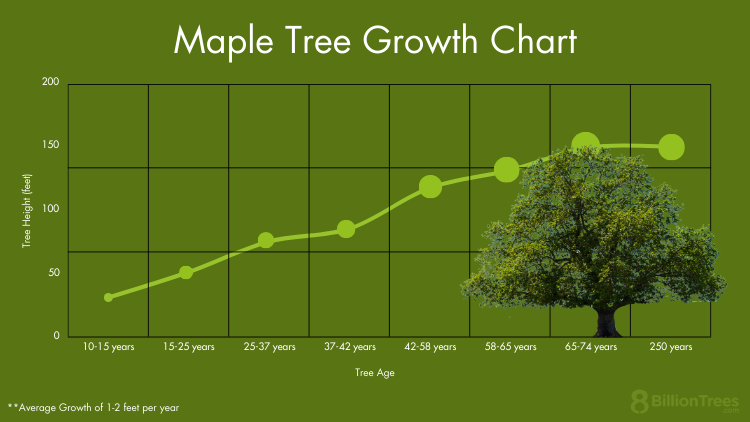
The difference three years makes: a young tree showing strong establishment and canopy development due to proper structural care. (Credits Billiontrees.com)
Structural Pruning in Year 3
Year three is the optimal window for intentional structural young tree pruning. This is the stage where you help establish the permanent “scaffold” branches that will form the lifecycle architecture of the mature tree.
Pay close attention to eliminating any competing co-dominant leaders. If two main stems side by side grow upward in a tight “V” form, they will have weak included bark and during strong winds when the tree matures it can split apart. This is important because if the problem is not corrected early, the tree could end up with significant structural problems in the future that could necessitate more complicated methods such as “tree cabling” which may eventually be needed to maintain the split canopy.
Because the cuts made during this developmental phase permanently dictate the tree’s lifetime shape, we highly recommend having a certified professional handle this step. Utilizing professional tree pruning and trimming ensures clean, perfectly placed cuts that respect natural defense mechanisms, avoiding the long-term decay risks associated with poor techniques like why proper pruning technique matters for young trees. Furthermore, depending on your tree’s location and size, major modifications within city limits may require checking into Seattle tree work permits. A specially designed crown reduction may be used to safely manage wind resistance if the canopy has become too thick.
Health Assessment – When to Call a Professional
If there is any growth abnormality, persistent pests and structural defects, it should be professionally addressed by 3 years. This is the time for trying to solve the chronic problem, much more economical than trying to cure an old and sick tree.
Be alert for signs that could indicate the tree is infected: Any unusual discoloration of leaves that isn’t a natural part of the fall season; open wounds or patches on the bark that ooze; unusual fungi growing near the tree trunk or thin, patchy spots in the upper canopy. If you see any of the above symptoms, it may be useful to determine the severity of the problem by checking with a guide for signs that your tree may be distressed or dead. An arborist can also, in unusual situations, be able to save the rest of your plantings in your landscape, if a young tree is structurally and/or root-compromised and cannot be salvaged, by understanding the methods of removing the tree.
Seattle Seasonal Care Calendar for Newly Planted Trees
The local climate has very pronounced seasonal cycles which affect the way that you care for a growing tree. This calendar is designed to be a handy reference for you to see at a glance what you will need to do during the year.
Seasonal Care Calendar: Newly Planted Trees in Seattle (Years 1–3)
| Season / Period | Year 1 Priority Tasks | Year 2 Priority Tasks | Year 3 Priority Tasks | Seattle-Specific Notes |
| Spring (Mar-May) | Plant in early spring; water well at planting; apply correct mulch ring immediately; do NOT fertilize. | Slow release fertiliser prior to bud break, stake tie and prune out light dead wood. | Evaluate pruning of structures, ask for soil test if growth is poor; replace mulch. | Ideal planting window. It is a moist, warm soil by nature. Do not plant in the middle of summer heat waves. |
| Summer (Jun–Aug) | Water 2-3 times per week July – September; do not depend on summer rain; watch for leaf scorch. | Water thoroughly once a week during dry periods; check for insect and disease problems on the foliage; avoid fertilization. | Water in prolonged periods of extreme heat, check for overall health, do not water lawn mowers near trunk. | July–September is Seattle’s dry season. The most critical time in the life of young trees. Avoid skipping any scheduled waterings. |
| Autumn (Sep–Nov) | Reduce watering when it rains again; don’t fertilize; take out any structural stakes. | Reduce water; check branch structure prior to leaf drop (when limbs are clearly visible). | Final structural pruning inspection; mulch to top before winter/plan treatments for spring. | Good second planting opportunity. During the summer, soil will stay warm and trees put in the fall will have time to root in over the winter. Typical shedding of leaves, learn why leaves change colour in autumn. |
| Winter (Dec–Feb) | Stake after any major winds and do not water late planted crops as it will cause damage to them with hard freezing. | Look for damage to canopy from winter storms; schedule spring maintenance; avoid watering during this period. | Look for storm splits, call for structural pruning in late winter dormancy. | Wet and mild winters. Water logging or soil with poor drainage can cause suffocation in roots as well as drought conditions. Be sure to have proper ground drainage; see preparing your trees for Seattle’s storm season. |
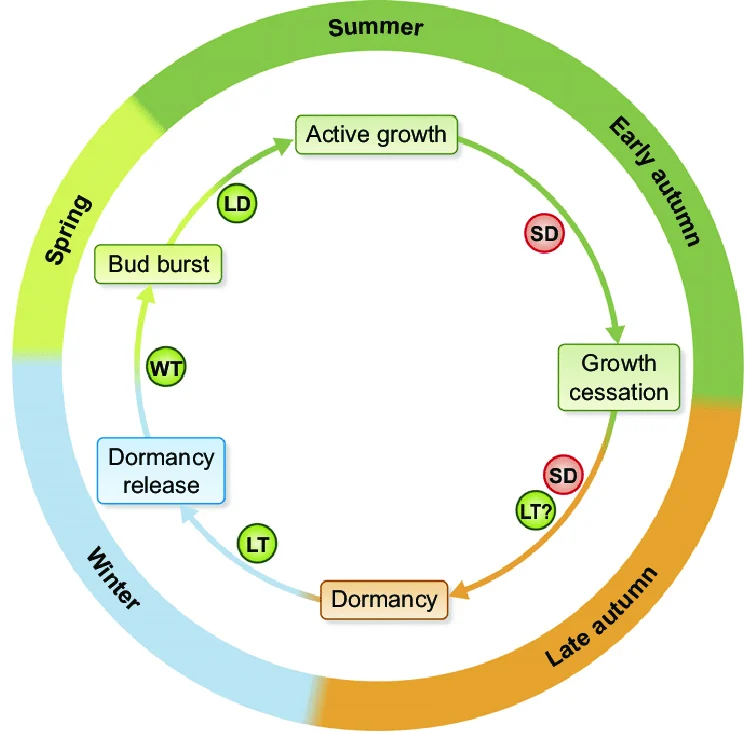
The shifting focus of young tree care through spring, summer, autumn, and winter.
Fact Check: Common Myths Verified
There is a lot of conflicting gardening advice out there on the internet, it’s easy to fall into outdated gardening practices. So let’s take a look at some of the claims tree care makes which are common today, and see what the International Society of Arboriculture (ISA) has to say about them.
CLAIM 1: “You should fertilize a newly planted tree right away to help it grow faster.”
- Verdict: FALSE. The Reality: Fertilization at planting time stimulates shoot and foliage growth before the damaged root system can keep up. The water needs of a large canopy of chemically induced trees cannot be met by the root system. Year 1 should be all about establishing roots. Also, excess amounts of artificial fertilizers may chemically scorch the new root tips. Wait at least 2 years before applying nutrients.
CLAIM 2: “Staking a tree tightly keeps it safe and helps it grow straight.”
- Verdict: PARTIALLY FALSE.
- The Reality: Trees need to move in order to grow right. The tree is swayed naturally in the wind and its natural sway releases hormones that stimulate the development of “reaction wood,” which thickens the trunk base and strengthens the roots. If a tree is kept rigid, then it is structurally weak and is likely to split and fail when the support is removed. Consider staking only when absolutely required, ensure flexibility of ties, and remove the system within 12-months.
CLAIM 3: “Watering every day is better for a new tree.”
- Verdict: FALSE.
- The Reality: When watering a tree from the hose every day, just a few inches deep, will only water the top inch of soil. This makes the tree’s root system weak and shallow, directly on the surface, and very susceptible to dehydration on hot days. Deep watering every now and then helps roots to grow deeper to areas that have a more consistent soil moisture supply. In addition, it’s easy to over water the soil each day, suffocating the root system and depriving it of oxygen.
CLAIM 4: “Once a tree is in the ground, it looks after itself.”
- Verdict: FALSE.
- The Reality: Forest trees are self-sustaining once mature, but young landscape trees must be carefully tended for the first three years. Properly watered, mulched and given some light structural guidance during this establishment phase, trees grow 2-3 times faster and have much higher long-term survival rates than non-treated trees.
Does Tree Species Affect Care in the First 3 Years?
Yes, the species of tree can impact the way you take care of your tree. Deep watering and mulching are similar concepts but each species will have its individual requirements for care, growth and susceptibility to structure.
When selecting trees for your yard, take into account the differences in profile and their impact on the level of maintenance:
- In the Pacific Northwest, trees such as a Doug Fir, Bigleaf Maple, or Red Alder quickly grow into the soil. Usually establish quickly, do not need much supplemental fertilization, and are very well established by year 3 with good natural drought tolerance.
- Japanese Maples: Shallow and fine root system. They are sensitive to changes in moisture, and in their first two years, require additional protection from blistering afternoon sun and drying winds.
- Flowering Cherries & Ornamentals: These varieties are very moisture sensitive during Year 1. Always prune after the completion of their sequence of spring blooms (2 or 3 years) to prevent loss of future flower buds.
- Water Needs of Birch Trees: Birch is a very water hungry tree. When drought stressed in their establishment phase, they are ideal hosts for destructive pests, such as the Bronze Birch Borer. Specialized birch tree treatment can offer a key line of defense for trees that are compromised or at risk.
- Evergreens (Cedars and Firs): Conifers will take longer to exhibit signs of transplant stress. They may remain static without showing much new top growth for the first two years. Do not mistake this slow start for failure, they are simply working diligently below ground. If you’re still considering things for your new yard addition you can look at popular choices in our fast growing trees for Seattle yard list.
When to Call a Professional Arborist
Although most of the day-to-day care can be performed by an attentive homeowner, there are some pivotal times within the first 3 years when professional advice is of great value. Working with a certified arborist by the ISA can be extremely beneficial at important times.
When your young tree wilts, drops leaves or reveals bare branches after six weeks of regular watering, diagnostic care by a professional can lead to the diagnosis of root problems or indicate concerns about possible protection from pests that have not yet been discovered. Entrusting structural cuts to an expert prevents long-term weakness and structural hazards, making sure your landscape develops safely under our professional Tree and Plant Care Programme.
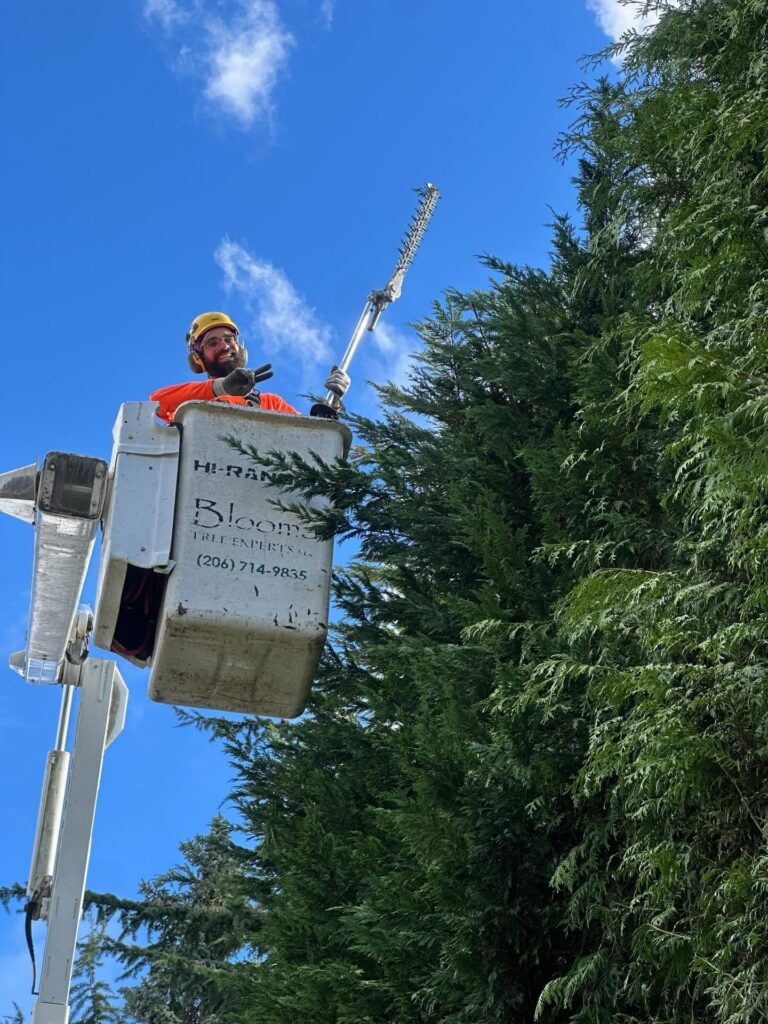
A Bloomatree ISA-certified arborist inspecting the health and structural form of a residential tree.
Give Your New Tree the Best Start
The first three years of a tree’s life represent a meaningful investment of time, care, and expectation, and that investment is well worth protecting. From a structural pruning assessment to an expert soil evaluation to a diagnostic view of a young tree that isn’t growing well, Bloomatree arborists are trained and certified as ISA arborists, dedicated to helping you. We pride ourselves in our professional, upfront service in the greater Seattle area.
Looking to lock in the success of your landscape? Get an estimate now without leaving the house or give us a call at 206-714-9835 to talk to one of our neighborhood tree professionals. Want innovative maintenance solutions and a long-lasting landscape? Learn about our comprehensive, ongoing Tree and Plant Care Programme.